Roadmap to Zero-Gap Joinery: Seamless uPVC Welding Guide
The Engineering Logic of Zero-Gap Joinery in Ahmedabad
In the high-precision world of uPVC fabrication, the transition from traditional 2mm weld seams to zero-gap joinery is a fundamental shift in structural engineering and aesthetic standards. For fabricators in Ahmedabad, the local demand for premium aesthetics in high-rise residential projects has made the Double Head Seamless Welding Machine an essential asset rather than a luxury. Traditional welding creates a thick bead of flash that must be mechanically removed, often leaving a scarred or off-color groove. In contrast, seamless technology uses a specialized 'limit-knife' system that compresses the molten polymer back into the profile chambers. This results in a finished joint with a tolerance of less than 0.2mm, effectively eliminating the need for secondary corner cleaning. As a senior engineer with 15 years on the shop floor, I can confirm that the 'seamless' label is often misused; true seamlessness is achieved only when the pneumatic pressure, heater plate temperature, and the knife-edge position are synchronized via a high-response PLC system.
Technical Specifications: Defining Precision in uPVC Machinery
To achieve industry-leading results, you must look beyond the exterior of the machine and evaluate the internal engineering specs. A professional-grade uPVC window manufacturing machine must meet specific technical benchmarks. At Mechnovate, we recommend heater plates coated with high-grade PTFE (Teflon) that can withstand constant cycling at 260°C without carbonization. The pneumatic system must operate between 0.5 and 0.8 MPa to ensure consistent clamping force. We reference BS EN 12020 and IS 1285 standards when assessing profile corner strength; a seamless weld must not only look better but also withstand a minimum breaking load that exceeds the profile's own structural rating. This requires a double-head configuration where both heads are synchronized to ±0.5mm, ensuring the frame is perfectly square. Fabricators should insist on a machine that utilizes linear motion guides rather than simple bushings to maintain this accuracy over thousands of cycles in the demanding Ahmedabad industrial climate.
Case Study: Performance Metrics from Our Pune Testing Facility
In our Pune facility, we conducted a rigorous 6-week trial comparing traditional welding lines against a new seamless configuration. We tested three different profile brands common in the Indian market, focusing on 60mm and 70mm series. The results were transformative. By integrating a Double Head Seamless Welding Machine and an Automatic Double Head Cutting Machine, we reduced the total corner processing time from 4 minutes per frame (including cleaning) to just 90 seconds. The data showed a reduction in cutting waste from 12% to 3% because the seamless welder allows for more precise 'melt-allowance' calculations (exactly 2.8mm per side). Most importantly, the output increased by 40 frames per day without adding additional staff. This measurable increase in throughput directly impacts the ROI for any uPVC machinery manufacturer and fabricator looking to scale their operations.
Integration Strategy: The Role of the Double Head Cutting Saw
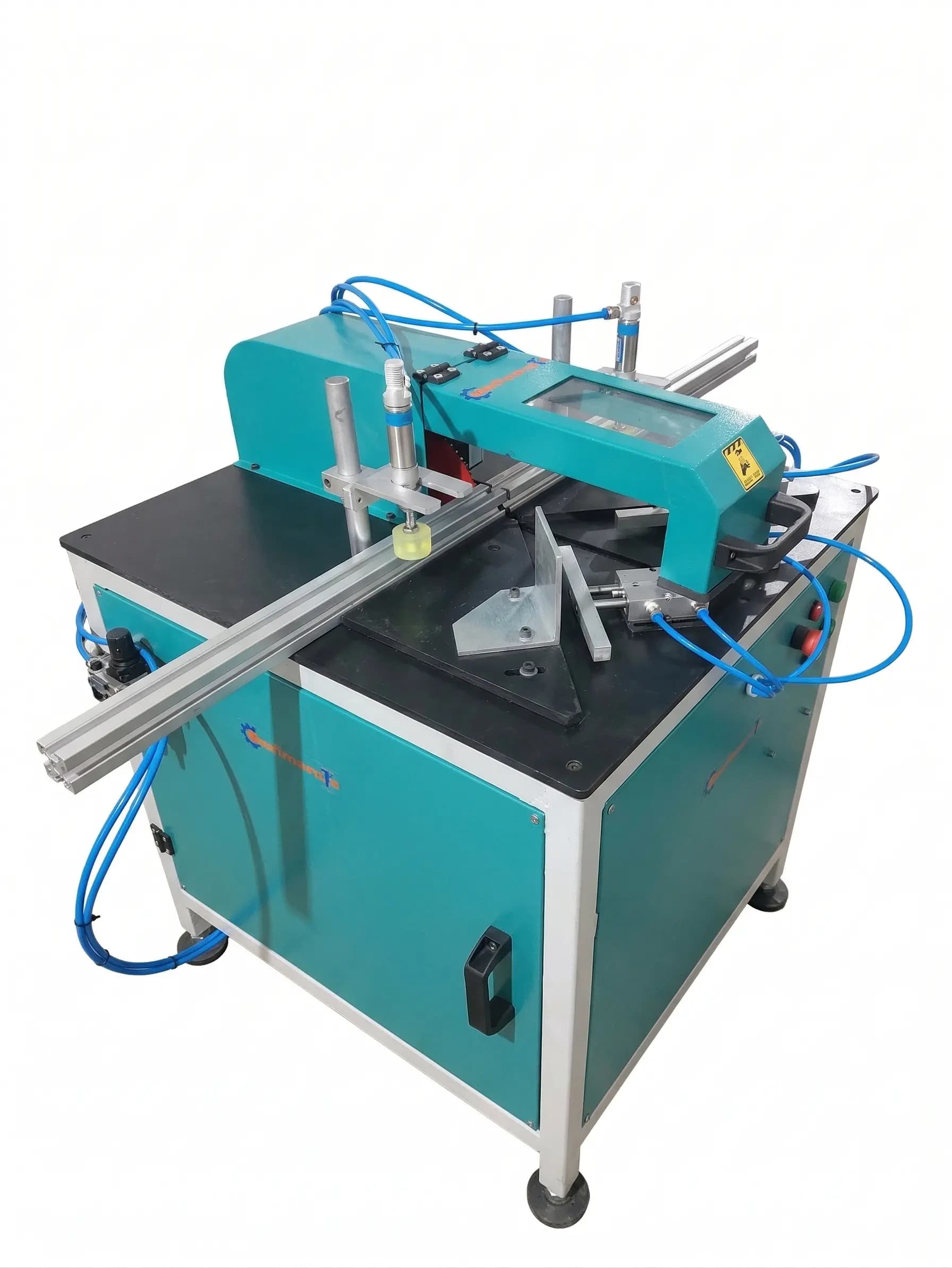
A common mistake fabricators make is investing in a high-end welder while using an outdated aluminium cutter machine or a manual uPVC cutter. The quality of your seamless weld is 70% dependent on the quality of your cut. If the 45-degree angle is off by even 0.5 degrees, the heater plate will not make uniform contact with the profile surface, leading to 'cold spots' and weak joints. An automatic double head cutting machine price India might seem like a high upfront cost, but it is the foundation of the zero-gap roadmap. For fabricators in Ahmedabad and Surat, where humidity can affect profile expansion, using a CNC-controlled cutting machine ensures that every piece is identical before it hits the welding bed. This synergy between cutting and welding is what separates a world-class window from a local workshop product.
Avoiding the 'Cold Weld' Trap: Lessons Learned from the Shop Floor
After years of troubleshooting production lines across India, the most frequent failure I see is the 'Cold Weld.' This occurs when the profile's melting temperature is reached, but the transfer time between the heater plate retracting and the profiles joining is too slow. In the hot, dusty environments of Gujarat, dust can settle on the molten surface during this split-second transfer, compromising the chemical bond. A high-quality upvc windows making machine must have a transfer speed of less than 2 seconds. Furthermore, the use of a voltage stabilizer is mandatory in many Indian industrial zones; a 10V drop in power can lead to a 5-degree drop in heater plate temperature, which is the difference between a structurally sound window and one that will crack under wind load in a high-rise building.
What to Watch Out For: Procurement and Maintenance
When searching for aluminum window machinery manufacturers in Ahmedabad or uPVC machinery suppliers, don't just look at the price list. Evaluate the build quality of the machine frame. A lightweight frame will vibrate during the high-speed movements of the welding heads, leading to micro-misalignments. Look for heavy-duty cast iron or thick-walled steel frames. Maintenance is also a critical factor; the Teflon on the heater plates must be changed every 500-800 welds. If you see the profile 'sticking' or leaving a residue on the plate, your joint strength is already declining. We suggest a daily cleaning routine using only a dry cotton cloth and a weekly check of the pneumatic oilers to ensure the solenoids remain lubricated. For those in Lucknow or Kolkata looking for uPVC window machinery manufacturers, always ask about the availability of local service engineers and spare parts like solenoid valves and limit switches.
Cost Analysis: Setting Up a uPVC Manufacturing Unit in India
The cost of setting up uPVC window manufacturing unit in India ranges from 15 lakhs for a basic setup to over 65 lakhs for a fully automated line. For a startup, I recommend a balanced approach: invest heavily in a Double Head Seamless Welding Machine and a reliable Automatic Double Head Cutting Machine. You can save on secondary machines like the uPVC Window Corner Cleaning Machine because the seamless welder removes that step entirely. This strategic allocation of capital allows you to produce a higher-quality product (the zero-gap window) while keeping your total equipment footprint small. This 'lean manufacturing' model is currently the most successful path for new window businesses in the Indian market.
FAQ: Critical Questions from Professional Fabricators
Q1: Can a seamless welder handle both white and laminated (wooden finish) profiles? Absolutely. In fact, it is specifically designed for laminated profiles. Traditional corner cleaners often remove the colored film at the joint, leaving a white line that must be touched up with a marker. Seamless welding keeps the film intact, creating a perfect wood-grain transition at the corner.
Q2: How does the machine handle different wall thicknesses? Most high-quality uPVC windows machines have adjustable PLC settings for 'melt time' and 'joining pressure.' If you are switching from a 2.0mm wall thickness to a 2.5mm 'Class A' profile, you must increase the melt time by 3-5 seconds to ensure the core reaches the proper plastic state.
Q3: Is the maintenance for a seamless welder more expensive than a standard welder? The only additional cost is the specialized limit-knives, which need occasional sharpening or replacement. However, this is more than offset by the elimination of the corner cleaning machine's maintenance and the significant reduction in manual labor costs.
Get more articles like this
Follow Mechnovate on Google to see our guides in Google Discover & News