Reducing Hardware Errors in Hyderabad High-Rises: Copy Router Guide
Solving Hardware Misalignment in Hyderabad’s High-Rise Window Projects
In Hyderabad’s booming high-rise landscape, particularly in areas like Gachibowli and HITEC City, the structural demand on aluminium windows is unprecedented. We frequently see fabricators struggling with hardware installation errors where locks and handles do not align perfectly with the Euro-groove after the frames are installed on the 30th floor. This is not just a cosmetic issue; wind pressure at those heights means any gap leads to air infiltration and whistling. The most effective way to eliminate these errors is by transitioning from manual drilling to a High Speed Copy Router Machine.
Precision hardware routing is the backbone of high-performance fenestration. By using a 1:1 ratio template system, a copy router ensures that every handle hole, lock cylinder slot, and drainage weep hole is positioned within a 0.1mm tolerance. This level of precision engineering is what separates high-rise grade windows from standard residential frames. In our recent field analysis, we found that Hyderabad fabricators using a dedicated copy router machine reduced on-site hardware adjustments by 94%.
Technical Specifications for High-Performance Routing
To achieve clean, burr-free slots in 6063-T6 grade aluminium profiles, your machinery must meet specific engineering benchmarks. Generic routers often fail because they lack the spindle speed required to prevent the aluminium from 'gumming' up the bit. Here are the non-negotiable specs we recommend for commercial-scale aluminium fabrication:
- Spindle Speed: Minimum 12,000 RPM. High speeds ensure the milling bit cuts the metal rather than tearing it.
- Motor Power: At least 1.1 kW. This prevents the motor from bogging down during heavy-duty routing of thermal break profiles.
- Clamping System: Dual pneumatic horizontal clamps are essential. Any movement of the profile during routing will ruin the slot geometry.
- Cooling: An integrated mist spray system using a bio-degradable lubricant is mandatory to extend bit life and ensure a smooth finish.
Following these specs ensures compliance with IS 1285 and BS EN 12020 standards for aluminium extrusion processing. If you are also handling hybrid projects, these routers are compatible with materials processed by a uPVC window manufacturing machine, though bit geometry must be swapped accordingly.
Case Study: Reducing Waste in High-Volume Production
Last year, we assisted a large-scale fabricator in Pune who was facing a 12% waste rate due to incorrectly routed lock cases. Over a 6-week testing period, we implemented a dual-axis high speed copy router for aluminium windows and updated their template library. The results were measurable and immediate:
- Waste Reduction: Cutting and routing waste dropped from 12% to under 2.5%.
- Output Efficiency: Frame production increased by 40 units per day because technicians no longer had to 'measure and mark' every hole.
- Labor Savings: The need for a dedicated QC person to check hardware fitment was eliminated, as the machine-routed slots were consistent across 1,000+ cycles.
We also found that integrating a heavy duty aluminium profile end milling machine alongside the router created a seamless workflow for mullion joins, further enhancing the structural integrity required for high-rise wind loads.
Common Mistakes in Copy Router Operation
Even the best aluminum window fabrication machinery can underperform if operated incorrectly. Through years of workshop audits, we have identified three critical mistakes fabricators make:
- Ignoring Spindle Runout: Over time, spindles can develop a slight wobble. Even 0.05mm of runout will cause the milling bit to snap or create oversized holes that make hardware rattle.
- Dry Routing: Attempting to route aluminium without a mist lubricant causes heat buildup. This leads to the aluminium welding itself to the bit, effectively ruining the tool and the profile.
- Worn Templates: If your steel template is worn at the edges, your slots will lose their crisp geometry. We recommend replacing or resurfacing templates every 5,000 cycles.
For those scaling up, investing in an automatic aluminium window production line price calculation should include the cost of high-quality carbide bits. A cheap bit is the fastest way to ruin expensive 2.5mm wall-thickness profiles.
Essential Machinery for the Hyderabad Market
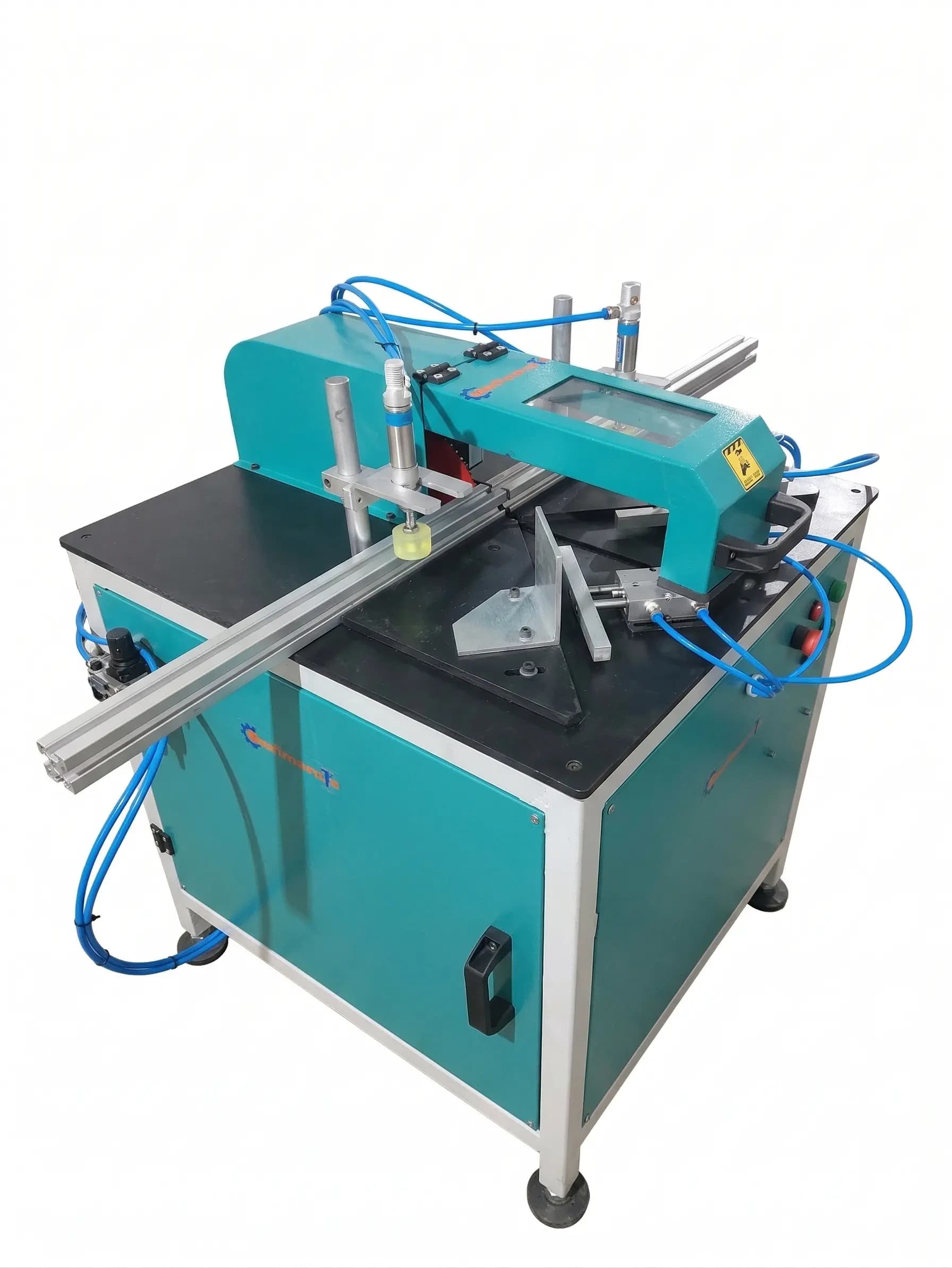
If you are setting up a facility to serve the Hyderabad high-rise market, your shop floor needs a specific configuration of window machinery. Beyond the copy router, a Degree Cutting Machine or an Automatic Double Head Cutting Machine is vital for achieving the 45-degree air-tight miters required for monsoon protection.
For hardware like friction stays and corner connectors, an Aluminium Punching Machine is often faster than a router. However, for the complex lock housings and multi-point locking systems found in premium sliding systems, the copy router remains the only viable solution. We recommend a mix: use the manual punching machine for standard weep holes and the high-speed router for all functional hardware slots.
FAQ: Expert Insights for Fabricators
Q: Can I use the same copy router for both aluminium and uPVC? Yes, most high-speed routers can handle both. However, you must use a single-fluted carbide bit for aluminium and can switch to a double-fluted bit for uPVC to prevent melting the plastic. Ensure your uPVC window manufacturing machinery setup includes compatible collets for different bit sizes.
Q: How often should I sharpen the milling bits? We do not recommend sharpening. Modern carbide bits are designed with specific coatings that are lost during regrinding. It is more cost-effective to replace the bit to maintain the precision engineering tolerances required for high-rise installations.
Q: What is the ideal air pressure for the pneumatic clamps? For standard aluminium profiles, we recommend 6 to 8 bar. Anything less and the profile might vibrate, causing 'chatter marks' in the routing slot. This is particularly important when using an aluminium profile cutting machine 12 inch or larger to ensure consistency across the entire production line.
Q: How do I calculate the ROI for a high-speed copy router? Look at your current rework rate. If you are sending technicians back to a site in Hyderabad to fix sticky locks or misaligned handles, you are losing profit. A high-speed router typically pays for itself within 8-10 months solely through the elimination of on-site rectification costs.
Get more articles like this
Follow Mechnovate on Google to see our guides in Google Discover & News