Preventing uPVC Corner Weld Burn Marks: Expert Maintenance Guide
Burn marks on uPVC corner welds are one of the most common quality complaints in aluminium and uPVC fabrication workshops across India. A clean corner weld should be flush, colour-matched, and free of discolouration — but when welding plates run too hot, dwell times extend past the profile's tolerance, or Teflon coatings wear out without replacement, the result is a scorched corner that cannot be cleaned away or hidden under finishing. Understanding the mechanical causes and applying consistent maintenance habits is the only reliable way to eliminate this defect at the source.
Root Causes of Burn Marks on uPVC Corner Welds
Burn marks trace back to one or more of three sources: welding plate temperature that exceeds the profile's thermal tolerance, excessive dwell time that holds the PVC against the hot plate too long, or a degraded Teflon (PTFE) coating that allows PVC to contact bare metal and char.
Welding plate temperature is the primary variable. uPVC begins to discolour and degrade when held at temperatures above 260°C, yet many operators push beyond this limit to speed up cycle times or to compensate for a plate that has lost even heat distribution due to age. When temperature exceeds the safe range, the outer profile surface chars before the inner weld zone reaches proper fusion temperature, producing burn marks along the seam even when the structural bond appears adequate.
Dwell time compounds the problem. If the profile rests against the heating element longer than the machine's specification — typically 20–35 seconds for standard 60–80 mm profiles — even a correctly calibrated temperature can scorch the surface. Dwell errors are most common when operators control the sequence manually rather than relying on a timer-controlled automatic cycle.
Correct Welding Temperature for Indian uPVC Profiles
For the profile systems most widely used in India — including those compatible with Domal, Jindalinium, Dumal, Hindalco, and Alumil — the correct welding plate temperature sits between 240°C and 255°C. Thin-wall profiles with a wall thickness below 2.5 mm require the lower end of this range, closer to 240–245°C, because less material mass means faster heat transfer and a heightened risk of surface damage at higher temperatures.
One factor that fabricators across Gujarat, Rajasthan, and Maharashtra frequently underestimate is ambient temperature. During summer months — April through June — workshop temperatures can reach 38–44°C, causing welding plates to reach thermal equilibrium faster and profiles arriving at the weld station already warm. Under these conditions, operators should reduce the set-point temperature by 3–5°C relative to their cooler-season baseline. A workshop running cleanly at 252°C in December may need 247–249°C in May to produce the same result. Failing to make this seasonal adjustment is one of the leading reasons burn mark complaints spike during summer production runs.
Teflon Plate Maintenance: The Most Overlooked Step
The Teflon coating on the welding plate is the non-stick barrier between the hot metal surface and the softened PVC. When this coating degrades through wear, heat cycling, or chemical contamination, bare metal contacts the profile and causes sticking, tearing, and charring that mimics temperature-related burn marks — but will not go away even when the temperature is reduced.
Follow this maintenance schedule to protect plate condition and weld quality:
- After every 50 welds: Wipe the plate surface with a dry, lint-free cloth while the plate is still warm. Remove any PVC residue that has transferred to the surface. Do not use solvents — they accelerate Teflon breakdown.
- Every 200–300 welds: Inspect the Teflon surface under good lighting for scratches, pitting, or discoloured patches. A uniform, slightly glossy appearance is normal. Dull spots, raised edges, or visible scoring indicate localised wear that will worsen quickly.
- At 500–800 welds (cumulative): Replace the Teflon plate entirely. Most plates are rated for this range under normal operating conditions. Running a plate beyond this threshold is the single most common cause of unexplained burn marks in workshops that otherwise have correct temperature settings.
- After any visible sticking incident: If a profile sticks and must be pulled free, inspect the plate immediately. A single stick-and-tear event can score the Teflon surface deeply enough to require early replacement regardless of total weld count.
- Store spare plates flat and protected: Teflon plates left loose in a drawer pick up scratches from contact with tools and hardware. Keep spares on a flat, padded surface or in a sleeve to preserve the coating before first use.
Pressure Calibration and How Profile End Quality Affects Welds
Even with a correct temperature setting and a fresh Teflon plate, burn marks can appear if the profiles do not seat flat and square against the heating element. Uneven clamping pressure creates hot spots — areas where one side of the profile presses harder and absorbs heat faster — producing asymmetric burn patterns that look like temperature errors but are actually a contact and alignment problem.
Calibrate welding pressure so that both profile ends contact the heating plate simultaneously across the full face width. If one end seats fractionally before the other, it absorbs more heat during that interval. Check clamp alignment quarterly and after any maintenance that requires removing or adjusting the clamping assemblies.
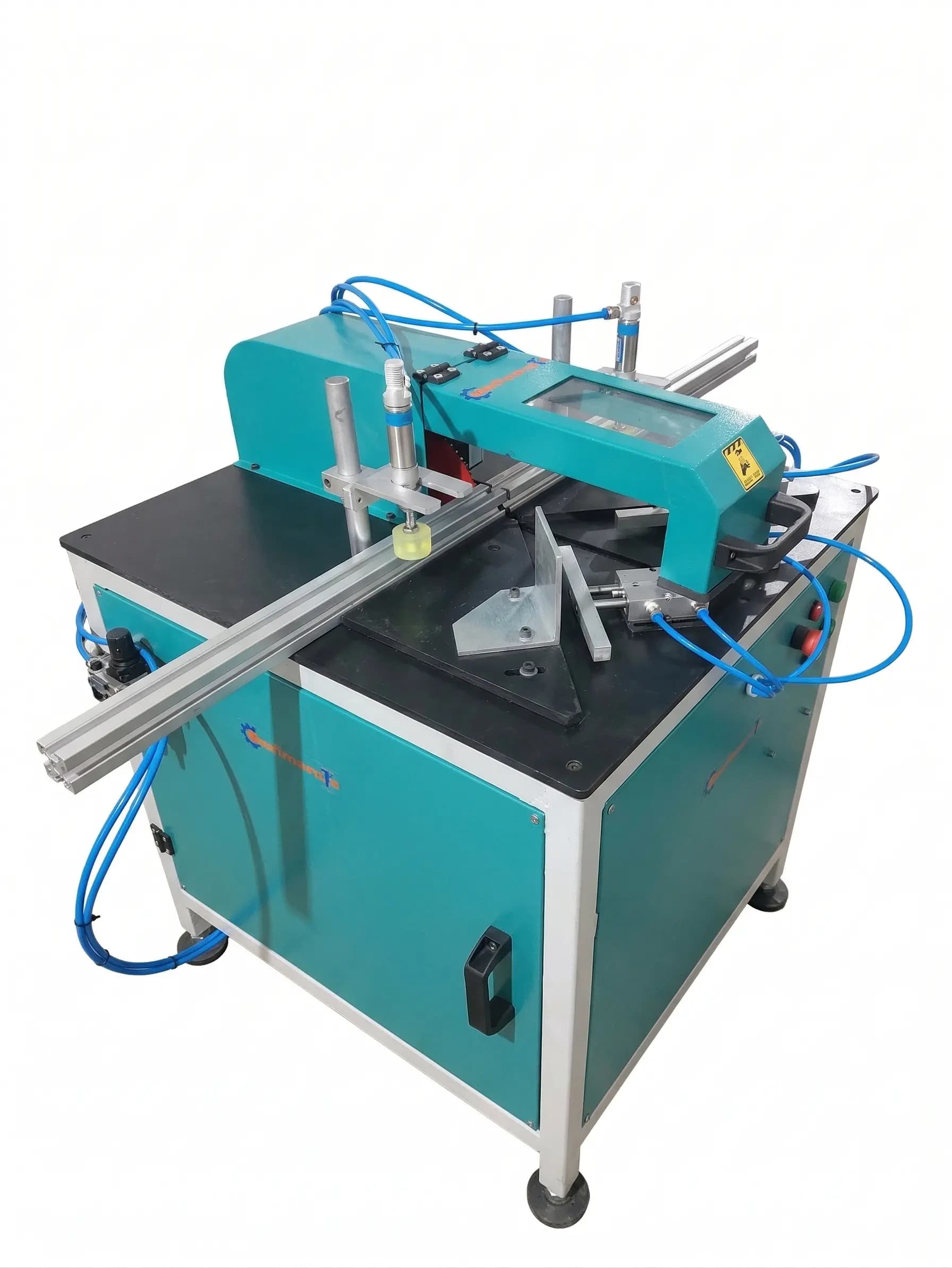
Profile end quality has an equally direct effect. A profile end that is not perfectly square — whether from a worn blade, incorrect mitre angle, or a skipped end-preparation step — will rock slightly on the heating plate rather than lying flat. This irregular contact creates uneven heat distribution and localised charring. Preparing profiles with a well-maintained 45/90 Degree Cutting Machine and ensuring square, burr-free ends before welding eliminates this category of defect entirely. The workshop setup guide covers the full preparation sequence from cutting through welding.
FAQ
What temperature should I set for welding uPVC profiles in summer?
When workshop ambient temperatures exceed 35°C, reduce your welding plate set-point by 3–5°C from your standard setting. For most Indian uPVC profiles rated for 240–255°C, this means working at 240–248°C rather than the upper end of the range. Make the adjustment gradually — drop by 2°C, run three test welds, inspect for burn marks and fusion quality, then adjust further if needed. Do not restore the higher setting until ambient temperatures drop significantly.
How do I know when to replace the Teflon plate on my welding machine?
Replace the Teflon plate at 500–800 cumulative welds under normal use, or earlier if you observe any of these signs: visible scratches or scoring on the plate surface, PVC material sticking to the plate after a weld cycle, uneven gloss or discolouration on the coating, or burn marks appearing even though temperature and dwell settings are confirmed correct. Replacing a worn plate costs far less than rejecting a batch of finished frames or repairing customer complaints.
Can a poorly cut profile end cause burn marks?
Yes. A profile end that is not perpendicular to the profile axis rocks on the heating plate instead of lying flat, creating uneven contact pressure. The side with more contact overheats while the opposite side under-heats, producing burn marks on one edge and insufficient fusion on the other. Always ensure profile ends are cut square using a properly calibrated machine. For guidance on selecting the right equipment, see our Cutting machine buying guide.
Why do burn marks appear only on one corner and not all four?
Burn marks isolated to one corner point to a station-specific problem rather than a general temperature setting issue. Common causes include a worn or scratched section of the Teflon plate on that particular station, a clamp that applies uneven pressure on that position, or profiles with dimensional variation in a specific batch that requires a lower temperature for that wall thickness. Inspect the Teflon plate on the affected corner station first, then check clamp alignment and contact pressure at that position before adjusting any machine-wide settings.
Ready to Upgrade?
Consistent weld quality starts with consistent profile preparation — square cuts, clean ends, and properly executed hardware holes before the frame ever reaches the welding station. Mechnovate manufactures a complete range of aluminium and uPVC fabrication machinery from our Ahmedabad facility, including the 45/90 Degree Cutting Machine starting at ₹55,000, the Manual Copy Router Machine from ₹35,000, and the full punching machine range. With 15+ years of combined engineering experience, ISO 9001:2015 and CE certification, and 500+ fabricators served across 20+ Indian cities, we build equipment that holds calibration shift after shift.
Call our team at +91-9265699061 or contact us to discuss the right machinery setup for your workshop's volume and profile range.
Get more articles like this
Follow Mechnovate on Google to see our guides in Google Discover & News