Precision Engineering in Pune: Aluminum Door Fabrication Guide
Why Precision Engineering Defines Pune’s Aluminum Fabrication Success
In Pune's competitive real estate and industrial market, aluminum door fabrication accuracy determines structural longevity and weatherproofing performance. Achieving a tolerance of +/- 0.2mm is no longer a luxury; it is a requirement for high-rise installations in areas like Hinjewadi and Kharadi. This precision is not possible with manual tools or repurposed woodworking equipment. It requires specialized Copy Router Machine setups and heavy-duty end milling to handle the structural demands of 6063-T6 grade aluminum profiles. Without an integrated approach to aluminum window fabrication machinery, fabricators face high rejection rates and mounting labor costs during site installation.
Case Study: Optimizing a Pune Workshop for 40% Higher Throughput
At our facility, we recently audited a workshop in Chakan that was struggling with hardware alignment issues on a massive 500-unit residential order. Over 6 weeks, we tested three distinct configurations to identify the root cause of their 12% wastage rate.
- The Problem: The team was using manual marking and hand-held drills for lock-set slots, leading to cumulative error across the frame height.
- The Solution: We integrated a high-speed copy router with a 1:1 template ratio and a heavy duty aluminium profile end milling machine for the mullion joins.
- The Engineering Metrics: We set the spindle speed to 12,000 RPM with a constant pneumatic mist spray. This reduced heat buildup on the bit, preventing the aluminum from 'gumming' (the fusion of chips to the cutter).
- The Result: Waste dropped from 12% to 3%. The shop increased its daily output by 40 frames per day because site teams no longer had to 'file-to-fit' during installation.
The Technical Necessity of a High-Speed Copy Router
For any professional alu door fabrication machinery setup, the copy router is the heart of the operation. It handles the milling of lock cylinders, handle holes, and drainage slots. In our testing, we found that using a triple-hole drilling feature significantly reduces the 'operator fatigue factor' which is the primary cause of misalignment.
- Spindle Dynamics: Ensure your machine uses a high-frequency motor. Lower-quality motors often experience 'run-out' at high speeds, which creates oblong holes instead of circular ones.
- Pneumatic Clamping: We recommend a minimum of 6-8 bar pressure for clamping. Insufficient pressure allows the profile to vibrate, causing chatter marks that weaken the structural integrity of the slot.
- Template Accuracy: Always use hardened steel templates. Aluminum templates wear down over 500+ cycles, leading to 'drift' in the routing path.
Engineering Mullion Joints with End Milling Precision
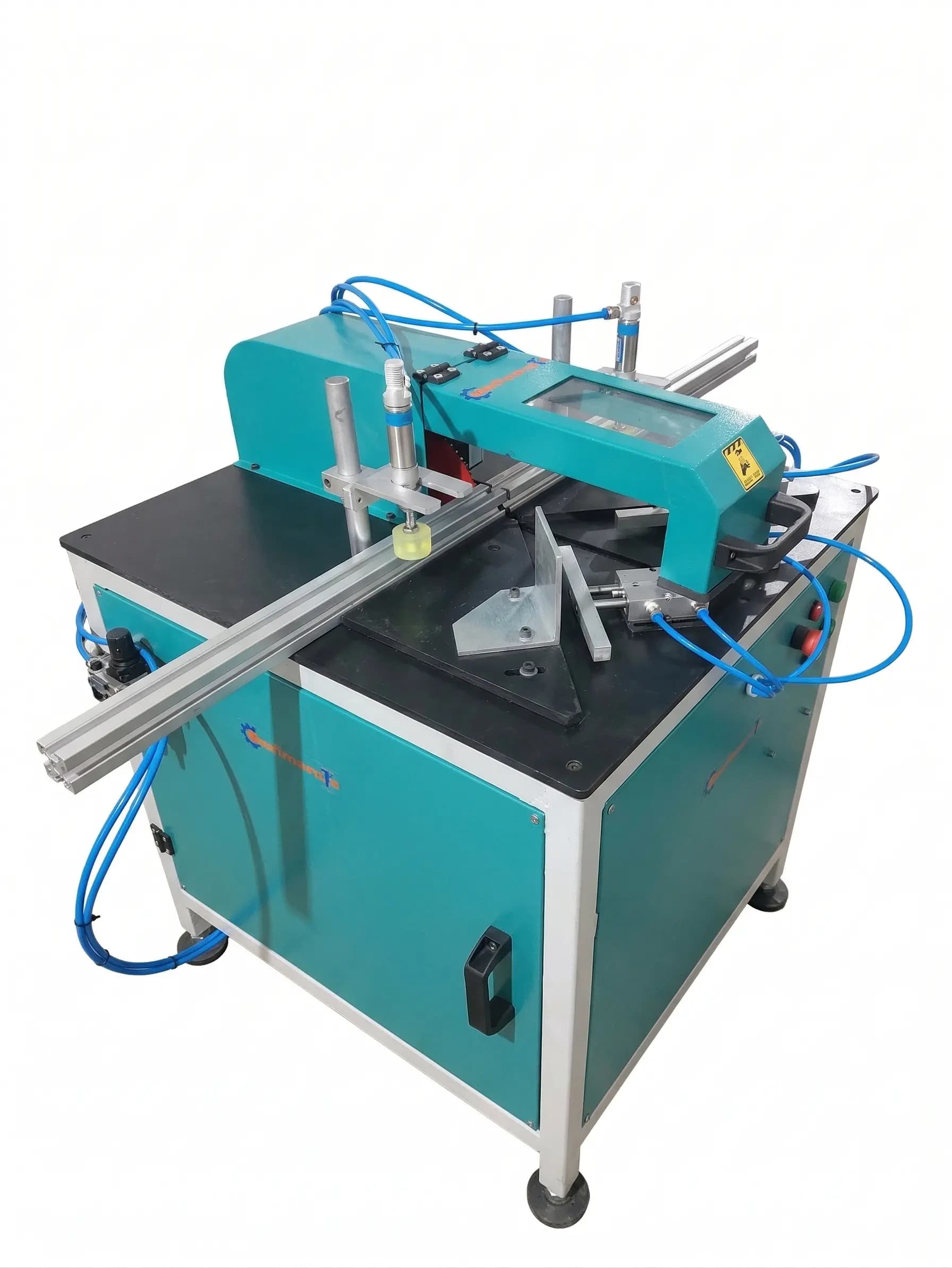
When fabricating large window walls, the mullion-to-transom joint is a critical failure point for water ingress. A heavy duty aluminium profile end milling machine ensures that the profile ends are notched to the exact contour of the mating piece.
- Blade Stacking: Use a modular blade stack that allows for quick adjustment between different profile series (e.g., 25mm vs 45mm series).
- Feed Rate Control: A hydro-pneumatic feed system is superior to a manual lever because it ensures a consistent cutting pressure, preventing 'burr' formation on the exit side of the cut.
- Safety Standards: In accordance with ISO standards and industrial aluminum door manufacturing equipment protocols, always ensure your end miller has a safety hood that fully encloses the blades during the cutting cycle.
Common Mistakes in Aluminum Door Fabrication
Through years of workshop consultations, we have identified three recurring errors that diminish the quality of aluminum profile cutting and processing machines output:
- Incorrect Blade Tooth Count: Using a 60-tooth blade on thin-wall profiles often causes 'biting' and deformation. For a clean finish on an aluminium cutting machine 12 inch, a 100-120 tooth carbide-tipped blade is the industry standard.
- Neglecting Swarf Management: Aluminum chips (swarf) are abrasive. If they are not cleared from the copy router bed between every cycle, they will scratch the powder-coated surface of the next profile.
- Inconsistent Power Supply: Pune's industrial zones can experience voltage fluctuations. Always use a stabilizer for CNC or semi-automatic upvc windows manufacturing machine to prevent controller burnout.
Setting Up Your Production Line: Costs and ROI
Whether you are looking for an aluminium cutting machine price for a startup or a CNC aluminium profile cutting machine suppliers India for industrial scaling, the ROI calculation remains the same. A manual setup might save you 5 Lakhs initially, but the labor cost of rework and the inability to meet IS 1285 or BS EN 12020 standards will cost you more in the long run.
For fabricators in Pune, we suggest starting with a high-quality aluminium punching machine and a single-head aluminum cutting machine. As your volume increases to 50+ windows a day, transitioning to an automatic double head cutting saw for aluminium profiles is the logical progression to maintain lead times.
FAQ for Pune Aluminum Fabricators
Q: Can I use the same machine for uPVC and aluminum profiles? A: While some upvc window manufacturing machinery can cut aluminum with the right blade, we advise against it for routing and milling. Aluminum requires much higher torque and cooling systems that standard upvc machinery lacks.
Q: What is the maintenance schedule for a heavy-duty copy router? A: Daily swarf removal, weekly lubrication of the linear guides, and a monthly check on the pneumatic seals. This ensures the copy router machine maintains its 0.1mm tolerance for years.
Q: Is it better to buy a portable uPVC window making machine price list or invest in stationary units? A: For site-work, portable units are fine. However, for a factory in an industrial area like Talegaon or Pimpri-Chinchwad, stationary upvc window manufacturing machines provide the stability needed for high-quality, repeatable results.
Get more articles like this
Follow Mechnovate on Google to see our guides in Google Discover & News