Precision Engineering for Mumbai’s High-Rise Coastal Windows
Why 45-Degree Precision is Vital for Mumbai’s Wind-Resistant Windows
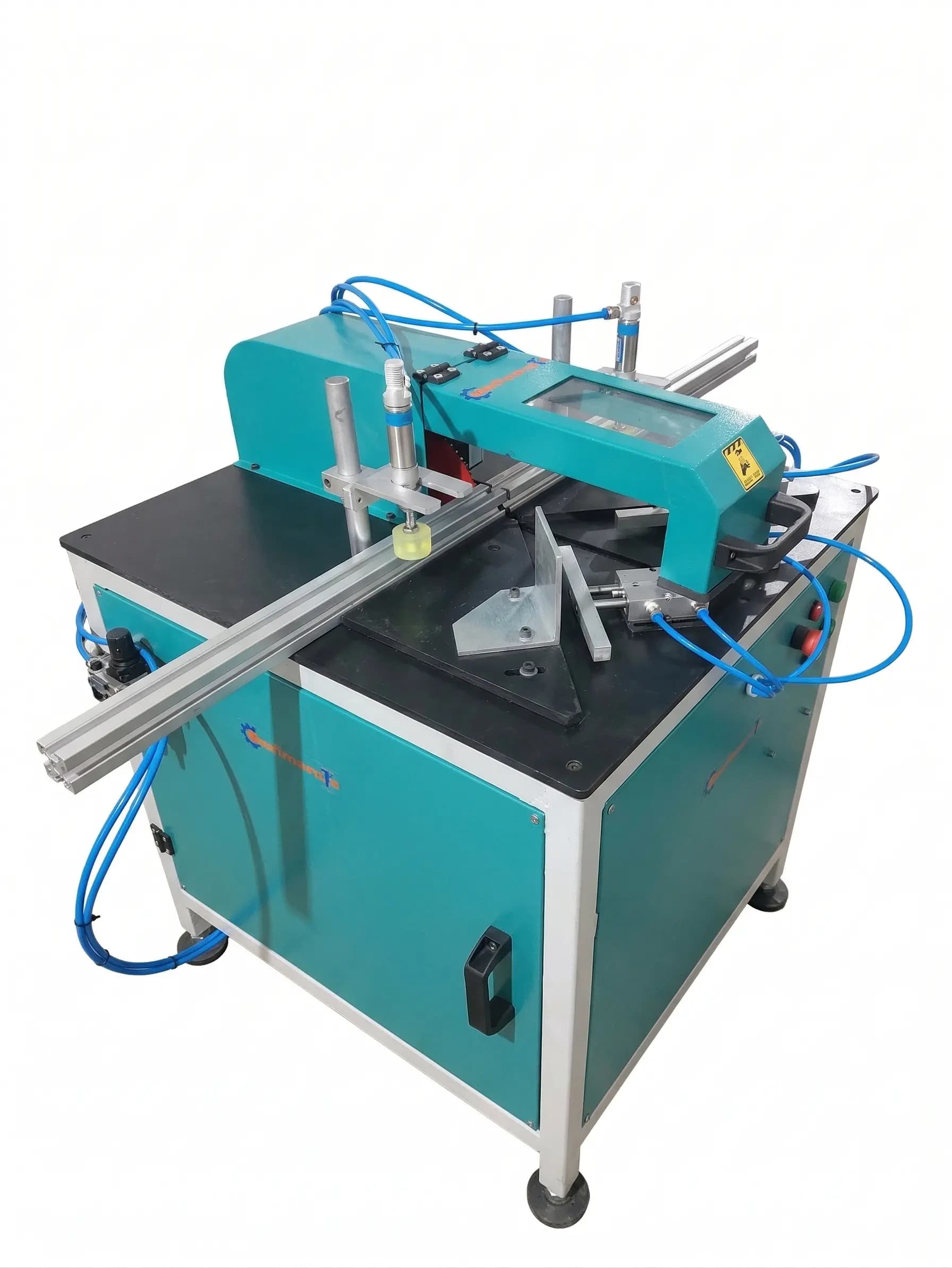
In Mumbai’s coastal high-rise environment, windows must withstand extreme wind pressures exceeding 2.5 kPa (kiloPascals). Achieving this structural integrity starts with the miter joint. If your 45 Degree Double Head Cutting Machine is off by even 0.2 degrees, the resulting gap compromises the corner strength and air-tightness of the frame. Precision engineering in aluminium fabrication is not just about aesthetics; it is about the safety of structures facing the Arabian Sea’s monsoon gusts. By ensuring a perfect 45-degree mating surface, fabricators can meet the rigorous IS 875 (Part 3) wind load standards required for buildings over 100 meters.
Optimizing Your 45 Degree Double Head Cutting Machine for High-Performance Profiles
To manufacture high-performance windows, you must optimize the aluminum cutting machine for thick-walled, thermally broken profiles. Standard residential sections often use 1.2mm to 1.5mm wall thicknesses, but Mumbai’s skyscrapers require 2.5mm to 3.0mm profiles. This requires specific machine adjustments to maintain accuracy and surface finish.
Critical Adjustment Parameters:
- Blade Feed Rate Control: For heavy-duty aluminum profile cutting, we recommend a hydro-pneumatic damping cylinder set to a feed rate of 0.5m/min to 1.2m/min. Too fast, and you risk blade deflection; too slow, and you cause heat buildup.
- Clamping Pressure Optimization: Use a minimum of 6 bar pressure on the horizontal and vertical clamps. For complex uPVC window manufacturing machines, ensure the clamping blocks are customized to the profile geometry to prevent deformation.
- Coolant Atomization: Use a high-quality synthetic mist. This reduces the friction coefficient during the cut, preventing the 'burr' that ruins miter joints in high-speed copy router for aluminium windows operations later in the line.
- Blade Selection: Use a 500mm or 600mm TCT (Tungsten Carbide Tipped) blade with a negative rake angle of -5 degrees. This prevents the blade from 'grabbing' the thin-walled sections of the profile.
Case Study: Reducing Rejection Rates by 15% in a Mumbai Fabrication Facility
Last year, our team at Mechnovate consulted for a major window manufacturer in Thane who was struggling with 'light-gap' issues on their 45-degree joints. Their existing upvc window manufacturing machines were producing variations of ±0.5mm across a 2-meter span, which is unacceptable for premium high-rise projects.
We implemented a 3-week optimization protocol. First, we replaced their standard 12-inch blades with 500mm high-precision TCT blades. Second, we recalibrated the digital display linear scale system. After 21 days of testing, the results were measurable: miter joint gaps were reduced from 0.4mm to less than 0.05mm. This allowed the client to pass the ASTM E283 air infiltration test for a 40-story project in Lower Parel. Furthermore, by optimizing the aluminium cutting machine price performance through better maintenance, the daily output increased from 110 units to 145 units due to reduced rework.
Technical Edge: Engineering Specs for Heavy-Duty Aluminium Fabrication
When evaluating an automatic double head cutting machine price India, don't just look at the cost; look at the frame rigidity. A cast-iron base is superior to welded steel for dampening vibrations during the high-speed rotation of the aluminium cutter machine 12 inch or larger 500mm variants.
| Specification | Requirement for High-Rise Windows | Standard Residential Requirement |
|---|---|---|
| Profile Wall Thickness | 2.5mm - 3.2mm | 1.2mm - 1.6mm |
| Angular Tolerance | ± 0.1° | ± 0.5° |
| Cutting Length Accuracy | ± 0.1mm | ± 0.5mm |
| Blade RPM | 2800 - 3200 RPM | 2500 RPM |
| Motor Power | 2.2kW x 2 | 1.5kW x 2 |
For downstream processing, integrating a high-precision Aluminium Punching Machine ensures that drainage slots and handle holes are perfectly aligned with the mitered corners. This synergy between the head cutting machine and the punching unit is what separates industrial aluminum door manufacturing equipment from hobbyist tools.
Common Mistakes in Double Head Miter Saw Calibration
Through 15 years of workshop experience, I have seen these three mistakes repeatedly destroy the profit margins of Indian fabricators:
- Ignoring the Linear Guide Lubrication: In Mumbai’s humid environment, the linear bearings on a upvc window machine can develop micro-corrosion. This causes 'stutter' during the head movement, leading to length inconsistencies.
- Using Improper Support Rollers: If the profile sags by even 2mm over a 6-meter length, the 45-degree cut will actually be a compound angle. Always use height-adjustable support tables.
- Over-tightening Clamps: Excessive pressure on uPVC window machinery can distort the inner chambers of the profile. This leads to poor weld quality when using a upvc welding machine or a double head seamless welding machine for uPVC windows.
For complex hardware preparations, ensure your Copy Router Machine is calibrated to the same datum point as your cutting machine. Discrepancies in datum points are the leading cause of hardware misalignment in the field.
The Financial Reality: Automatic Double Head Cutting Machine Price India
Investing in a CNC aluminium profile cutting machine suppliers India can seem daunting, with prices ranging from ₹4,50,000 to ₹18,00,000. However, for a business targeting the Mumbai high-rise market, the ROI is found in the 'Cost of Quality'. A manual aluminium profile cutting machine might have a lower entry price, but the labor cost of hand-finishing gaps and the high rejection rate of faulty windows will erode your margins within 12 months.
FAQ: Fabricator Insights
Q: Can I use the same machine for both uPVC and Aluminium? No. While some 'combo' machines exist, the blade geometry (TCT vs. high-speed steel) and the RPM requirements differ significantly. A dedicated upvc window manufacturing machine is optimized for plastic thermal properties, whereas aluminum require higher torque and specialized cooling.
Q: How often should I sharpen the blades on my 45 degree double head cutting machine? In a high-volume Mumbai shop, blades should be inspected every 500 cuts and typically sharpened every 3,000-5,000 cuts. Dull blades cause 'burrs' and increased motor strain, which can lead to premature failure of the head cutter machine spindle.
Q: Is a 12-inch blade sufficient for Mumbai projects? A 12-inch or aluminium cutting machine 12 inch is generally insufficient for the wide, multi-track sliding profiles used in luxury coastal apartments. We recommend a minimum 450mm or 500mm blade to ensure a clean, single-pass cut on wide-track balcony door sections.
Get more articles like this
Follow Mechnovate on Google to see our guides in Google Discover & News