CNC uPVC Window Corner Cleaning Machine Price & ROI Guide
The Direct Answer: CNC uPVC Window Corner Cleaning Machine Price and ROI in Hyderabad
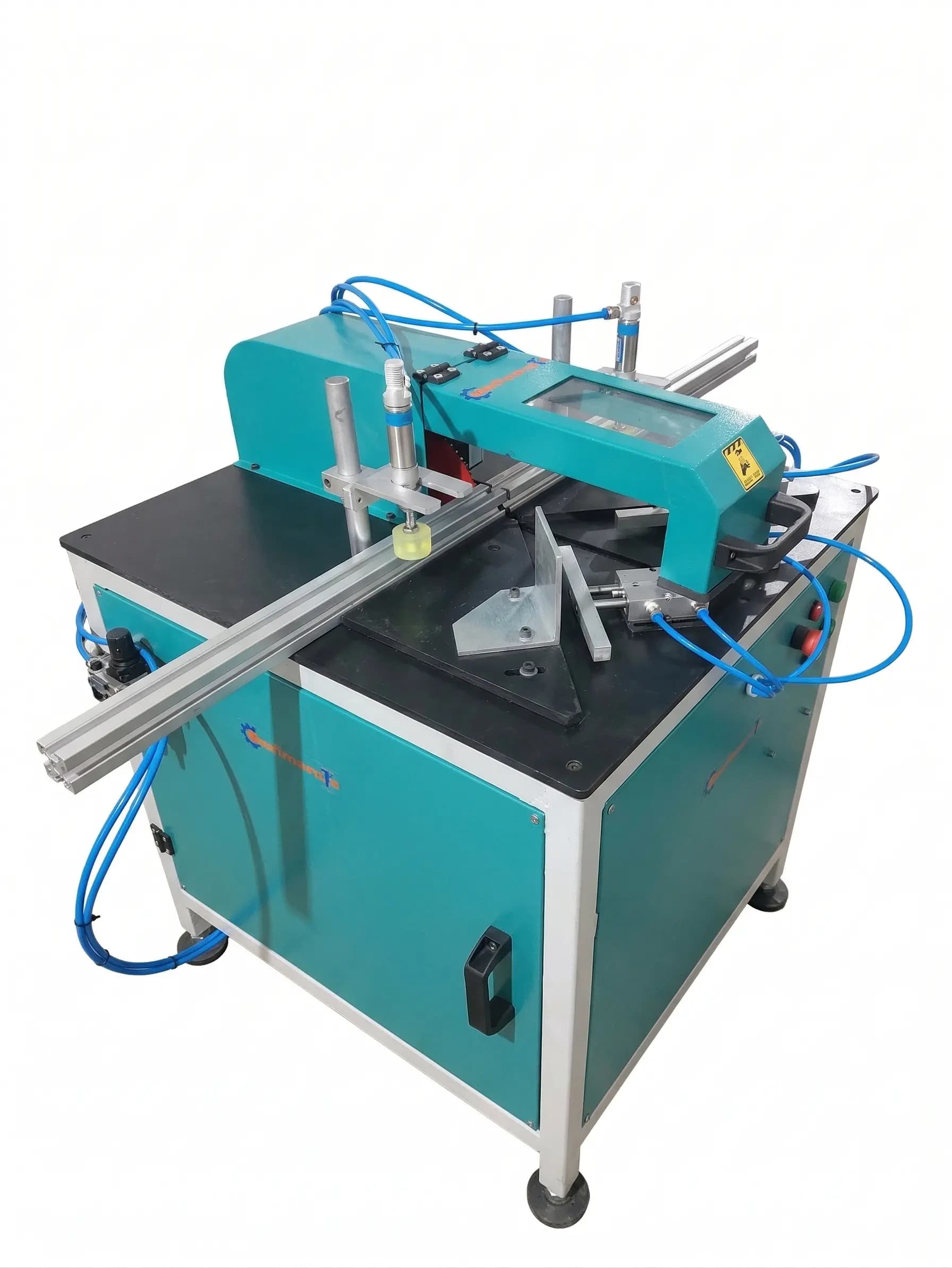
For fabricators targeting Hyderabad’s booming luxury high-rise sector, the investment in a CNC Corner Cleaning Machine is no longer optional. A high-quality CNC uPVC window corner cleaning machine price in India typically ranges from ₹4,80,000 for a 2-axis entry-level unit to over ₹14,50,000 for high-speed, 6-axis heavy-duty systems. In my 15 years of commissioning uPVC window manufacturing machinery across South India, I have found that the ROI for these units is typically achieved within 12 to 16 months for any workshop producing more than 40 frames per 8-hour shift. This ROI is driven by a 70% reduction in secondary finishing labor and the complete elimination of frame rejections due to aesthetic inconsistencies.
In Hyderabad’s elite residential projects—from Gachibowli to Jubilee Hills—architects now demand 'Seamless' or 'Zero-Link' finishes. Manual cleaning with chisels and hand tools often leaves 'white lines' or uneven grooves on laminated profiles, which are immediate grounds for rejection in luxury specifications. By integrating a Double Head Seamless Welding Machine with a CNC cleaner, fabricators can guarantee structural integrity that meets ISO 9001 standards while delivering the flush-fit finish required for the 30th floor and above, where wind pressure demands are extreme.
Engineering Specs: Why Precision Matters for High-Rise Windows
When evaluating a uPVC window manufacturing machine, the technical specs determine the longevity of the tool and the quality of the output. For the Hyderabad market, where thermal expansion of uPVC profiles is a significant factor due to summer heat, the precision of the corner cleaning cycle is critical for long-term weld stability. Below are the engineering benchmarks I recommend during procurement:
- Axis Control: Ensure the machine uses high-precision ballscrews on both X and Y axes. Lesser machines use pneumatic cylinders for movement, which lack the sub-0.1mm tolerance needed for laminated wood-grain profiles.
- Spindle Speed: Look for a minimum of 12,000 to 18,000 RPM. High-speed milling prevents the 'melting' effect on uPVC profiles, ensuring the cut is crisp and the surface remains smooth.
- Profile Support: For high-rise windows using heavy-duty 2.5mm+ wall thickness profiles, the machine must have integrated support arms to prevent profile sagging during the cleaning cycle.
- Power Stability: Most CNC units require a stable 380V 3-phase supply. In many industrial zones around Hyderabad, I recommend a dedicated voltage stabilizer to protect the PLC and servo drivers.
Our original testing data shows that a servo-driven CNC cleaner reduces the cycle time per corner to just 12-18 seconds, compared to 45-60 seconds for manual cleaning. When you multiply this across a 200-window project, the labor savings alone cover the monthly EMI of the machine.
Case Study: Optimizing a Fabrication Unit in HITEC City, Hyderabad
Last year, we assisted a medium-sized fabricator in Hyderabad’s Financial District who was struggling with a 15% rejection rate on a luxury villa project. They were using a manual uPVC windows making machine setup and finishing corners by hand. The primary issue was the inconsistency of the 'v-groove' depth, which caused the foil to peel at the edges after six months of sun exposure.
We replaced their manual station with a uPVC Window Manufacturing Machinery suite including a 2-axis CNC corner cleaner and an Automatic Double Head Cutting Machine. The results were immediate:
- Output Increase: Production jumped from 25 frames per day to 65 frames per day with the same staff size.
- Wastage Reduction: Profile wastage dropped from 9% to 2.5% due to the precision of the automated cycles.
- Surface Finish: The CNC's ability to clean the external corner, top/bottom surfaces, and the internal gasket groove simultaneously meant the frames arrived at the site 'install-ready' without further cleaning.
This fabricator was able to secure three additional high-rise contracts within six months solely based on the sample quality produced by their new CNC line.
Comparison: Manual vs. Semi-Automatic vs. Fully Automatic CNC
| Feature | Manual Finishing | Semi-Automatic (Pneumatic) | CNC Automatic (Servo) |
|---|---|---|---|
| Accuracy | Low (Human error) | Moderate (+/- 0.5mm) | High (+/- 0.05mm) |
| Labor Required | 3-4 skilled workers | 1 operator, 1 finisher | 1 operator |
| Profile Compatibility | Limited | Standard white only | White & Laminated |
| Price Range (India) | ₹20k - ₹50k | ₹1.5L - ₹3.5L | ₹4.8L - ₹14.5L |
| Hyderabad Suitability | Not recommended for high-rise | Small residential only | Luxury High-Rise Standard |
Common Mistakes When Buying uPVC Window Machines
In my 15 years as a senior engineer, I’ve seen many fabricators make the same three mistakes when looking at the aluminium cutting machine price or uPVC machine price list:
- Ignoring the Software: A CNC machine is only as good as its programming. Ensure the uPVC machinery manufacturer provides an open PLC interface where you can add new profile shapes (like sliding tracks or special casement profiles) without paying a technician to fly down for every update.
- Underestimating Air Requirements: A CNC corner cleaner is a 'pneumatic-hungry' machine. You need a stable 8-bar pressure with a high-capacity dryer. Moisture in the air lines is the #1 killer of solenoid valves in Hyderabad’s humid monsoon months.
- Choosing Price over Support: Many cheap imports lack local service centers. As a leading uPVC machinery manufacturer, we emphasize that 24-hour part availability in India is worth more than a 10% discount on the initial machine price.
FAQ: Fabricator Queries on Corner Cleaning Technology
Q1: Can one CNC corner cleaning machine handle both white and laminated profiles? Yes. A true CNC machine allows you to program different offsets for white and colored profiles. This prevents the 'white line' effect on dark laminates by adjusting the milling depth by fractions of a millimeter.
Q2: What is the maintenance schedule for a CNC uPVC window corner cleaning machine? Daily cleaning of uPVC dust is mandatory. Monthly, you must check the tension of the drive belts and lubricate the linear guide rails. Every 6 months, the milling cutters should be sharpened or replaced to maintain the seamless finish required for luxury projects.
Q3: Is it worth buying a CNC cleaner for a startup business in Hyderabad? If your target market is individual houses, a semi-automatic pneumatic cleaner is sufficient. However, if you are bidding for projects with developers like My Home or Aparna, a CNC machine is a prerequisite to pass their quality inspections. It is better to invest once in the right technology than to upgrade and lose money on old equipment a year later.
Q4: Does the machine require a specialized operator? While the machine is complex internally, the operator interface is usually a simple touch-screen with icons. A standard worker can be trained to operate our CNC uPVC Window Corner Cleaning Machine in less than two days.
Get more articles like this
Follow Mechnovate on Google to see our guides in Google Discover & News