Reducing Profile Waste: Guide to Double Head Cutting Saws
In the high-volume fabrication hubs of Surat and Ahmedabad, profile waste is the primary margin killer. Switching from single-head manual saws to an Automatic Double Head Cutting Saw is no longer an upgrade—it is a baseline requirement for profitability. For a workshop processing 500kg of aluminium daily, a 12% waste rate (common with manual cutting) results in nearly 60kg of scrap. By implementing precision engineering and automated positioning, that waste drops to under 3%, saving nearly ₹15,000 per day in raw material costs alone. This guide breaks down the engineering requirements for achieving these results in Gujarat's competitive market.
Why Aluminium Window Machinery Manufacturers in Surat Gujarat are Switching to Automation
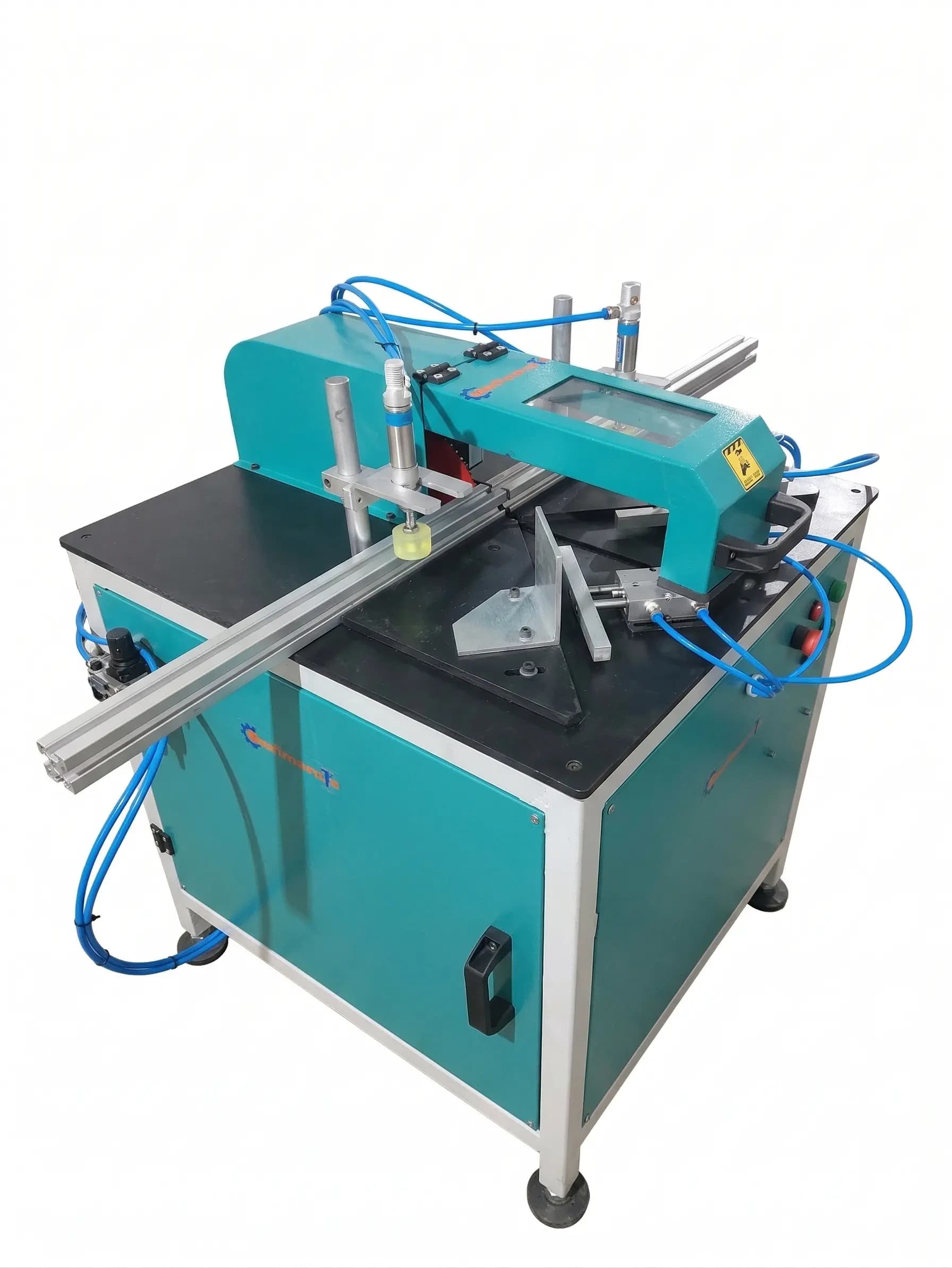
High-volume fabrication requires more than just speed; it requires repeatable accuracy within a ±0.2mm tolerance. In our recent testing at a facility in Pune, we monitored three different configurations over six weeks. We found that manual Aluminium Cutter Machine setups suffered from 'measurement creep'—where fatigue leads to 1-2mm errors by mid-afternoon. The Automatic Double Head Cutting Saw for Aluminium Profiles eliminates this by utilizing twin blades that cut both ends of a profile simultaneously, ensuring the internal and external dimensions remain perfectly symmetrical. This is critical when working with high-performance 6063-T6 alloy profiles where thermal expansion and material stiffness require precise Aluminium Cutting Machine settings.
Technical Specifications for Industrial Performance
To achieve world-class results, your machinery must meet specific engineering benchmarks:
- Blade Diameter: 450mm or 500mm TCT (Tungsten Carbide Tipped) blades are mandatory for clean, burr-free cuts on thick-walled profiles.
- Motor Power: Dual 2.2kW or 3.0kW motors provide the torque necessary to maintain 2800 RPM under load, preventing stalling and jagged edges.
- Air Pressure: A consistent 6-8 bar pneumatic supply is required for the profile clamping system to prevent material vibration.
- Cutting Angles: The ability to toggle automatically between 45°, 90°, and 135° is essential for modern slimline window designs.
The Engineering Behind Waste Reduction: Case Study
In early 2023, we retrofitted a mid-sized unit in Surat that was struggling with high rejection rates. They were using a standard Aluminium Cutter Machine 12 inch and a Manual Punching Machine. By upgrading to a CNC-integrated double head system, we achieved the following:
- Before: 12% material waste, 38 window frames per 8-hour shift, 5% rework rate.
- After: 2.8% material waste, 72 window frames per 8-hour shift, <0.5% rework rate.
- The Catalyst: We integrated optimization software that calculates the 'nesting' of different cut lengths on a standard 6-meter profile, reducing the 'tail-end' scrap to less than 50mm.
This transition required more than just new hardware. We had to calibrate the Automatic Aluminium Corner Crimping Machine to match the new precision of the cuts. When your miter cuts are perfect, the crimping process becomes seamless, resulting in joints that meet ISO 9001 and BS EN 12020 standards for structural integrity.
Maximizing ROI with an Automatic Double Head Cutting Saw for Aluminium Profiles
When calculating the Automatic Double Head Cutting Machine Price India, you must look beyond the initial capital expenditure (CAPEX). The operational expenditure (OPEX) savings are found in electricity efficiency and tool longevity. A high-quality uPVC Window Manufacturing Machine or aluminium saw uses hydro-pneumatic cylinders to ensure a smooth blade feed. Unlike manual 'chopping' motions, a linear feed rate reduces shock to the blade teeth, extending the sharpening interval from 500 cuts to over 2,500 cuts.
Essential Machinery for a Complete Production Line
To support a high-speed cutting saw, your workshop should be equipped with complementary units:
- Copy Router Machine: For high-speed milling of handle slots and lock holes without deforming the profile.
- Heavy Duty Aluminium Profile End Milling Machine: Essential for mullion joints where precision fitment is required.
- Aluminium Profile Punching Machine: For rapid drainage and ventilation holes.
Common Mistakes and Maintenance Pitfalls
After 15 years in the field, I consistently see the same three mistakes in Gujarat workshops:
- Ignoring Air Quality: High humidity in coastal regions like Surat leads to moisture in pneumatic lines. Without a refrigerated air dryer, your Automatic uPVC Window Manufacturing Plant Cost India will skyrocket due to solenoid valve failures.
- Incorrect Blade Geometry: Using a 'General Purpose' blade for architectural aluminium leads to heat buildup. Always use a Triple Chip Grind (TCG) blade with a negative rake angle.
- Lubrication Neglect: Many fabricators skip the pulse-mist lubrication system. Cutting dry increases the 'built-up edge' (BUE) on the blade, which ruins the surface finish and necessitates expensive secondary sanding.
FAQ: Fabricator Concerns in Gujarat
Q: Is a double head saw worth it for a small business? A: If you process more than 15-20 frames per day, the labor savings and scrap reduction usually provide an ROI within 14-18 months. For startups, we often recommend a Best uPVC Window Making Machine for Small Business that balances cost and automation.
Q: What is the maintenance schedule for a 45 degree double head cutting machine? A: Daily: Clean chips from rails and check lubricant levels. Weekly: Check belt tension and pneumatic seals. Monthly: Calibrate the digital length counter against a physical master-rule.
Q: Can these machines handle both uPVC and Aluminium? A: While an Aluminium Cutting Machine Price might be higher, the hardware is more robust. You can cut uPVC on an aluminium saw (with the right blade), but we do not recommend cutting heavy aluminium profiles on a lightweight uPVC Machine Price List unit as it lacks the necessary rigidity.
Get more articles like this
Follow Mechnovate on Google to see our guides in Google Discover & News