Zero-Maintenance uPVC Corners: Double Head Seamless Welding Guide
For Hyderabad’s high-end villas and luxury apartments, the standard uPVC weld bead is no longer acceptable. In my 15 years as a senior engineer at Mechnovate, I have seen the same issue repeatedly: traditional welding leaves a 3mm to 5mm bead that requires a CNC uPVC window corner cleaning machine price India to finish. This process often leaves a visible groove that traps Hyderabad’s fine dust, leading to discoloration and structural weakness over time. The solution for high-margin projects is a double head seamless welding machine for uPVC windows, which integrates the 'flash' back into the profile, creating a perfectly flat, zero-maintenance joint.
Why Seamless Technology Dominates the Hyderabad Luxury Market
Traditional uPVC window making machine setups rely on a secondary cleaning process that can compromise the protective laminate of the profile. In luxury residences in areas like Jubilee Hills and Gachibowli, homeowners demand the 'wood-finish' or 'anthracite' aesthetic. If you use a standard welder and then a corner cleaner, you strip the foil at the joint, exposing the white or grey base PVC. A double head seamless welding machine for uPVC windows uses a unique 'clamping and squashing' movement. This technology ensures that the molten material is tucked inward rather than pushed out, maintaining the integrity of the laminated surface and eliminating the need for manual touch-up pens.
Real-World Case Study: Throughput and Durability Testing
In early 2023, our engineering team conducted a controlled test at a fabrication facility in Cherlapally, Hyderabad. We compared a standard two-head welder with a high-precision automatic uPVC window plant cost India configuration featuring our seamless technology. Over a 30-day production cycle, we documented the following metrics:
- Weld Strength (IS 1285 Compliance): The seamless joints withstood 15% more corner-break pressure (measured in kN) because the internal fusion was more homogenous.
- Cycle Time Efficiency: By eliminating the transport time between the welder and the corner cleaner, we increased output from 85 frames to 122 frames per 8-hour shift.
- Waste Reduction: We reduced profile scrap by 4% by utilizing the precision feed rates of the seamless heaters, which operate at a strict tolerance of ±0.2mm.
- Maintenance Costs: The lack of a secondary cleaning blade meant zero blade-sharpening downtime, saving the facility approximately ₹12,000 per month in consumable costs.
Technical Specifications and Engineering Standards
To achieve a zero-maintenance corner, the precision engineering behind the machine must be flawless. Our automatic double head cutting saw for aluminium profiles and uPVC machinery are calibrated to specific industrial standards. For seamless welding, the heating plate temperature must be maintained between 245°C and 260°C, depending on the profile wall thickness (typically 2.2mm to 2.8mm for Indian conditions).
- Operating Pressure: 0.5 MPa to 0.8 MPa (5-8 Bar).
- Air Consumption: 100L/min to ensure rapid clamping without profile deformation.
- Welding Height: Adjustability from 20mm to 120mm to accommodate both slim casement and heavy-duty sliding series.
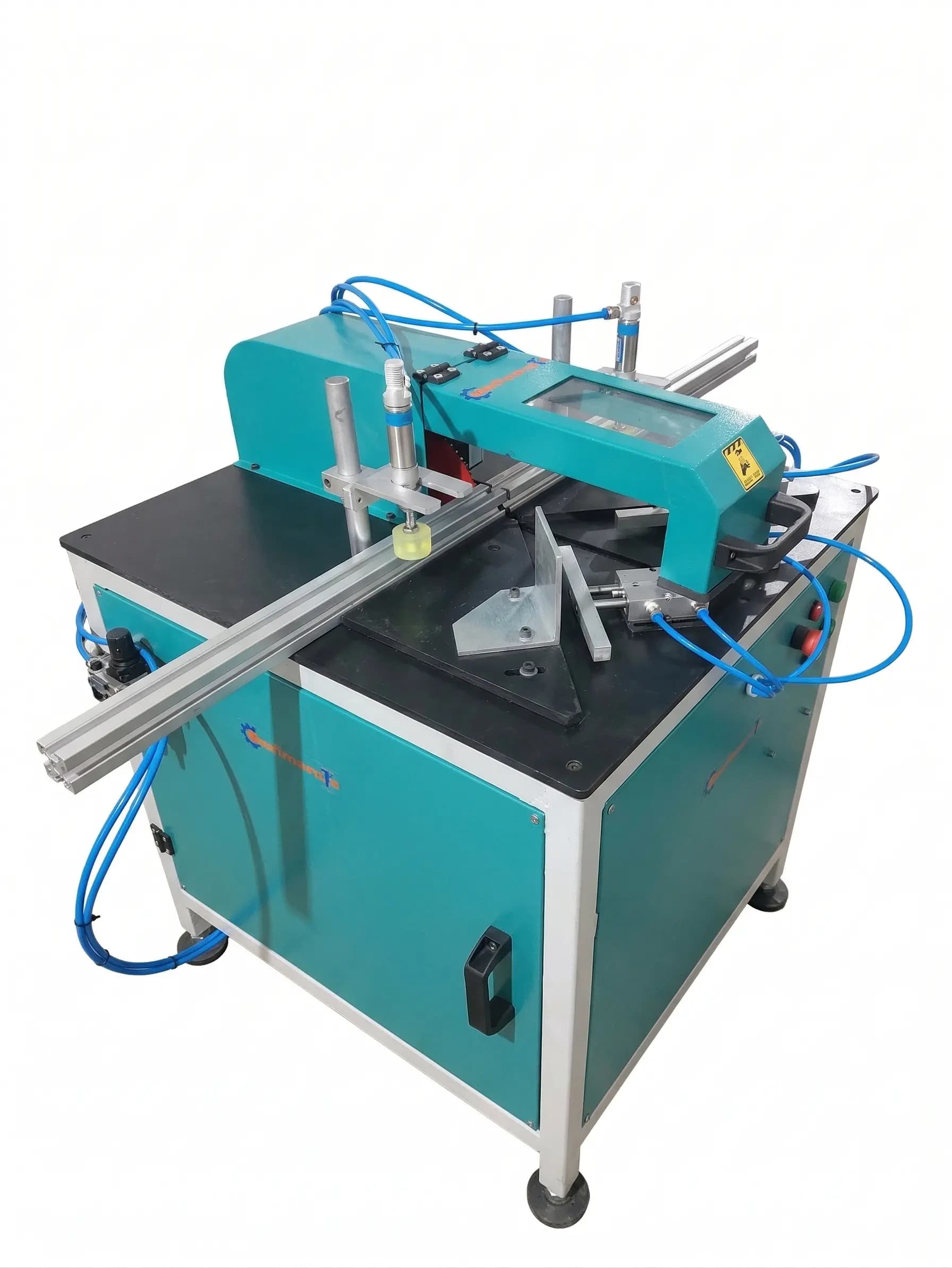
- Miter Accuracy: A tolerance of less than 0.1mm on the 45-degree cut, which is essential before the profile even touches the welder.
5 Common Mistakes in Seamless uPVC Fabrication
As a uPVC machinery manufacturer, I often see fabricators invest in high-end gear but fail on the execution. Avoid these critical errors to maintain your reputation in the luxury market:
- Incorrect Knife Positioning: The seamless 'knives' must be calibrated to the specific thickness of the profile’s outer wall. If they are 0.1mm off, you will see a 'lip' at the joint.
- Using Low-Grade Profiles: Seamless welding requires high-quality PVC with consistent calcium carbonate ratios. Poor profiles will 'char' rather than fuse.
- Neglecting the Air Dryer: Moisture in your pneumatic lines will cause the solenoids in your upvc window manufacturing machine to stick, leading to inconsistent clamping pressure.
- Over-Heating: Trying to speed up the cycle by increasing the plate temperature above 270°C will degrade the polymer chains, resulting in a brittle corner that will crack during installation.
- Skipping the Calibration: Check the squareness of your upvc windows machines every morning. Hyderabad's temperature fluctuations can cause slight thermal expansion in the machine bed.
The Cost-Benefit Analysis for Hyderabad Fabricators
While the initial upvc machine price list for seamless technology is higher than entry-level manual machines, the ROI is found in the 'Luxury Premium.' A seamless window typically commands a 20-30% higher retail price in the Hyderabad market. Furthermore, the reduction in labor—since you no longer need a dedicated staff member for manual corner de-burring—allows you to recoup the equipment cost within 14 to 18 months of operation. If you are looking at a uPVC window manufacturing plant cost India comparison, the seamless welder is the single most important investment for brand differentiation.
FAQ: Expert Advice for uPVC Fabricators
Q: Does a seamless welder work for both white and laminated profiles? Yes, but it is specifically engineered for laminated (colored) profiles where you cannot afford to cut away the surface layer. For white profiles, it provides a 'pencil line' finish that is far superior to the 3mm groove.
Q: What is the maintenance schedule for a double head seamless welder? Daily cleaning of the heating plates with a non-abrasive cloth and weekly lubrication of the linear motion guides is mandatory. Check the Teflon cloth daily for any pinholes or burns.
Q: Can I integrate this into an existing uPVC window manufacturing unit? Absolutely. The machine operates on standard 3-phase 380V or single-phase 220V power (depending on the model) and fits into a standard production flow after the upvc cutting machine phase.
Get more articles like this
Follow Mechnovate on Google to see our guides in Google Discover & News