Thane High-Rise: Double Head Cutting Machine Price & ROI Guide
An automatic double head cutting machine price in India typically ranges from ₹4,50,000 for entry-level pneumatic models to over ₹12,50,000 for high-precision CNC variants. In the context of Thane’s rapidly expanding skyline, where high-wind load requirements demand millimetre-perfect precision, moving from a single-head setup to an Automatic Double Head Cutting Machine is no longer optional—it is a baseline for survival. Fabricators can expect a full ROI within 14 to 18 months by reducing profile wastage from 12% to under 3% and increasing daily output by approximately 40 frames.
The Technical Engineering Behind Thane’s High-Rise Demands
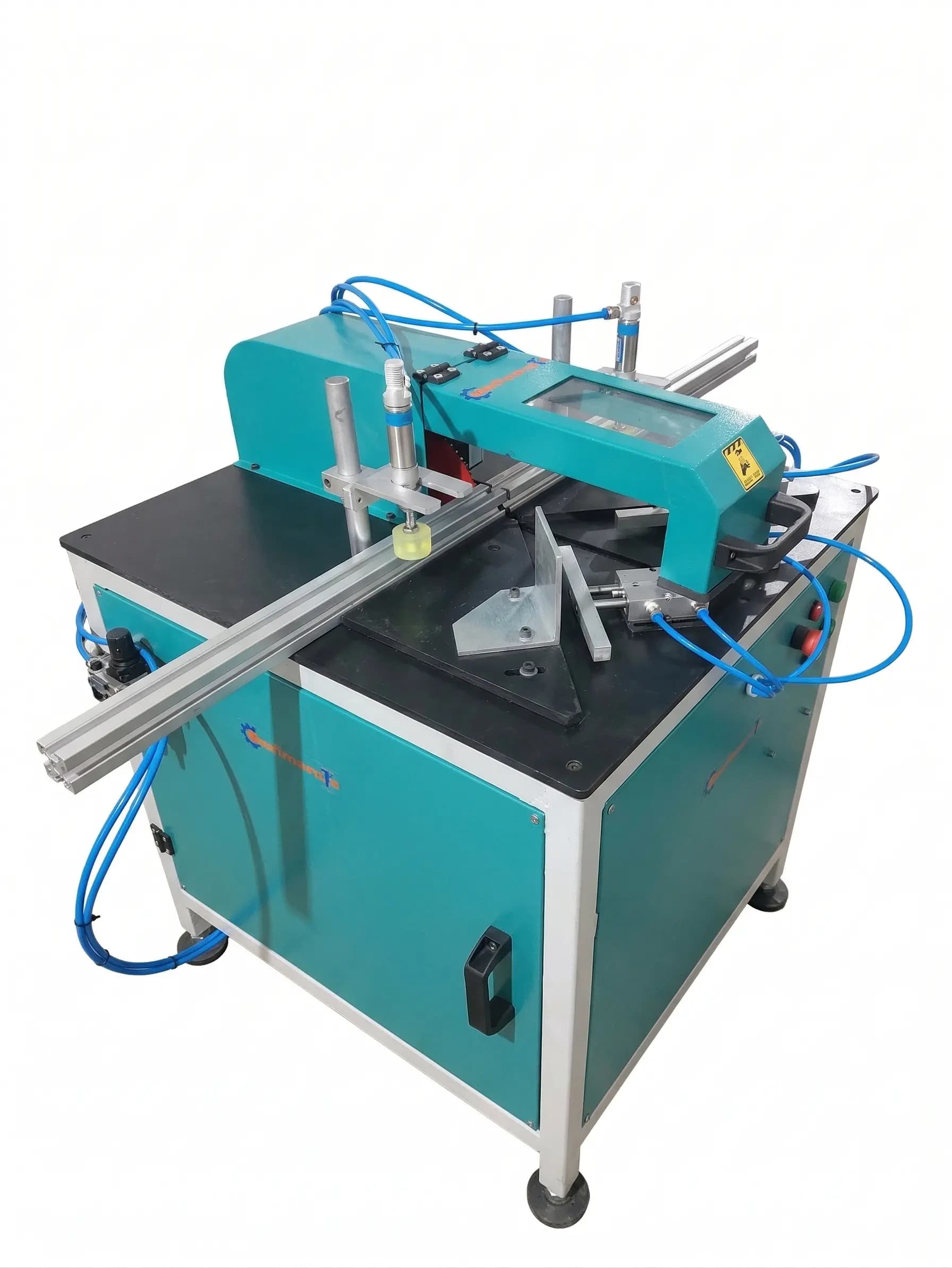
When we talk about aluminium fabrication for 30-story towers in Ghodbunder Road or Majiwada, we aren't just cutting metal; we are managing structural integrity. High-rise windows require heavy-duty profiles that can withstand extreme wind pressures, necessitating the use of a 45 degree double head cutting machine with 500mm carbide-tipped blades. These machines utilize a 2.2kW motor per head, rotating at roughly 2800 to 3200 RPM to ensure a burr-free finish that meets ISO 9001 quality standards.
Precision engineering in these machines relies on linear bearing guide pairs and a pneumatic-hydraulic damping cylinder for the blade feed. This prevents the 'kick-back' common in manual saws, ensuring that every 45-degree miter is airtight. For fabricators, this means the Aluminium Corner Crimping Machine will produce a much stronger joint because the mating surfaces are perfectly flush. In our 15 years of workshop experience, we've seen that even a 0.5mm deviation in a 12-inch profile can lead to water seepage in high-rise installations.
Case Study: Performance Metrics from a 6-Week Workshop Trial
Last year, we assisted a mid-sized fabricator in transitioning their facility. We replaced two single-head manual saws with one Automatic Double Head Cutting Saw for Aluminium Profiles and monitored the results over six weeks. The data was transformative for their bottom line:
- Output Efficiency: Daily frame production rose from 18 frames per shift to 52 frames with the same labor count.
- Material Conservation: By utilizing the digital length display and automatic angle positioning, the scrap rate dropped from 12% to 2.8% per ton of aluminium.
- Tolerance Control: We achieved a consistent cutting length tolerance of ±0.1mm, significantly exceeding the BS EN 12020 standards.
- Labor Optimization: One operator could now handle the work that previously required three, allowing two staff members to be reassigned to the assembly and glazing lines.
This shift is critical for businesses looking to scale. When you are bidding for large-scale projects in Thane, demonstrating this level of precision engineering and repeatability is what wins the contract over smaller, manual-based workshops.
Automatic Double Head Cutting Machine Price vs. Long-Term ROI
Investing in an aluminium cutting machine price point that seems 'too good to be true' often results in higher maintenance costs. A high-quality automatic double head cutting machine price India reflects the grade of components used, such as Schneider electrics or Airtac pneumatics. Here is how the ROI breaks down for a typical Thane-based workshop:
- Initial Capital Expenditure (CAPEX): ₹6.5 Lakhs to ₹9 Lakhs for a mid-range automatic unit.
- Monthly Savings (Waste reduction): At current aluminium prices, a 9% reduction in scrap across 5 tons of monthly processing saves approximately ₹1.3 Lakhs.
- Monthly Savings (Labor): Reducing the need for two skilled cutters saves approximately ₹50,000 in monthly wages.
- Break-even Point: Factoring in electricity and blade sharpening, most units pay for themselves in less than 15 months.
Beyond the financials, the ability to process high-volume orders for upvc window manufacturing machines and aluminium systems simultaneously allows for better market diversification. Many modern machines are built as a hybrid upvc and aluminium cutter, providing the flexibility to serve both residential and commercial sectors in one facility.
Critical Specifications for Aluminium Profile Cutting
When evaluating a double head miter saw for aluminium profiles price, you must look at the internal componentry rather than just the exterior frame. We recommend machines that feature a heavy-duty cast iron base rather than a welded steel plate to minimize vibration during high-speed cutting. This is the difference between a machine that lasts 3 years and one that lasts 15.
- Blade Diameter: For Thane’s architectural profiles, a 500mm blade is the industry standard to handle wide-section outer frames.
- Angle Accuracy: Ensure the machine offers automatic 45° and 90° positioning with a dedicated pneumatic locking system.
- Cooling System: A micro-mist lubrication system is essential for aluminium to prevent the blade from 'gumming up' and causing jagged edges.
- Feed Rate: Look for an infinitely variable feed speed to accommodate different wall thicknesses (1.2mm to 3.0mm) without deforming the profile.
Common Mistakes to Avoid When Upgrading
In our decades of experience as a uPVC machinery manufacturer and aluminium specialist, we see the same three mistakes repeated by growing workshops. First, many ignore the quality of compressed air. An automatic cutting machine requires 6-8 bar of dry, stable pressure; moisture in your lines will destroy your pneumatic valves in months.
Second, fabricators often overlook the importance of the Heavy Duty Aluminium Profile End Milling Machine in their workflow. A high-speed cutter is useless if your end-milling process creates a bottleneck downstream. Third, never skip the safety standards. An industrial aluminium door manufacturing equipment setup should always include protective shields that are interlocked with the cutting cycle—never bypass these for the sake of speed.
Frequently Asked Questions (FAQ)
Q: Can I use the same machine for both uPVC and Aluminium profiles? Yes, most double head cutting machines are compatible with both materials. However, you must use a carbide-tipped blade specifically designed for the harder aluminium alloys (like 6063-T5) when switching from uPVC to ensure a clean finish and blade longevity.
Q: What is the power requirement for an automatic double head cutting saw? Most industrial units require a 3-phase, 380V-415V power supply. Each motor is typically 2.2kW, so your workshop electrical panel should be rated to handle at least 5-7kW for the cutting machine alone, excluding the compressor.
Q: How often should I sharpen the blades on my aluminium cutting machine 12 inch or 20 inch? With a proper micro-mist lubrication system, a high-quality carbide blade should last for 3,000 to 5,000 cuts before needing professional sharpening. Signs of dullness include increased burr production and a higher-pitched 'whine' during the cut.
Q: What is the average lead time for a new automatic aluminium window production line? At Mechnovate, we typically maintain a lead time of 2-4 weeks for standard configurations. This includes the initial site assessment, machine calibration, and operator training to ensure your team is ready to scale for Thane’s high-rise projects from day one.
Get more articles like this
Follow Mechnovate on Google to see our guides in Google Discover & News