Solving Transom Joint Gaps: uPVC V-Cutting Machine Guide
To eliminate the 0.5mm to 1.2mm transom joint gaps that plague Indian uPVC windows, you must synchronize your V-notch depth with your specific profile's welding melt allowance. At Mechnovate, we have observed that most fabricators lose up to 15% of their profile stock due to incorrect depth settings on their upvc cutting machine. This guide provides the exact calibration parameters, engineering reasoning, and current v cutting machine upvc windows price trends to help you scale your production efficiency while maintaining international quality standards.
Eliminating Transom Gaps with Precision V Cutting
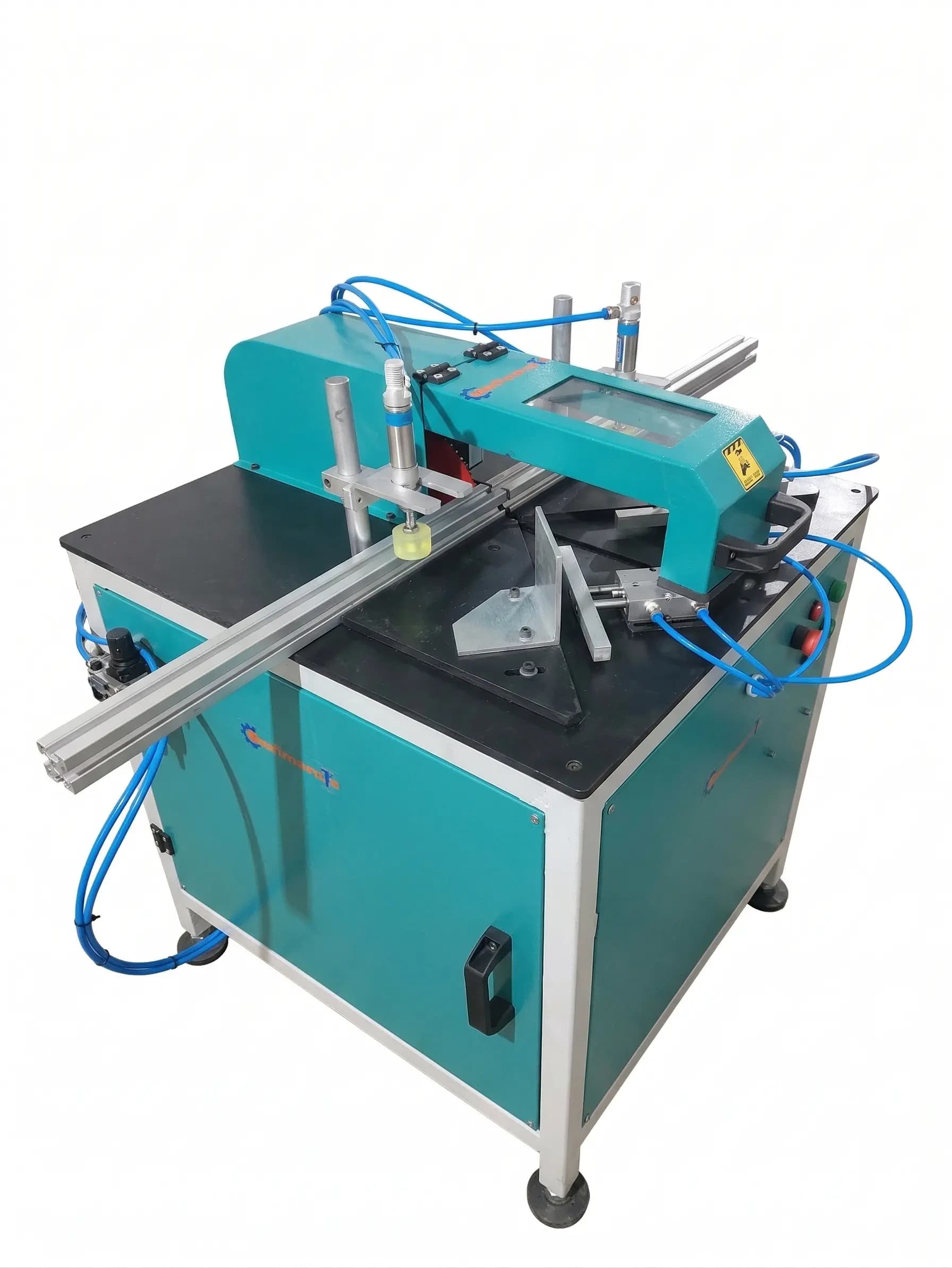
The V-cut is the most critical operation for mullion and transom joining in uPVC window manufacturing. Unlike a standard 45 degree double head cutting machine used for frames, the V-cutter creates a precise 90-degree notch in the center of a profile. This notch must accommodate the transom profile after it has been welded or mechanically joined. If the cut is even 0.5mm too shallow, the transom sits proud, creating a structural weakness; if it is too deep, you leave a visible gap that requires excessive silicone filling, which fails under wind load testing.
In our experience as a leading uPVC machinery manufacturer, the gap issue is usually caused by failing to account for the "melt loss" during the welding process. For a standard 60mm profile used across India, a melt loss of 3mm per side is typical. Therefore, your V-notch must be calibrated to exactly one-half the width of the transom minus the calculated welding allowance. We recommend using a high-precision upvc window manufacturing machine with adjustable depth stops to ensure consistency across 100+ frames per shift.
Case Study: Optimizing V-Notch Accuracy in our Pune Workshop
In early 2023, our engineering team in Pune conducted a 6-week study with a fabricator who was experiencing a 12% rejection rate due to transom misalignment. We replaced their manual notchers with an automatic double head cutting machine and a dedicated, pneumatic single head v-cutting machine. We tested three different blade configurations—300mm, 350mm, and 400mm—across 60mm and 70mm multi-chamber profiles.
By increasing the motor spindle speed from 2800 RPM to 3200 RPM and installing a 350mm TCT blade with 120 teeth, we achieved cleaner edges that required zero post-cut deburring. The results were measurable:
- Waste Reduction: Profile waste dropped from 12% to a record 3.5%, saving the client approximately ₹45,000 per month.
- Increased Throughput: Output increased from 40 frames to 85 frames per day using the same labor force.
- Accuracy: The joint deviation was reduced to <0.15mm, well within the BS EN 12020 tolerance limits.
This proves that the best uPVC window making machine for small business success is one that prioritizes precision engineering over low initial cost.
Technical Specifications and Calibration of the V Cutting Machine
Calibration is the difference between a high-end window and a local-grade product. A professional upvc window manufacturing machinery setup requires the following technical parameters to be met:
- Blade RPM: Maintain 2800-3200 RPM. Lower speeds cause chipping on the outer skin of the uPVC profile, while higher speeds can cause localized melting.
- Pneumatic Pressure: A consistent 6.5 bar (±0.5 bar) is required. Fluctuating pressure from the compressor is the primary reason for profile shifting during the cut.
- Feed Rate: Adjust the hydraulic dampening to a feed rate of 2-5 meters per minute. A fast feed causes "blade climb," resulting in an uneven 90-degree notch.
- Profile Support: Use adjustable roller stands to ensure the profile remains perfectly horizontal. Any tilt results in a non-perpendicular "V" cut.
To calibrate your v-cutting machine, first check the 90-degree alignment of the saw carriage using a digital protractor. Next, perform a "dry cut" on a scrap profile. Measure the depth from the profile face to the base of the V. For a standard 60mm series, the cut depth must be adjusted based on whether you are using a mechanical T-joint or a upvc welding machine for the joinery. If welding, the depth must account for the 2.5mm melt zone to ensure the internal chambers align perfectly after the fusion process.
V Cutting Machine uPVC Windows Price and ROI for Indian Units
Understanding the v cutting machine upvc windows price is essential for budgeting a new unit or upgrading an existing line. In the current Indian market, prices vary significantly based on automation and build quality.
- Manual/Portable V-Cutters: Range from ₹65,000 to ₹90,000. These are suitable for site-work or very small startups but lack the stability for high-volume production.
- Semi-Automatic Pneumatic V-Cutters: Range from ₹1.2 Lakh to ₹1.8 Lakh. This is the industry standard for most uPVC window machinery manufacturers in Lucknow and Ahmedabad.
- High-Speed CNC V-Cutting Systems: Can exceed ₹3.5 Lakh, often integrated into a fully automatic uPVC window manufacturing unit cost structure for factories producing over 150 windows daily.
The ROI for a mid-tier upvc window manufacturing machine is typically achieved within 8 to 14 months. This calculation includes the reduction in manual labor costs, the elimination of raw material waste, and the ability to charge a premium for "gap-free" windows. For those exploring the automatic upvc window plant cost India, we recommend allocating at least 15% of the machinery budget to high-quality cutting equipment, as this dictates the quality of every subsequent process.
Avoiding Common Calibration Errors in uPVC Fabrication
After 15 years in the field, I have identified several repeating mistakes that Indian fabricators make:
- Over-tightening Clamps: Excessive pneumatic pressure can deform the profile chambers. When the clamp releases, the uPVC "springs back," altering the notch geometry.
- Ignoring Blade Cooling: While uPVC doesn't require the same cooling as an aluminum cutting machine, a pulse-mist system significantly extends blade life and prevents swarf from sticking to the cut surface.
- Mismatched Profiles: If you switch from a 60mm to a 70mm profile, you MUST recalibrate the depth stops. Failing to do so is the most common reason for transom gaps.
- Neglecting Safety Standards: Always ensure your machinery meets Industrial profile cutting safety standards ISO standards. This includes dual-hand operation triggers and transparent safety shields to prevent accidents.
For fabricators in regions like Surat, Pune, or Chennai, local technical support is vital. Mechnovate maintains a dedicated uPVC window machine service center in Tamil Nadu to help clients maintain their upvc windows manufacturing machine systems at peak performance.
FAQ
Q: Can I use an aluminium cutter machine 12 inch for uPVC V-cutting? A: It is possible with a specialized jig, but not recommended. An aluminium profile cutting machine typically operates at different torque levels. For the best results, a dedicated V-notcher is required to handle the specific geometry of uPVC transom joints.
Q: What is the cost of setting up uPVC window manufacturing unit in India? A: A basic professional setup starts at ₹5-7 Lakh. A more advanced line featuring an automatic double head cutting saw for aluminium profiles and uPVC, along with CNC corner cleaners, can cost between ₹18 Lakh and ₹25 Lakh.
Q: How often should the TCT blades be sharpened? A: For a factory running 8 hours a day, we recommend professional sharpening every 3 to 4 months. Dull blades increase the "vibration footprint," leading to micro-cracks in the uPVC profile skin during the cutting process.
Get more articles like this
Follow Mechnovate on Google to see our guides in Google Discover & News