Solving Joinery Inaccuracies: 45 Degree Double Head Cutting Machines
The Precision Crisis in Nagpur Window Fabrication
If your fabrication shop in Nagpur is still struggling with corner gaps that require excessive silicone filler, you are losing money and reputation. Joinery inaccuracies in uPVC and aluminium fabrication usually stem from a single source: the inability of a manual aluminium cutter or single cutting setup to maintain a perfect 45-degree miter under high-volume stress. In the extreme heat of the Vidarbha region, where temperatures hit 48°C, thermal expansion in aluminium profiles makes precision even more critical. A gap of just 0.5mm at the joint leads to air leakage, whistling sounds, and structural instability.
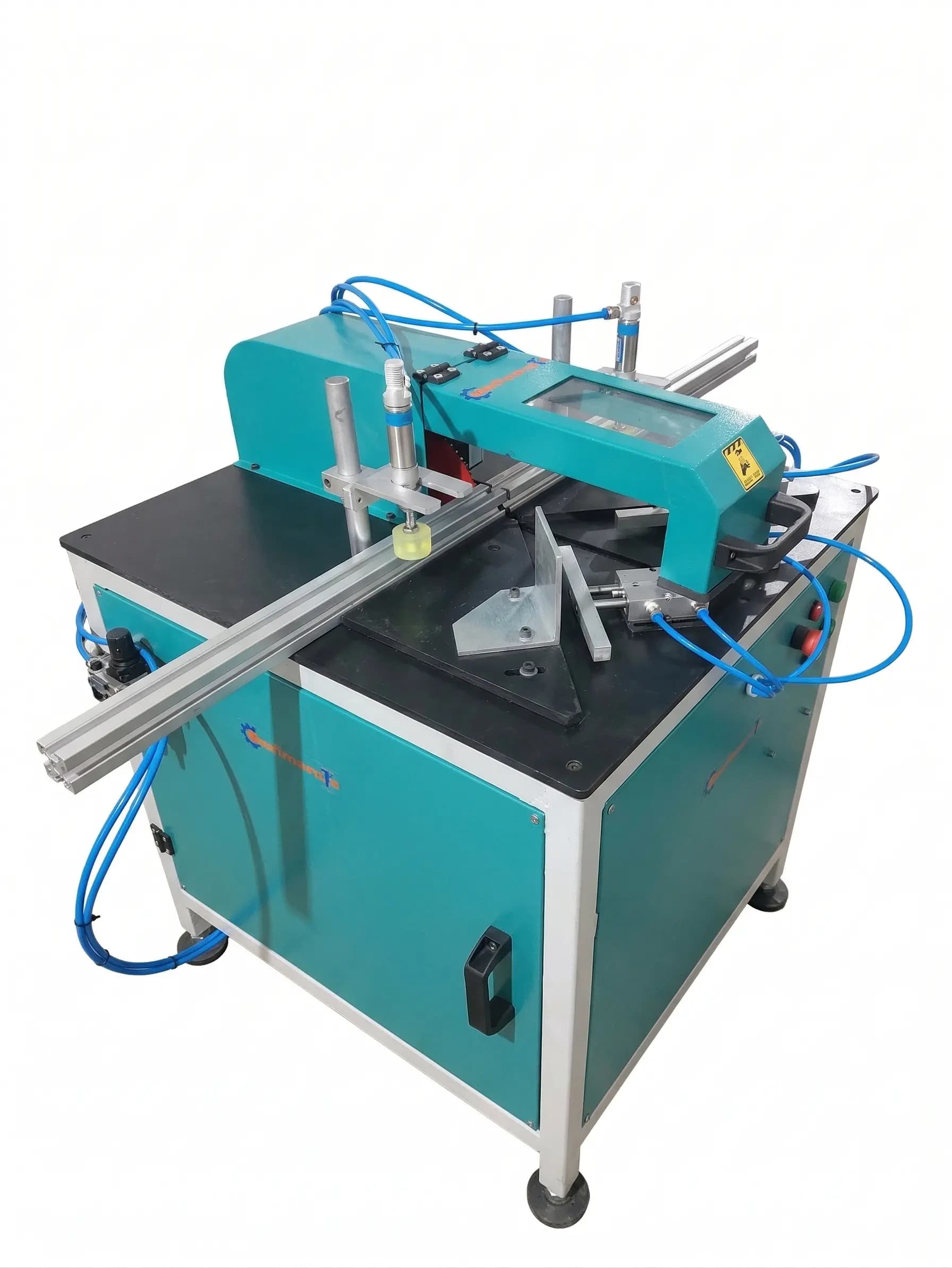
To solve this, leading Nagpur fabricators have shifted to the 45 Degree Double Head Cutting Machine. This industrial-grade aluminium cutting machine eliminates the 'human variable' by cutting both ends of the profile simultaneously. When you use an automatic double head cutting saw for aluminium profiles, you ensure that the internal and external lengths match perfectly, every single time. This is the cornerstone of precision engineering in modern window machinery.
Technical Mastery: Why 45 Degrees is Not Always 45 Degrees
In my 15 years on the shop floor, I have seen many fabricators wonder why their degree cutting machine produces joints that don't square up. The answer lies in the engineering physics of the blade entry and profile clamping. A standard aluminium cutting machine 12 inch might flex under the resistance of heavy-duty architectural profiles. Here is the technical breakdown of what makes a high-performance head cutting machine work:
- Blade Diameter and Stability: We recommend a 500mm TCT blade over the standard 12-inch versions. The larger diameter provides a cleaner sweep, reducing the burrs on the aluminium profile cutting machine output.
- Hydropneumatic Feed Control: Mechanical feeds stutter. A hydropneumatic system ensures a smooth, constant feed rate (typically 0-3 m/min), which is essential for maintaining the integrity of the uPVC window manufacturing machinery.
- Clamping Pressure: You must maintain a steady 6-8 bar pressure. If the clamping is weak, the profile vibrates, leading to 'stepped' cuts.
- Angular Tolerance: High-end uPVC machinery manufacturer standards require an angular accuracy of ±2′. This ensures that when the profiles move to the upvc welding machine, the melt-down is uniform across the entire cross-section.
The Nagpur Case Study: From 12% Waste to 3%
Last year, we worked with a mid-sized uPVC windows manufacturers machine setup in the Hingna Industrial Area. They were using a manual aluminium cutter machine 12 inch and facing a 12% rejection rate due to corner misalignments. We implemented a transition to a fully automatic uPVC window manufacturing unit cost-effectively by introducing a CNC-controlled double head miter saw for aluminium profiles.
Over six weeks, we recorded the following measurable results:
- Before: 42 frames per 8-hour shift with 12% material waste.
- After: 85 frames per 8-hour shift with 3% material waste.
- Outcome: The cost of the aluminium profile cutting machine price was recouped in just 7 months through material savings alone.
The key mistake they were making was cutting profiles individually. By moving to a double head cutter, they ensured that the 'long-to-short' dimensions were locked in by the machine's digital display, not a worker's measuring tape. This level of upvc window manufacturing machine precision is what separates premium vendors from local fabricators.
Essential Workflow for High-Performance Joinery
To achieve ISO-standard results, your head cutting machine must be part of a synchronized production line. Follow this step-by-step documentation for your Nagpur facility:
- Profile Calibration: Always check the wall thickness of your profiles against BS EN 12020. Even the best aluminium cutter machine cannot compensate for warped or sub-standard raw material.
- Simultaneous Cutting: Use the 45 Degree Double Head Cutting Machine to cut the height and width profiles in batches. This ensures that all 'Left' and 'Right' components are identical.
- Hardware Preparation: Once cut, use an Aluminum Punching Machine for handle holes and stay-arm slots. Avoid manual drilling, which weakens the profile wall.
- Drainage Routing: Use a high speed Copy Router Machine to create water drainage slots. If the 45-degree joint is perfect but the drainage is poorly routed, the window will still fail during Nagpur's monsoon season.
- Welding/Crimping: For uPVC, the upvc welding machine temperature must be set to 240°C-250°C. For aluminium, use an automatic aluminium corner crimping machine price-justified by the structural strength it adds to the joint.
Common Mistakes and Maintenance Lessons
One of the most frequent errors I see in Nagpur workshops is neglecting the cooling system on the aluminium cutting machine. Aluminium is a soft, 'gummy' metal. Without a proper mist-spray lubrication system, the metal chips weld themselves to the blade teeth, leading to rough cuts and inaccurate angles.
- Watch Out For: Build-up of uPVC dust in the sliding rails of the upvc window making machine. This dust acts as an abrasive, wearing down the linear guides and throwing the 45-degree angle off by 0.5 to 1 degree.
- Safety Tip: Ensure your industrial profile cutting safety standards ISO standards are met. This includes two-hand safety starts and emergency stop buttons on both heads of the machine.
- Calibration: Every Monday morning, perform a 'dry square' test. Cut four 200mm pieces at 45 degrees and assemble them into a frame. If there is any light visible in the joints, recalibrate the head degree settings before starting production.
The ROI of Automatic vs Manual Machinery
While the aluminium cutter machine price for a manual unit is lower, the long-term automatic upvc window plant cost India analysis shows that automation is cheaper. A manual setup requires three skilled workers to produce the output of one semi-skilled worker operating a CNC uPVC window fabrication machine.
| Feature | Manual 12-inch Cutter | 45 Degree Double Head Machine |
|---|---|---|
| Precision | ±0.5mm | ±0.1mm |
| Production Speed | 5 mins / profile | 45 seconds / profile |
| Waste Rate | 10-15% | < 3% |
| Operator Skill | Expert required | Basic Training |
For a startup business, a portable uPVC window making machine price list might look attractive, but for those targeting high-end residential projects in Nagpur, the heavy duty aluminium profile end milling machine and double head saw are non-negotiable.
FAQ: Expert Answers for Fabricators
Q1: Can I use the same machine for both uPVC and Aluminium profiles? Technically yes, but you must change the blade. Aluminium requires a TCT blade with a negative rake angle, while uPVC requires a different tooth pitch to prevent chipping. Most high-volume Nagpur plants prefer dedicated uPVC window machinery for efficiency.
Q2: What is the ideal blade speed (RPM) for a clean 45-degree cut? For aluminium profiles, we typically set our machines to 2800-3200 RPM. Anything faster can cause the aluminium to melt at the edges; anything slower can cause 'chatter' marks.
Q3: How often should I replace the blades on my head cutting machine? In a standard 8-hour shift environment, we recommend professional sharpening every 3-4 weeks. Using a dull blade increases the motor load and ruins the 45-degree accuracy.
Q4: Is it worth investing in a CNC uPVC window corner cleaning machine? If you are producing more than 20 windows a day, yes. A CNC corner cleaner ensures the aesthetics of the 45-degree joint are professional, which is a major selling point for high-performance windows in the Nagpur market.
Get more articles like this
Follow Mechnovate on Google to see our guides in Google Discover & News