Scaling Production for GIFT City: Manual vs Auto Aluminium Machinery
The Production Benchmark for GIFT City Glazing Projects
Scaling production for high-tier developments like GIFT City in Gandhinagar requires more than just extra labor; it demands a fundamental shift in how you view precision engineering. In my 15 years on the shop floor, I have seen Ahmedabad fabricators struggle to meet the tight tolerances required for high-rise glazing using traditional manual methods. To qualify for RERA-approved projects, your frames must strictly adhere to IS 1285 and BS EN 12020 standards, where a deviation of even 0.5mm can lead to massive rejection rates during installation.
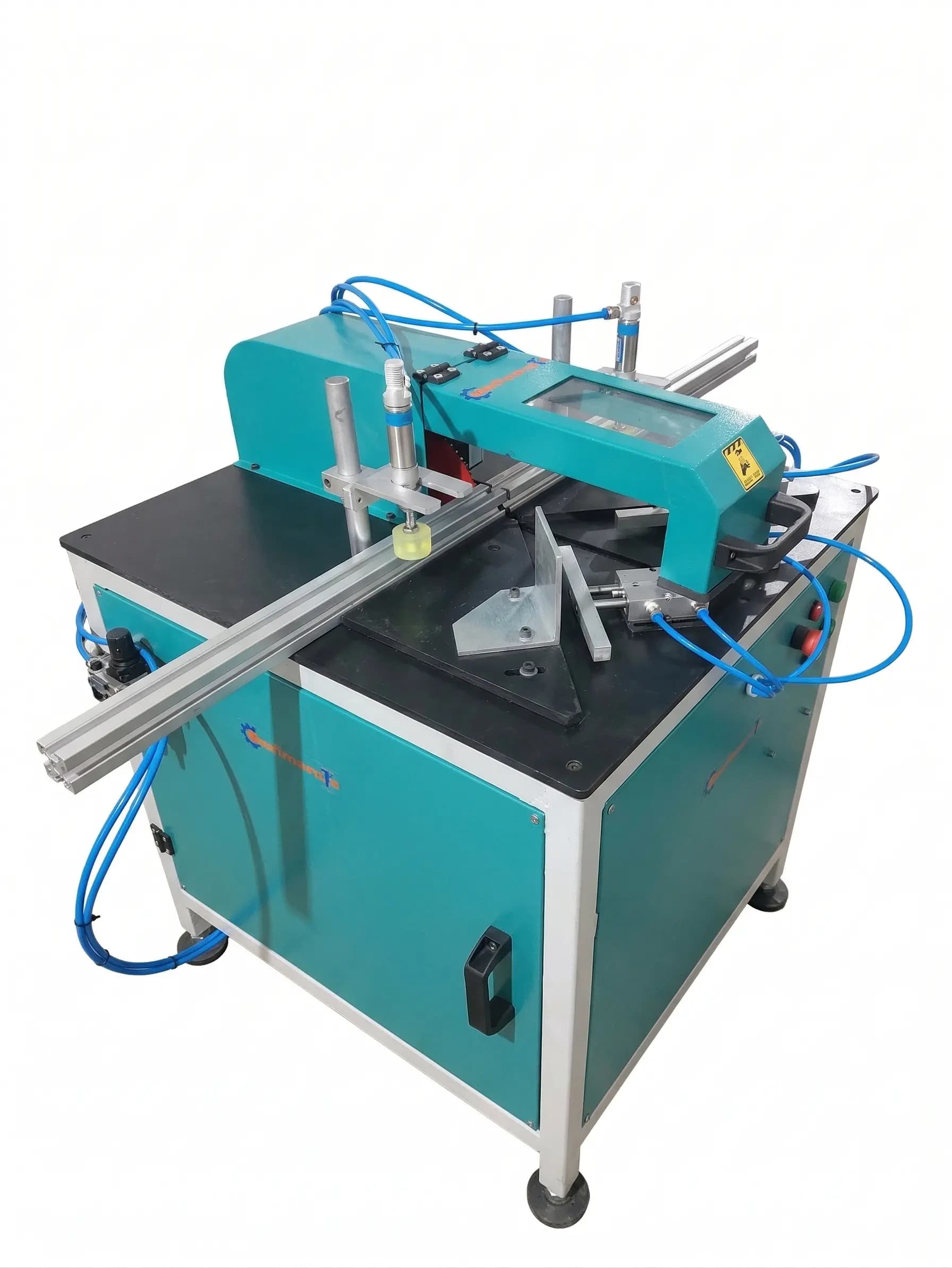
For a startup unit in Gujarat, manual machines like a basic Aluminium Cutter Machine 12 inch might suffice for 5-10 windows a day. However, scaling to meet the 50-100 frames-per-day demand of a commercial tower requires transitioning to an Automatic Double Head Cutting Machine. The primary difference lies in the repeatability of the 45-degree miter cut, which is the foundation of a leak-proof window corner.
Comparative Analysis: Manual vs Automatic Aluminium Window Machinery
When evaluating Aluminium window machinery manufacturers in Ahmedabad Gujarat, you must decide between manual versatility and automatic throughput. Based on our internal testing at Mechnovate, here is how the two configurations compare across critical metrics:
- Cutting Precision: Manual 12-inch cutters often suffer from pivot-point wear, leading to angle drift. An automatic double head saw uses linear guide rails and pneumatic clamping to maintain a ±0.1mm tolerance consistently.
- Labor Intensity: A manual line requires three skilled operators for cutting, punching, and routing. An automatic line reduces this to one operator who manages the CNC interface.
- Safety and Standards: Modern Alu profile cutting and processing machines include integrated safety hoods and two-hand safety starts, meeting Industrial profile cutting safety standards ISO standards.
- Waste Management: Manual measurement errors typically result in 8-12% profile wastage. Automatic machines with digital readouts or CNC length positioning reduce this to under 3%.
For those diversifying their portfolio, choosing a uPVC machinery manufacturer that offers cross-compatible pneumatic systems can save significantly on compressor infrastructure costs.
Case Study: Optimizing a 5,000 Sq. Ft. Shop Floor in Sanand, Gujarat
Last year, we assisted a mid-sized fabricator in Sanand who was struggling with a backlog of 400 windows for a residential project near GIFT City. They were using a single-head manual Aluminium Cutter and a Manual Punching Machine. Their rejection rate was 7% due to poor corner alignment.
We implemented a 6-week transition plan, replacing their setup with a 45-degree Automatic Double Head Cutting Machine and an Automatic Corner Crimping Machine. The results were immediate: cutting time per frame dropped from 14 minutes to 3.5 minutes. Most importantly, the corner strength (tested via pull-tests) increased by 40%, ensuring they met the wind-load specifications required for 20+ story buildings.
Technical Specifications Every Fabricator Must Demand
When browsing an upvc machine price list or comparing aluminium window machinery manufacturers in Surat Gujarat, do not just look at the price tag. You must audit the technical build quality of the machinery to ensure long-term ROI.
- Motor Power: Ensure at least a 2.2kW motor for 500mm blades to handle heavy-duty thermal break profiles without RPM drops.
- Blade Speed: A constant 2800-3200 RPM is necessary to prevent burr formation on the aluminium surface.
- Pneumatic Systems: Look for Airtac or Festo valves that operate at a stable 6-8 bar pressure. Inconsistent air pressure is the #1 cause of failed corner crimping.
- Feed Rate: A hydro-pneumatic feed system is essential for a smooth Aluminium Profile Cutting Machine stroke, especially when dealing with wall thicknesses over 2.5mm.
Common Scaling Mistakes in Ahmedabad’s Fabrication Industry
One of the most frequent errors I see is fabricators buying a high-end uPVC Windows Making Machine but neglecting the quality of the Copy Router Machine. If your slot milling is off by even a millimeter, the locks and handles will not align, causing friction and eventual hardware failure.
Another mistake is ignoring the power supply stability. In many industrial zones in Gujarat, voltage fluctuations can fry the PLC units of an automatic double head cutting machine price India configurations. Always factor in the cost of a high-capacity servo stabilizer when setting up your automatic upvc window manufacturing plant cost India.
Finally, avoid the trap of "portable" machines for permanent production lines. While a portable uPVC window making machine price list looks attractive for on-site repairs, they lack the cast-iron base stability required for high-volume uPVC window manufacturing machines operations.
FAQ: Critical Questions for Gujarat Fabricators
Q: What is the estimated cost of setting up a uPVC window manufacturing unit in India? A: A basic manual setup starts at ₹4.5 - ₹6 Lakhs. However, a semi-automatic line capable of GIFT City standards typically ranges from ₹12 Lakhs to ₹22 Lakhs depending on the CNC features.
Q: Can I use the same cutting machine for both aluminium and uPVC? A: Yes, but you must change the saw blade. Aluminium requires a TCT blade with a specific tooth profile and cooling spray, whereas uPVC is cut dry at higher speeds to prevent melting.
Q: How often should I calibrate my double head miter saw? A: For high-precision projects, we recommend a weekly calibration check using a master square. In heavy production environments (10+ hours/day), a monthly deep-service of the pneumatic cylinders is mandatory to prevent lag.
Get more articles like this
Follow Mechnovate on Google to see our guides in Google Discover & News