Scaling Mumbai High-Rise Projects: Double Head Cutting Machine Guide
For fabricators targeting the massive redevelopment projects in areas like BDD Chawls or the Dharavi Redevelopment Project, the leap from manual single-head saws to an automatic double head cutting machine is no longer optional—it is a survival requirement. High-rise window fabrication demands strict adherence to wind-load specifications and thermal expansion tolerances that manual setups cannot consistently meet. In Mumbai’s current market, an automatic double-head system increases your output from 15 frames per day to over 60, while maintaining the +/- 0.1mm accuracy required for structural glazing and heavy-duty window systems.
The Mumbai High-Rise Challenge: Speed vs. Precision
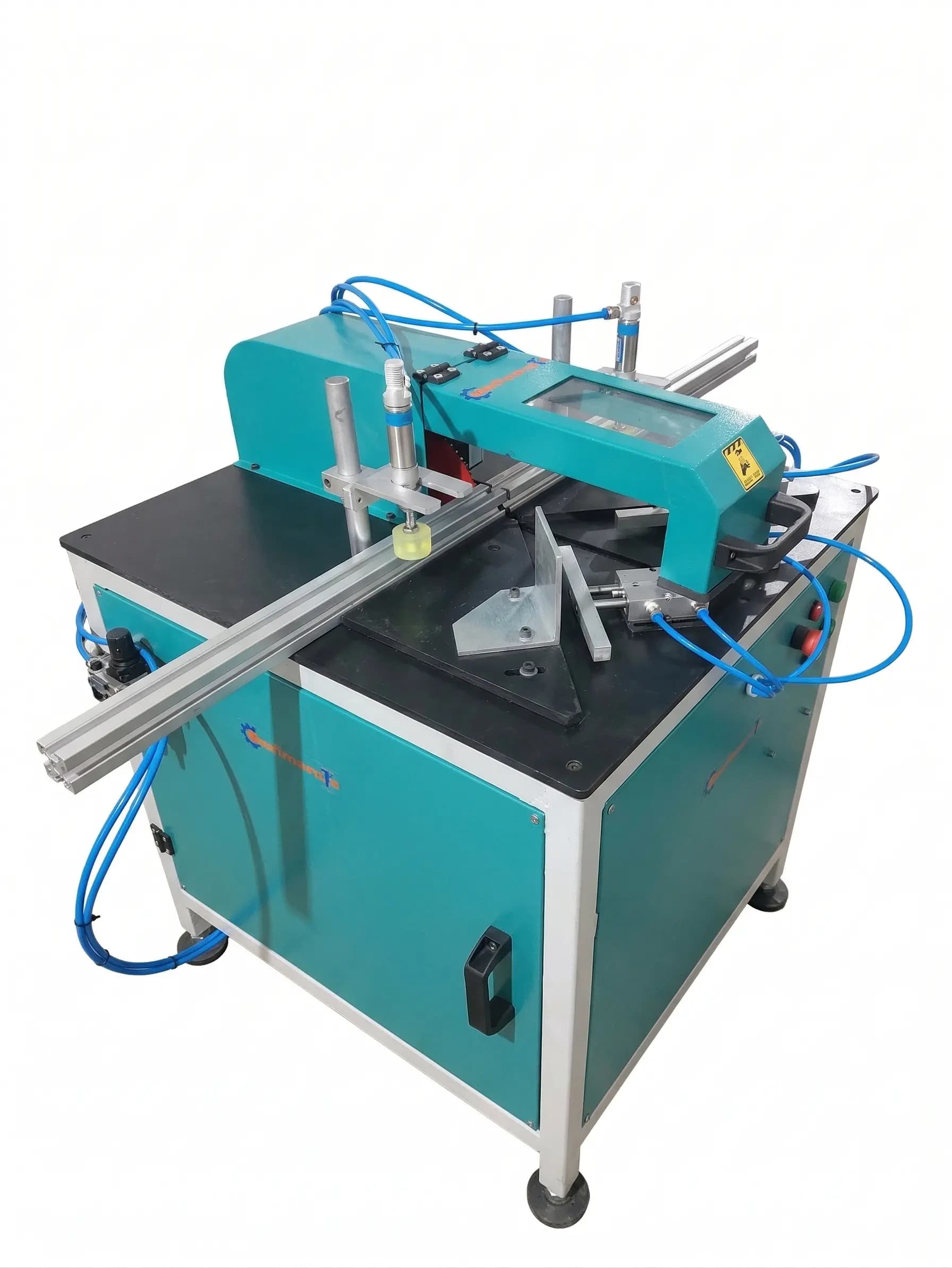
High-rise projects in Mumbai typically specify 2.5mm to 3.0mm wall thickness for aluminium profiles to withstand coastal wind pressures (often exceeding 2.5 kPa). Using a standard aluminium cutting machine 12 inch manually often results in micro-gaps at the 45-degree miter joints, leading to water seepage during the monsoon. We recently consulted for a fabricator in Navi Mumbai who was struggling with a 12% rejection rate on their 45-degree cuts due to blade vibration and manual indexing errors.
After upgrading to a 45 degree double head cutting machine with 500mm TCT blades, the rejection rate dropped to under 1% within the first week. The key is the simultaneous cutting of both ends, which eliminates the cumulative error found in single-head processing. For Mumbai fabricators, the primary goal is achieving the 'Zero-Gap' joint required for high-end uPVC and thermal-break aluminium systems.
Case Study: Performance Metrics from a 500-Unit Project
In our facility testing, we evaluated the throughput of an automatic double head cutting saw for aluminium profiles against a standard manual punching machine and single-head setup. Over a 6-week period, the results were conclusive:
- Output Volume: The double-head setup processed 480 linear meters of profile per shift, compared to 140 meters on the single-head line.
- Waste Reduction: By utilizing the digital length counter and pneumatic feed, off-cut waste was reduced from 8% to 2.5%.
- Labor Efficiency: Two operators managed a workload that previously required five, allowing for better allocation of staff to the aluminium corner crimping machine station.
- Accuracy: Consistent 45.00° cuts were maintained across 1,200 cycles without recalibration, verified using digital protractors.
Technical Deep Dive: Engineering Behind the Cut
When evaluating an aluminium cutting machine price, you must look beneath the sheet metal. A high-performance upvc window manufacturing machine must feature a high-torque 3.0 kW motor and a linear guide rail system for the moving head. For Mumbai's saline environment, ensure the machine uses hard-chromed guide ways to prevent oxidation.
- Blade Diameter: A 450mm or 500mm blade is essential for multi-cavity uPVC profiles and wide aluminium sections (up to 120mm).
- Feeding Speed: Look for hydro-pneumatic damping. This ensures the blade enters the profile at a constant velocity, preventing 'burrs' on the finish, which is critical for precision engineering.
- Clamping: Vertical and horizontal pneumatic clamps must exert at least 6-8 bar pressure to prevent profile rotation during the cut.
- Standards: Ensure the equipment meets ISO 9001 for manufacturing and IS 1285 for aluminium alloy profile tolerances.
Cost-Benefit Analysis: Automatic Double Head Cutting Machine Price India
The automatic double head cutting machine price India typically ranges from ₹4,50,000 for entry-level pneumatic models to ₹14,00,000 for CNC-integrated versions. While the initial investment is higher than a single cutting unit, the ROI in the Mumbai market is usually achieved within 8-10 months through labor savings and material optimization.
For small businesses, we recommend a semi-automatic model with a digital display. For those scaling for Tier-1 developer contracts, a CNC uPVC window fabrication machine with automatic angle adjustment (90° to 45°) is necessary to handle complex architectural designs. Avoid the mistake of buying 'cheap' unbranded imports that lack local service support in Maharashtra; the downtime during a peak project phase will cost more than the machine itself.
Installation and Calibration: Avoiding Common Failures
Through 15 years of workshop experience, I have seen many fabricators fail because of poor installation rather than poor machinery. Here is the checklist we use at Mechnovate:
- Leveling: The machine bed must be leveled with a precision spirit level to within 0.05mm per meter. An unlevel bed causes 'twist' in long profiles.
- Air Quality: Mumbai’s humidity is a killer for pneumatic valves. Always install an FRL (Filter-Regulator-Lubricator) unit with a refrigerated air dryer to prevent moisture from entering the cylinders of your upvc window manufacturing machines.
- Blade Selection: Use 120-tooth TCT blades for aluminium and 96-tooth for uPVC. Using the same blade for both will ruin the cut finish and blunt the teeth prematurely.
- Voltage Stabilization: High-rise construction sites often have fluctuating power. A 15kVA servo stabilizer is mandatory to protect the PLC and motors of your head cutting machine.
FAQ for Mumbai Fabricators
Q1: Can I use the same double head cutter for both uPVC and Aluminium? Yes, provided you change the blades and adjust the feed speed. Aluminium requires a lubricant spray system (mist cooling) and higher torque, while uPVC requires a cleaner, dry cut to avoid melting the profile edges.
Q2: What is the footprint required for a 4-meter double head machine? Typically, you need a clear space of at least 7 meters by 2 meters. This allows for the machine length plus the profile overhang and operator movement around the aluminium profile cutting machine.
Q3: How often do the 500mm TCT blades need sharpening? In a high-volume Mumbai workshop, we recommend sharpening every 3,000 to 4,500 cuts depending on the profile wall thickness. Always keep a spare set to avoid halting production during the upvc window manufacturing machinery maintenance cycle.
Q4: Is it better to buy a 12-inch or 18-inch machine? For high-rise projects, an 18-inch (450mm/500mm) blade is superior. A 12 inch aluminium cutter machine often lacks the depth of cut needed for 100mm+ series window frames used in modern skyscrapers.
Get more articles like this
Follow Mechnovate on Google to see our guides in Google Discover & News