Scaling Hyderabad High-Rises: Automatic Double Head Cutting Machine Price Guide
The Reality of High-Rise Fabrication in Hyderabad
If you are targeting high-rise projects in Gachibowli or the Financial District, manual aluminium profile cutting machine setups will fail you on two fronts: structural integrity and throughput. For projects exceeding 20 floors, wind load requirements (governed by IS 875 Part 3) necessitate heavier profile sections—often 75mm to 100mm series with wall thicknesses above 2.2mm. An automatic double head cutting machine is no longer a luxury; it is the baseline for achieving the ±0.1mm tolerances required for these massive window spans.
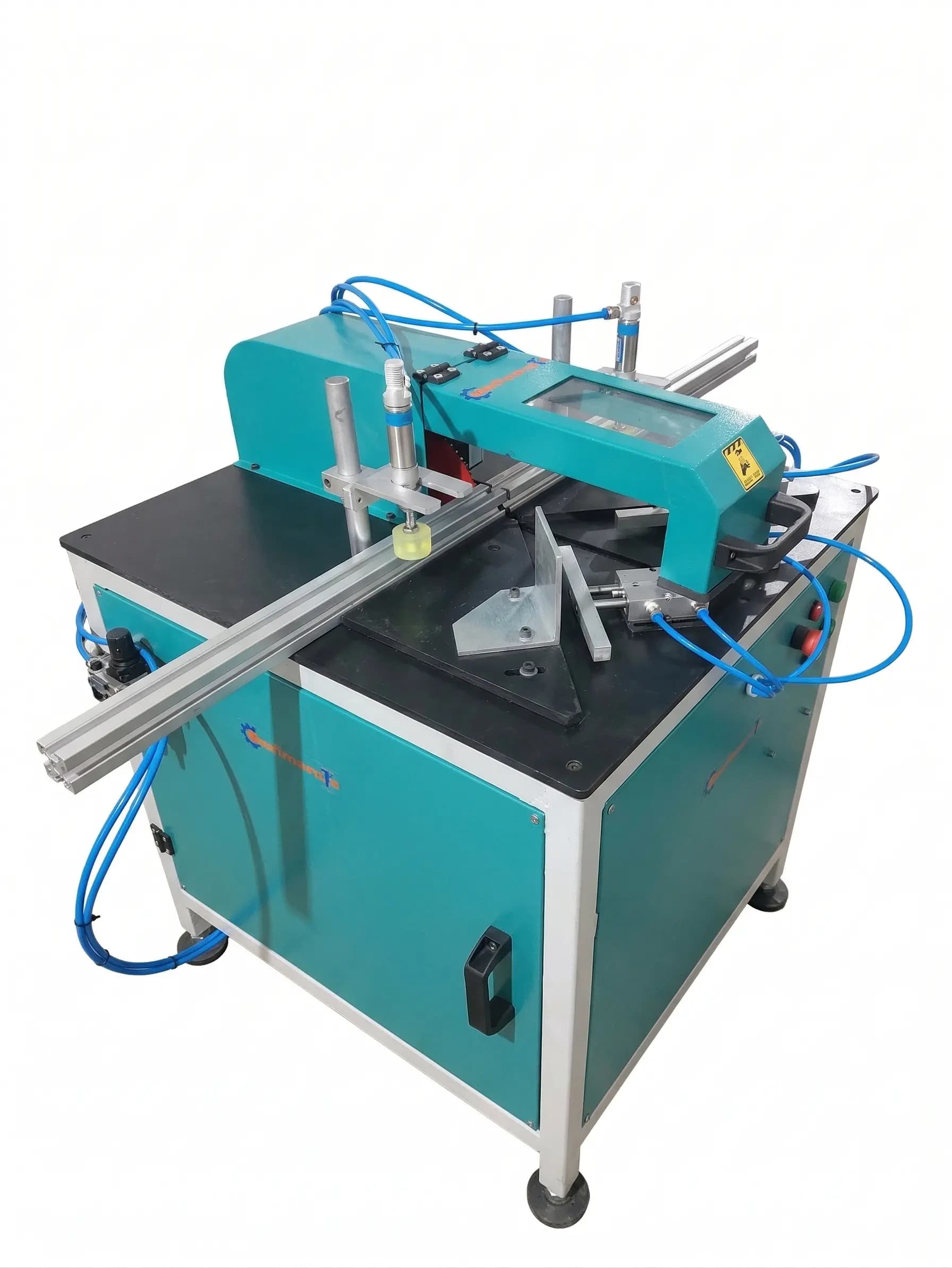
In our Mechnovate testing facility, we compared a 12-inch aluminium cutter machine against a 500mm automatic double head cutting saw for aluminium profiles. The results were stark. While the single-head manual unit struggled with heat dissipation during continuous 45-degree miter cuts on heavy-gauge profiles, the double-head system maintained 100% repeatability over an 8-hour shift. This is the precision level Hyderabad’s Grade-A developers now demand during pre-handover inspections.
Technical Deep Dive: Why Double Head Machines are Non-Negotiable
The engineering logic behind a double-head system involves more than just having two blades. It is about the synchronization of the moving head via high-precision linear guide rails and a digital display or CNC control system. Most upvc window manufacturing machinery units used in high-rises must handle varying profile depths without requiring frequent recalibration.
- Blade Diameter and RPM: For high-density profiles, a 450mm or 500mm carbide-tipped blade is essential. Lower RPM (2800-3200) with higher torque prevents the aluminum from 'gumming' the blade teeth.
- Hydro-Pneumatic Feed: This system ensures the blade advances at a constant rate regardless of the operator's fatigue. This consistency is what prevents the 'burr' that ruins high-end powder coating finishes.
- Clamping Pressure: Dual-axis pneumatic clamping (vertical and horizontal) is critical. Without it, profiles shift by fractions of a millimeter during the cut, leading to leaky corners in upvc window manufacturing machines.
The Hyderabad Case Study: Scaling From 40 to 120 Frames Daily
Last year, we assisted a fabricator in Cherlapally who was struggling to meet a 2,000-window order for a high-rise project near Kokapet. Their existing manual punching machine and single-head upvc window machine were producing only 35-40 frames per day with a 7% waste rate due to measurement errors. We replaced their setup with a CNC-integrated upvc windows making machine and a high-speed copy router machine.
The Transformation Metrics:
- Before: 40 frames/day | 7% waste | 3 manual operators for cutting.
- After: 124 frames/day | 1.2% waste | 1 operator using an automatic double head cutting machine.
- Timeline: Full ROI was achieved in 6.5 months by slashing labor costs and material scrap. This proves that while the initial aluminium cutting machine price is higher for automatic units, the long-term unit cost per window drops significantly.
Price Analysis: Automatic Double Head Cutting Machine Price India
When evaluating the upvc machine price list for 2024-25, you must distinguish between entry-level pneumatic units and full CNC systems. In the Indian market, particularly for fabricators looking for uPVC window machinery manufacturers in Chennai or Hyderabad, price points generally fall into three tiers:
- Basic Automatic (Pneumatic Tilt): ₹4,50,000 to ₹6,50,000. These are excellent for upvc windows manufacturers machine startups but lack the digital integration for ultra-fast scaling.
- Mid-Range (Digital Display/Servo Move): ₹7,00,000 to ₹9,50,000. This is the sweet spot for Hyderabad’s mid-sized fabricators. They include auto-feeding features and higher-precision linear bearings.
- High-End CNC Systems: ₹11,00,000 to ₹16,00,000+. These are fully integrated aluminum machinery manufacturers in ahmedabad style heavy-duty units that link directly to fabrication software (like LogiKal or Windowmaker).
Engineering Mistakes to Avoid in Large Scale Production
Having consulted on dozens of upvc window manufacturing unit setups, I often see the same three errors that lead to machine failure within 18 months:
- Inadequate Air Filtration: Hyderabad's dust can be brutal. If your upvc welding machine or cutting saw doesn't have a high-quality water separator and oiler in the pneumatic line, your solenoid valves will seize.
- Blade Overheating: Many fabricators skip the spray mist cooling system to save on oil costs. This is a mistake. Without cooling, the blade loses its temper, and the aluminium cutting machine 12 inch equivalent will begin producing rough edges that require manual deburring.
- Ignoring Foundation Stability: A degree cutting machine must be bolted to a reinforced concrete floor. Even a 2mm vibration at the base translates to a visible gap in the window miter.
FAQ: Critical Questions for Fabricators
Q: Can I use one machine for both uPVC and Aluminium profiles? Technically, yes, but only if the machine has a variable speed drive (VFD). Cutting uPVC with a high-speed aluminium blade can melt the profile, while cutting heavy aluminium with a standard upvc machinery blade will dull the teeth instantly. We recommend dedicated blades for each material.
Q: What is the power requirement for a double head cutting saw? Most industrial aluminum cutting machine units require a 3-phase 415V supply. A typical dual-motor setup consumes roughly 3.0kW to 4.5kW during peak cutting cycles.
Q: Is a CNC corner cleaning machine necessary if I have a double head saw? Yes. While the saw gives you the perfect 45-degree cut, the upvc windows manufacturing machine workflow requires a CNC upvc window corner cleaning machine price India consideration to ensure the weld bead is removed precisely without damaging the profile surface. For high-rise aesthetic standards, manual cleaning is rarely acceptable.
Get more articles like this
Follow Mechnovate on Google to see our guides in Google Discover & News