Double Head Cutting Machine Price in India: ROI Guide for Window Fabricators
A fabricator processing 25 aluminium window frames per day on a single-head cutter is surrendering more than 40 operator-hours every month at the cutting station alone. Whether a double-head machine recovers that time fast enough to justify its price is a straightforward calculation — and the answer depends on three numbers: your daily frame count, your electrical supply, and the price tier you are buying into.
What Separates a Double-Head Cutter from a Single-Head
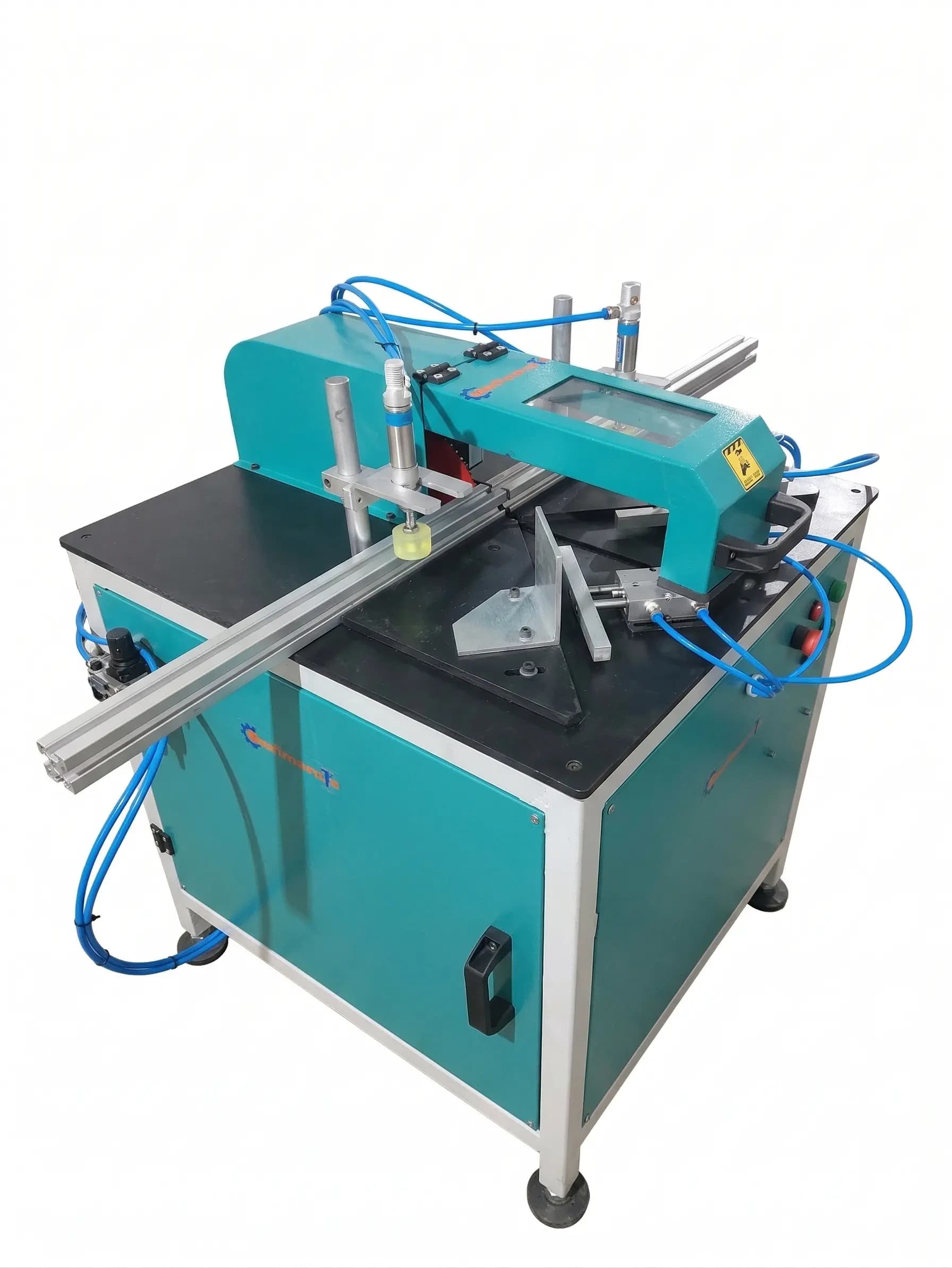
A double-head cutting machine (also called a double-head mitre saw) carries two saw blades mounted at opposing 45-degree angles on a single bed. Both ends of a profile member are cut simultaneously in one clamping operation. A single-head machine requires the operator to clamp, cut, release, reposition the profile, re-clamp, and cut again — two full operations per member, every time.
The engineering differences that matter most for daily production:
- Simultaneous dual cuts: Both 45-degree mitre cuts happen in a single stroke. This removes the repositioning step and eliminates the angle creep that accumulates when operators manually re-measure between cuts across a long shift.
- Digital length stop: Most double-head machines include a programmable digital stop that positions the profile at an exact length before every cut. No tape measure between pieces; the stop holds the dimension across the entire day's run.
- 3-phase power supply: The dual-motor configuration draws enough current to require 3-phase electrical supply (415V, 50 Hz). Single-head machines typically run on single-phase. Most GIDC and MIDC industrial estates carry 3-phase as standard; workshops in residential or mixed-use buildings may need a rotary phase converter, which adds ₹15,000–₹30,000 to the setup cost.
- Extended clamping bed: The longer bed accommodates profiles up to 6.5 metres without mid-profile flex — important for wide horizontal members in large casement or sliding window frames.
Consistent simultaneous cuts also mean that corner tolerances remain tight across the full day's output, not just the first few cuts when an operator is fresh. Corner joint accuracy directly affects the weatherproofing performance of the assembled frame.
Price Range and ROI for Indian Fabricators
What double-head machines cost in India
Double-head aluminium cutting machines span a wide price range depending on automation level:
- Entry-level with mechanical length stop: ₹1.5 lakh to ₹2 lakh. Both blades cut simultaneously, but the operator sets cut length manually using a mechanical stop rule.
- Mid-range with digital length stop: ₹2 lakh to ₹3 lakh. A programmable digital stop controls exact cut length across production runs. Suited for fabricators producing 20–60 frames per day.
- Fully automatic / CNC: ₹3 lakh to ₹4 lakh and above. Servo-driven length positioning, automatic profile feeding, and integration with digital cutting lists from window design software.
For fabricators producing fewer than 15 frames per day or setting up a first workshop, Mechnovate's 45/90 Degree Cutting Machine at ₹55,000 is the right entry point. The Cutting machine buying guide maps machine features to production volume in detail.
ROI calculation at 25 frames per day
A standard four-member aluminium frame requires eight mitre cuts. On a single-head cutter, each cut — clamping, cutting, repositioning — takes approximately one minute, with measuring time bringing the total to 8–10 minutes per frame. On a double-head cutter, clamping, simultaneous dual cut, and release takes approximately one minute per member: four members, four minutes per frame.
At 25 frames per day, saving 4 minutes per frame recovers 100 minutes of cutting time daily. On a ₹2 lakh mid-range machine, that translates as follows:
- Direct labour saving: 100 minutes at a blended operator cost of ₹300 per hour equals ₹500 recovered per day in direct labour.
- Monthly labour recovery: ₹500 × 26 working days = ₹13,000 per month, without producing a single extra frame.
- Throughput gain: A fabricator who converts just 4 minutes of freed daily time into one additional frame — at a net margin of ₹500 per frame — earns another ₹13,000 per month (₹500 × 26 days).
- Combined monthly recovery: ₹13,000 (labour) + ₹13,000 (one extra frame per day) = ₹26,000 per month.
- Payback period: ₹2,00,000 ÷ ₹26,000 = approximately 8 months. This is a conservative estimate — most fabricators running at 25 frames per day convert more than one incremental frame from the freed cutting time.
When a Single-Head Cutter Is the Right Call
A double-head machine is not the right investment for every operation. Before committing, work through these steps in order:
- Calculate your actual 30-day average: Count frames completed over the past month and divide by working days. If the result is consistently under 15 frames per day, a single-head cutter handles your output efficiently without the additional capital. The Single head vs double head cutter comparison covers the feature tradeoffs in detail.
- Confirm your electrical supply type: Check with your distribution company whether your meter is single-phase or 3-phase. This one step prevents the most common expensive surprise at installation.
- Measure your floor run: Allow at minimum 8 metres of clear space along the cutting axis — 4 metres infeed, 4 metres outfeed — before ordering a double-head machine. Many compact workshops cannot accommodate this without a layout reconfiguration.
- Check your order pipeline for consistency: If volume is project-based — strong for a few weeks, then slow — delay the investment until daily output is stable above 15–20 frames per day. ROI projections assume consistent daily utilisation.
- Add the true setup cost to your payback calculation: If 3-phase installation or a phase converter is needed, add ₹15,000–₹30,000 to the machine price before computing the break-even timeline.
FAQ
What daily frame volume justifies upgrading to a double-head cutting machine?
The break-even point sits at approximately 15 frames per day of sustained production. Below this, the cutting time saved each day does not recover a minimum ₹1.5 lakh investment within 12 months under typical Indian labour cost assumptions. Above 20 frames per day, payback falls within one financial year. At 25 frames per day, combining direct labour savings with even one incremental frame per day delivers recovery in approximately 8 months. Fabricators at 40 or more frames per day typically see payback within 5–6 months.
Do double-head cutting machines work with all aluminium section brands?
Yes, provided the clamping width and blade diameter are matched to the heaviest section you process. The profiles most commonly used by Indian window fabricators — Domal, Jindalinium, Dumal, Hindalco, and Alumil — are all compatible with standard double-head machines available in India. Always specify your widest and thickest section when requesting a quotation so the supplier can confirm blade diameter and clamping jaw specifications before delivery.
Is 3-phase power a firm requirement for double-head machines?
Yes, for all production-grade double-head cutting machines. The dual-motor and servo-driven length-stop configuration draws more current than single-phase supply can sustain. Fabricators outside GIDC or MIDC industrial estates can install a rotary phase converter at ₹15,000–₹30,000 additional cost, or apply for a 3-phase meter connection through their electricity distribution company. Confirm your supply type before placing a machine order.
What warranty does Mechnovate offer on cutting machines?
Mechnovate provides a 6-month warranty on all cutting machines, covering manufacturing defects in the cutting head assembly, motor, and clamping mechanism. Blades and wear parts are consumables and are excluded. Spare parts are stocked at the Ahmedabad facility and dispatched within 1–2 working days to Gujarat customers, 2–3 days to Maharashtra, Rajasthan, and Delhi NCR, and 3–5 days to South and East India. Reach the Mechnovate service team directly at +91-9265699061 for any warranty or parts queries.
Ready to Upgrade?
If your workshop is consistently processing 20 or more aluminium or uPVC frames per day and your cutting station is the production bottleneck, the ROI case for a double-head machine is clear. Mechnovate has supported 500+ fabricators across 20+ Indian cities in evaluating this exact decision — matching machine specifications to daily output, electrical supply, floor space, and profile brands including Domal, Jindalinium, Dumal, Hindalco, and Alumil.
Call +91-9265699061 or contact us to get a production assessment and machine recommendation tailored to your workshop before you invest.
Get more articles like this
Follow Mechnovate on Google to see our guides in Google Discover & News