Reducing Profile Wastage in Surat: Double Head Cutting Saws
The 8% Profit Leak in Surat's Commercial Fabrication Hub
Fabricators in Surat’s industrial clusters, from Ichchhapore to Sachin GIDC, are currently losing between 8% and 12% of their raw material margins specifically due to measurement inaccuracies and kerf loss from manual cutting. In a commercial project involving 10 metric tons of aluminium profile, a 10% wastage rate equates to 1,000kg of scrap. At current market rates for architectural grade aluminium in Gujarat, this is a direct hit to the bottom line that cannot be recovered through labor optimization alone. The transition to an Automatic Double Head Cutting Machine is no longer a luxury for Surat’s workshops; it is a mathematical necessity for survival in high-volume bidding.
Most workshops rely on a standard 12-inch manual aluminium cutter machine. While these are sufficient for small residential gates or partitions, they fail in commercial window fabrication where thermal break profiles and heavy-duty sections are used. Manual cutting introduces 'human-induced tolerance stack-up.' If a technician is off by just 0.5mm on a 45-degree miter cut, the resulting frame will have gaps that a Corner Crimping Machine cannot fix. We have audited several units in Ahmedabad and Surat where rework rates dropped by 70% simply by automating the primary cut.
Why the 12-Inch Manual Saw is Costing You Millions
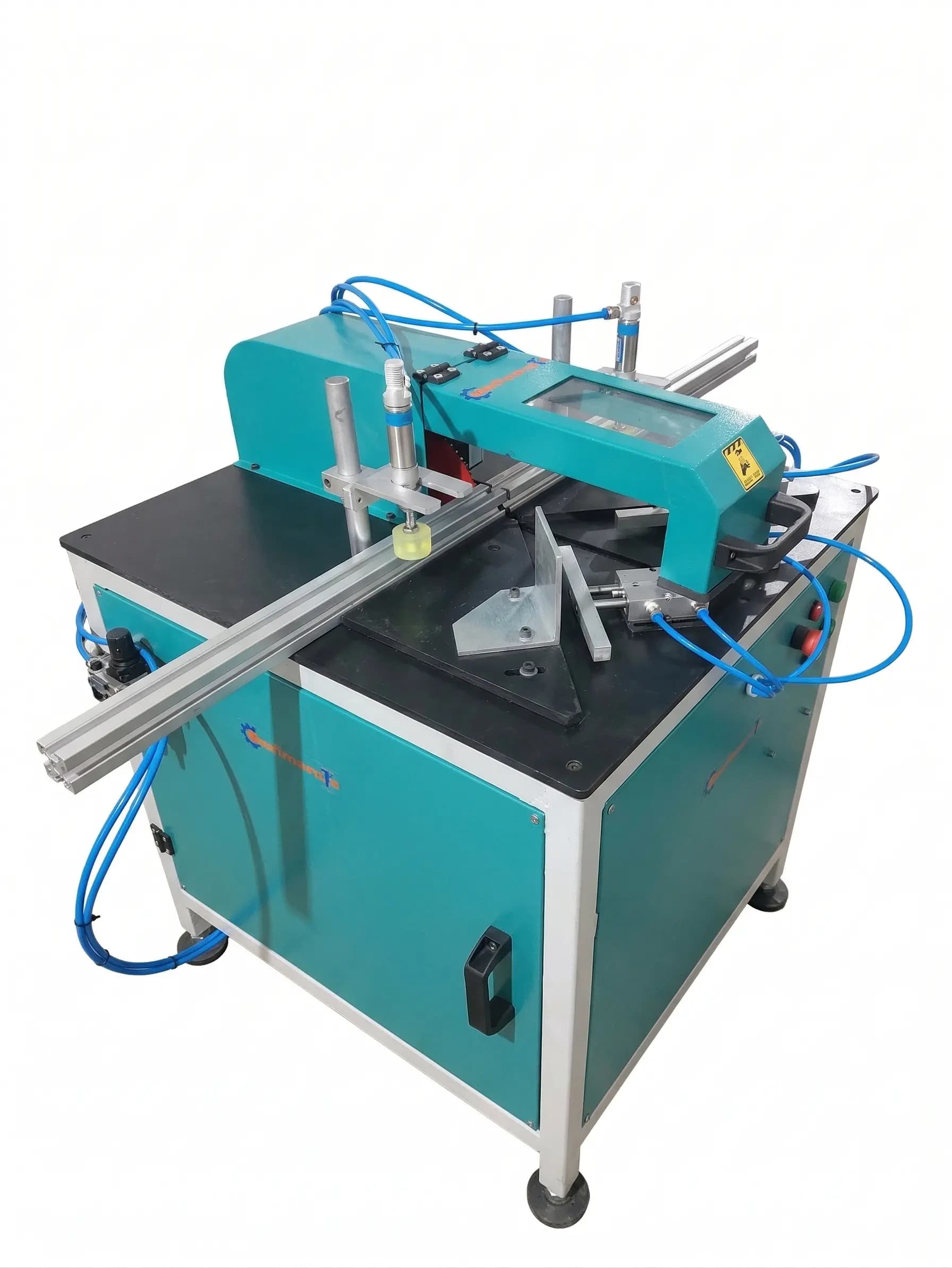
When we analyze the performance of a standard 12-inch manual cutting machine aluminium setup versus a professional-grade double head saw, the disparity in precision engineering becomes clear. A manual operator requires approximately 4 minutes to measure, mark, and execute two precision 45-degree cuts on a single profile. An automatic double head cutting saw for aluminium profiles completes this in under 45 seconds with 0.1mm repeatability.
Key technical limitations of manual setups include:
- Blade Deflection: Manual saws often use thinner 10 or 12-inch blades that vibrate at high RPM (above 2800), leading to a 'wavy' surface finish.
- Angular Inaccuracy: Locking a manual 45-degree miter is prone to 'creep' over a 10-hour shift, leading to inconsistent joints.
- Clamping Issues: Manual machines rarely have synchronized pneumatic clamping, causing the profile to shift slightly during the blade's entry.
By switching to a Heavy Duty End Milling Machine and an automatic cutting line, you ensure that every piece of the 6-meter stock length is utilized. Modern CNC-controlled saws calculate the optimal cutting pattern to minimize 'end-bits' or off-cuts, a process known in the industry as nesting optimization.
Technical Benchmarks: Precision Engineering for Commercial Grade Windows
For a shop aiming to supply high-rise projects in areas like Vesu or Adajan, the machinery must meet specific engineering standards. We recommend looking for the following specifications in an automatic upvc window manufacturing plant cost India calculation:
- Blade Diameter: Minimum 450mm to 500mm. This allows for cutting wide-chamber uPVC profiles and heavy aluminium sections in a single pass.
- Motor Power: At least 2.2kW per head to maintain constant torque when cutting through 3mm+ wall thickness profiles (IS 1285 standards).
- Pneumatic Feed: The blade feed should be air-oil dampened. Pure pneumatic feed is jerky; the oil buffer ensures a smooth stroke, which is critical for the longevity of carbide-tipped blades.
- Positional Accuracy: The moving head should travel on high-precision linear bearing rails, not just round shafts. This ensures the 45 degree double head cutting machine remains accurate for years.
In our testing facility, we compared a 12-inch aluminium cutter machine price entry-level model against a 500mm double head saw. The 500mm blade, running at a controlled 2800 RPM with a feed rate of 2 meters per minute, produced a surface roughness (Ra) value 4x lower than the manual saw. This level of finish is required for high-end powder coating and anodizing projects.
Case Study: Optimizing a 500-Unit Project in Vesu, Surat
Last year, a Mechnovate client in Surat secured a contract for a premium commercial complex requiring 500 units of DGU (Double Glazed Unit) windows. Initially, they estimated 14% wastage using their existing upvc windows making machine and manual cutters.
The Intervention: We replaced their manual line with an automatic double head cutting saw and a CNC uPVC window corner cleaning machine. We also calibrated their air pressure to a steady 7 bar using a dedicated refrigerated dryer system to prevent moisture in the pneumatic valves.
The Results:
- Wastage Reduction: Total profile waste dropped from 11.8% to 2.4%.
- Timeline: The project was completed 18 days ahead of schedule because the 'cutting and marking' phase was automated.
- Joint Quality: The air-tightness tests (as per BS EN 12020) passed on the first attempt because the 45-degree cuts were perfect, allowing the welding and crimping machines to create a hermetic seal.
This fabricator recovered the automatic double head cutting machine price India investment within just 8 months through material savings alone. For any upvc windows manufacturers machine buyer, this ROI calculation is the most important metric to track.
Engineering Checklist: Maximizing Tool Life and Cut Accuracy
To ensure your aluminium profile cutting machine maintains its precision, follow this engineering protocol developed over 15 years in the field:
- Blade Lubrication: Always use an air-oil mist cooling system. Cutting aluminium dry causes 'built-up edge' (BUE) on the teeth, which ruins the cut quality and leads to blade cracking.
- Profile Support: For 6-meter profiles, the mid-support rack must be perfectly level with the machine bed. A 2mm sag in the profile will result in an angled cut even if the machine is set perfectly.
- Electrical Stability: Most automatic machines in Gujarat industrial areas face voltage fluctuations. Use a 3-phase servo stabilizer to protect the PLC and electronic sensors.
- Chip Extraction: Aluminium chips are abrasive. Ensure your upvc window manufacturing machines are equipped with high-volume vacuum extractors to prevent chips from entering the linear guides.
Common mistake to avoid: Do not use a wood-cutting blade for aluminium. Aluminium blades have a negative rake angle to prevent the blade from 'grabbing' the soft metal. Using the wrong blade is the leading cause of workshop accidents and machine motor burnout.
Comparison Table: Manual vs. Automatic Performance
| Feature | Manual Single Head Cutter | Automatic Double Head Saw |
|---|---|---|
| Output (Frames/8hrs) | 25-30 Units | 120-150 Units |
| Accuracy Tolerance | +/- 1.5mm | +/- 0.1mm |
| Operator Skill Level | Highly Skilled Required | Semi-Skilled Operable |
| Safety Risk | High (Manual Guarding) | Low (Enclosed Cutting Zone) |
| Profile Wastage | 8-15% | 1-3% |
FAQ: What Fabricators Ask About Upgrading
Q: What is the average automatic double head cutting machine price in India for a startup? A: For a reliable, commercial-grade machine, prices typically range from ₹4.5 Lakhs to ₹9 Lakhs depending on the level of CNC automation and blade diameter. While cheaper imports exist, they often lack local service centers in Gujarat, leading to weeks of downtime.
Q: Can one machine handle both aluminium and uPVC profiles? A: Yes, but you must change the blade and adjust the RPM/feed rate. uPVC requires a different tooth geometry than aluminium. Many Surat fabricators use our upvc machinery for both by keeping a dedicated set of blades for each material.
Q: Is it difficult to train staff to use a CNC upvc window making machine? A: Not at all. Modern systems use touch-screen interfaces where the operator simply enters the length and angle. The machine handles the positioning and clamping. We provide full training at your Surat or Ahmedabad facility as part of the installation.
Q: How much space is required for a double head saw? A: You need a linear space of at least 5 meters for the machine itself, plus 6 meters on either side for profile loading and out-feed. A total length of 15-18 meters is ideal for a smooth workflow.
By investing in precision, Surat's fabricators can transition from small-scale workshops to industrial leaders capable of handling the largest commercial projects in Gujarat. The secret isn't just in the selling; it's in the cutting.
Get more articles like this
Follow Mechnovate on Google to see our guides in Google Discover & News