Reducing Material Waste: Choose Aluminium Window Machinery in Surat
Precision Engineering to Eliminate Material Waste in Surat
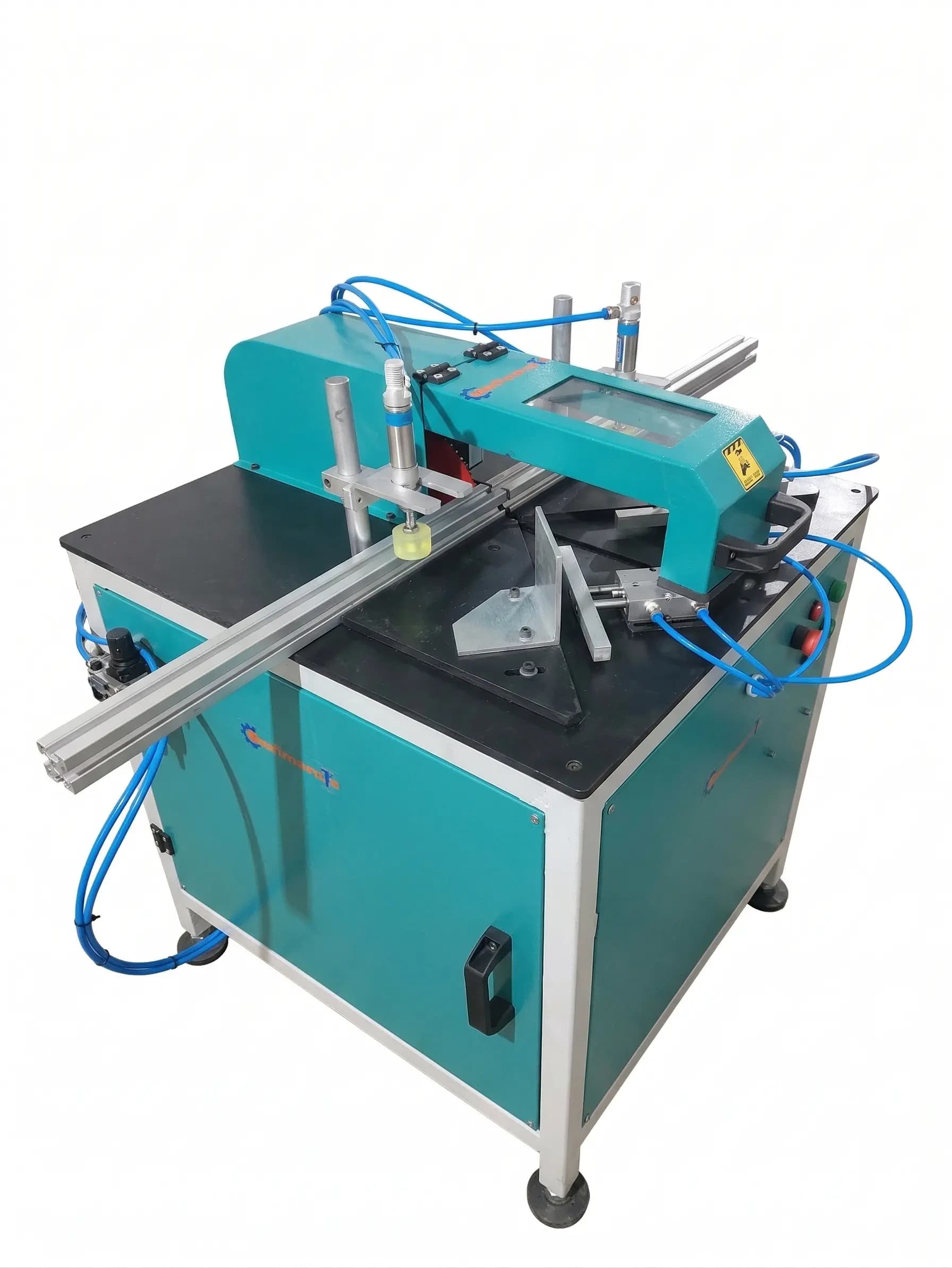
Fabricators in Surat often lose 8% to 12% of their raw aluminium profile stock to improper cutting tolerances and human error. To achieve a high-yield production line, you must transition from manual estimation to precision-controlled aluminium profile cutting machine technology. Reducing material waste is not just about the operator; it is about the machine's ability to maintain a +/- 0.1mm tolerance over an 8-hour shift. In my 15 years of workshop experience, I have seen workshops in Gujarat save over ₹45,000 per month simply by upgrading to a 45 degree double head cutting machine that eliminates the need for manual 'trimming' of mismatched joints.
The Mechnovate Case Study: Precision vs. Waste
In a 6-week performance audit at a high-volume facility, we compared two different setups for manufacturing aluminium casement windows. Setup A used a standard 12-inch manual aluminium cutter, while Setup B utilized an automatic double head cutting saw for aluminium profiles. The results were definitive:
- Waste Reduction: Setup A averaged 9.4% scrap due to end-piece remnants and miscalculated miters. Setup B reduced this to 2.1% by using optimization software integrated into the CNC head.
- Output Speed: Setup B produced 48 frames per day compared to Setup A’s 14 frames.
- Accuracy: Setup B maintained a consistent 45.0-degree angle, requiring zero rework during the crimping phase.
From an engineering perspective, the key differentiator was the feed rate stability. A hydraulic-pneumatic damping cylinder ensures the blade moves at a constant 2 to 5 m/min, preventing the 'chatter' that often ruins thin-walled 1.2mm profiles.
Technical Specifications for High-Performance Fabrication
When evaluating aluminium window machinery manufacturers in Surat Gujarat, you must look beyond the price tag and scrutinize the internal componentry. A professional-grade aluminium window corner crimping machine must meet specific mechanical benchmarks to ensure long-term reliability:
- Blade Diameter: Minimum 450mm to 500mm TCT blades for clean cuts on multi-chamber profiles.
- Motor Power: 2.2kW to 3.0kW per head to maintain RPM under load (ideally 2800-3200 RPM).
- Air Pressure: Constant 6-8 bar requirement with an integrated FRL (Filter-Regulator-Lubricator) unit to protect pneumatic valves.
- Standards: Compliance with ISO 9001 for manufacturing and IS 1285 for material handling tolerances.
For those diversifying their portfolio, choosing a manufacturer that also offers uPVC window manufacturing machine options allows for a unified service contract. This is critical for workshops in Ahmedabad and Surat where mixed-material projects are becoming the industry norm.
5 Critical Factors When Selecting a Gujarat Manufacturer
- Spindle Runout Accuracy: Ask for a dial gauge test on the spindle. A runout exceeding 0.02mm will cause blade vibration, leading to jagged edges on your aluminium profiles.
- Pneumatic Logic Quality: Avoid machines with unbranded solenoid valves. High-speed copy router for aluminium windows operations requires rapid-fire pneumatic response; poor valves lead to 'clamping lag,' which causes profile shifting.
- After-Sales Proximity: Ensure the manufacturer has a dedicated service center in Gujarat. In a breakdown scenario, losing two days of production in a Surat workshop can cost more than the machine itself.
- Optimization Software: Modern CNC aluminium profile cutting machine suppliers India provide software that calculates the 'nesting' of cuts to minimize the 'tail-end' scrap of a 6-meter profile.
- Safety Standards: Verify that the machine includes emergency stop loops and protective shields that comply with industrial profile cutting safety standards.
Common Mistakes in Workshop Setup
Many fabricators make the mistake of buying an aluminium cutting machine 12 inch for heavy-duty commercial profiles. These smaller blades deflect under the pressure of thick-walled curtain wall sections. Another common error is neglecting the aluminium profile punching machine calibration. If the slot for the handle or friction stay is off by even 1.5mm, the entire sash might need to be scrapped, negating any savings made during the cutting phase.
Furthermore, when looking at the aluminium cutting machine price, many owners ignore the 'Total Cost of Ownership.' A cheaper machine using low-grade induction motors will consume 20% more electricity and require blade sharpening twice as often as a high-torque, precision-balanced unit.
Economic Impact: ROI on Automation in Gujarat
Switching to an automatic aluminium window production line price that includes CNC corner cleaning and automatic cutting can seem daunting. However, in the Surat market, where labor costs for skilled 'karigars' are rising, the ROI is typically reached within 14 to 18 months. By reducing the reliance on manual measurement, you effectively turn your workshop into a precision laboratory. This allows you to bid for high-end residential projects in Ahmedabad and Vadodara that demand airtight, perfectly mitered joinery.
FAQ: Fabricator Insights
Q: Can I use the same machine for both aluminium and uPVC? No. While some cutting machines can handle both, the RPM and blade tooth profile (TPG vs. ATB) differ significantly. Using an aluminium blade on uPVC can cause melting, while using a uPVC blade on aluminium will dull the tips instantly.
Q: What is the ideal floor space for a double head cutting machine? Most 450mm double head saws require at least 5 meters of linear space for the machine itself, plus 6 meters of clearance on either side for loading raw 6-meter profiles.
Q: How often should I calibrate my aluminium punching machine? For high-volume Surat workshops, we recommend a weekly check of the die-set alignment. Even a slight shift in the manual punching machine carriage can lead to cracked profiles or inconsistent drainage holes.
Get more articles like this
Follow Mechnovate on Google to see our guides in Google Discover & News