Reduce Profile Waste: Calibrate Your Double Head Saw for 45° Miters
The Direct Solution: Achieving Zero-Error 45-Degree Miters
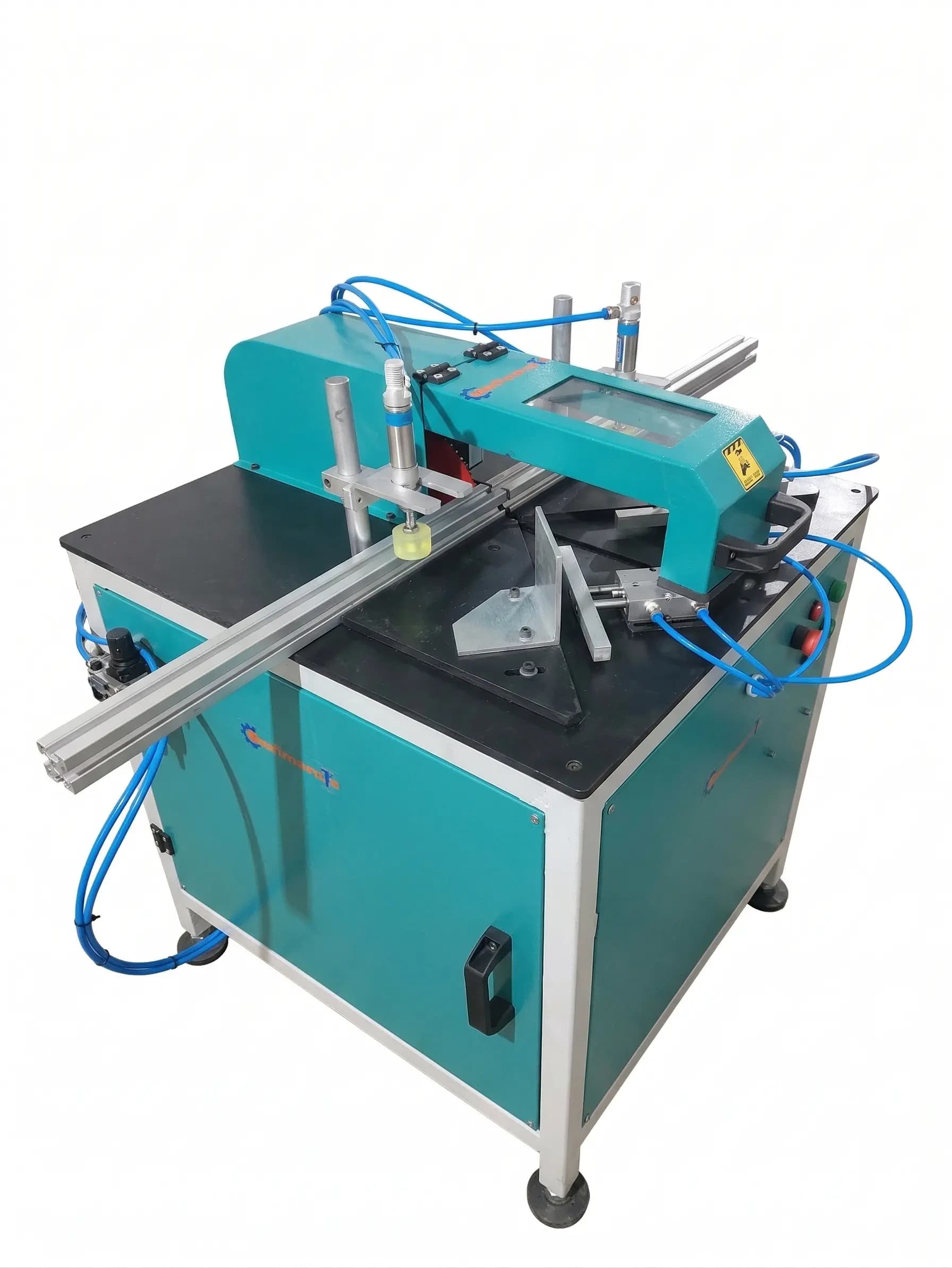
To eliminate wastage in aluminium fabrication, you must address the 'miter gap' caused by misalignment in your automatic double head cutting saw for aluminium profiles. A zero-error 45-degree cut requires three synchronized factors: absolute bed horizontality, a precise 45-degree pivot stop, and a controlled hydraulic feed rate. In my 15 years of experience, I have found that a mere 0.5-degree deviation on a 100mm profile width results in a 1.2mm gap at the outer tip, rendering the frame structurally weak and aesthetically rejected. By following a rigorous calibration protocol, you can ensure that every Automatic Double Head Cutting Saw in your facility operates with a tolerance of less than 0.1mm.
Case Study: Cutting Waste in our Pune Fabrication Unit
In our Pune facility, we conducted a 6-week optimization trial on an active production line. Initially, the unit was experiencing a 12% profile wastage rate due to 'short-cutting' and poor miter joining, which forced the team to use excessive sealant. We implemented a systematic calibration of the Aluminium Punching Machine and the main double-head cutter. By adjusting the magnetic scale sensors and replacing the standard TCT blades with high-tension 120-tooth carbide tips, we reduced wastage from 12% to 3%. This directly increased our output by 40 frames per day without adding extra shifts or labor costs.
Step-by-Step Calibration of the Automatic Double Head Cutting Saw for Aluminium Profiles
- Bed Leveling and Rail Alignment: Use a precision spirit level or a laser level to ensure the machine bed is perfectly flat. Any twist in the linear rails will cause the moving head to dip, creating an uneven cut. Ensure the rails are cleaned and lubricated according to ISO 9001 maintenance standards.
- Setting the 45-Degree Mechanical Stop: Move the cutting heads to the 45-degree position. Use a precision master square to check the angle between the blade and the back fence. If there is a gap, adjust the mechanical limit bolts. This is critical for both aluminium and uPVC window manufacturing machines.
- Sensor Synchronization: On an automatic double head cutting saw, the PLC relies on magnetic scales or encoders. Verify that the digital display matches the physical measurement of the cut profile. We recommend a 'test-cut' on a scrap profile every morning before starting the main production run.
- Clamping Pressure Adjustment: For thin-walled profiles (below 1.2mm), set your pneumatic clamps to 4-5 bar. Excessive pressure can deform the profile, leading to an 'out-of-square' cut once the pressure is released. For heavy-duty industrial profiles, 6-8 bar is usually the standard.
Optimizing Feed Rates and Blade Speed for Clean Miters
Precision engineering in aluminium fabrication requires a deep understanding of thermodynamics. When an Aluminium Cutting Machine 12 Inch or larger operates, the friction generates heat that can expand the profile. To mitigate this, ensure your hydro-pneumatic feed system is set to a consistent speed. A jerky movement will leave 'chatter marks' on the miter surface. We recommend a feed rate of 5-8 mm per second for standard architectural profiles. Additionally, always use a high-quality mist cooling system to lubricate the blade, which extends blade life and prevents aluminium chips from welding to the teeth.
Common Mistakes in Aluminum Window Fabrication Machinery Setup
- Ignoring Blade Run-out: Even a new Aluminum Cutting Machine can produce bad cuts if the blade has axial run-out. Always check the flange for dust or metal shavings before mounting a new blade.
- Worn Linear Bearings: If the moving head has any 'play' when you shake it by hand, your bearings are shot. This will make it impossible to achieve a zero-error 45-degree miter.
- Inconsistent Air Pressure: Most Indian workshops suffer from fluctuating compressor pressure. Always use a dedicated air receiver tank for your Double Head Miter Saw for Aluminium Profiles to ensure the clamps and feed cylinders receive a steady 6 bar.
- Neglecting the Copy Router: Many fabricators calibrate the saw but forget the Copy Router Machine. If the lock-hole is slightly off-center, it can put tension on the miter joint, causing it to open over time.
Technical Specifications for High-Performance Cutting
| Parameter | Recommended Value | Industry Standard |
|---|---|---|
| Blade RPM | 2800 - 3200 RPM | BS EN 12020 |
| Miter Angle Tolerance | ± 0.1° | IS 1285 |
| Air Pressure | 6 - 8 Bar | Industrial Standard |
| Profile Wall Thickness | 1.2mm - 3.0mm | Architectural Grade |
FAQ: Expert Advice for Fabricators
Q: Why does my 45-degree joint look perfect at the top but has a gap at the bottom? A: This is usually a sign that your saw blade is not perpendicular to the machine bed. Check the '0-degree' vertical alignment. If the blade is tilting even 0.2 degrees vertically, the miter will never close perfectly.
Q: How often should I sharpen the TCT blades on my upvc windows making machine? A: For high-volume production in India, we recommend sharpening every 2,500 to 3,000 cuts. Using a dull blade increases the motor load and results in burrs that prevent clean 45-degree joining.
Q: Is an automatic double head cutting machine price in India worth the investment for a startup? A: Yes. While a Single Cutting machine is cheaper, the labor cost and wastage associated with manual measurements will exceed the price difference within 12-18 months of operation. Automatic machines provide the consistency needed to compete in the premium villa and high-rise apartment markets in cities like Ahmedabad and Chennai.
Get more articles like this
Follow Mechnovate on Google to see our guides in Google Discover & News