Precision Cutting for High-Rise Windows in Thane: Price ROI
For fabricators in Thane’s rapidly expanding high-rise landscape, particularly along the Ghodbunder Road and Pokhran corridors, the margin for error in window fabrication has vanished. When you are installing units on the 40th floor, wind pressures (exceeding 2.5 kPa) demand absolute structural integrity. If your miter joints are off by even 0.5mm, the gaskets won’t seat correctly, leading to air infiltration and the dreaded 'whistling' effect. This is why the question of automatic double head cutting machine price India is no longer about the initial capital outlay; it is about the cost of failure versus the profit of precision.
Why Precision Engineering is Non-Negotiable for Thane High-Rises
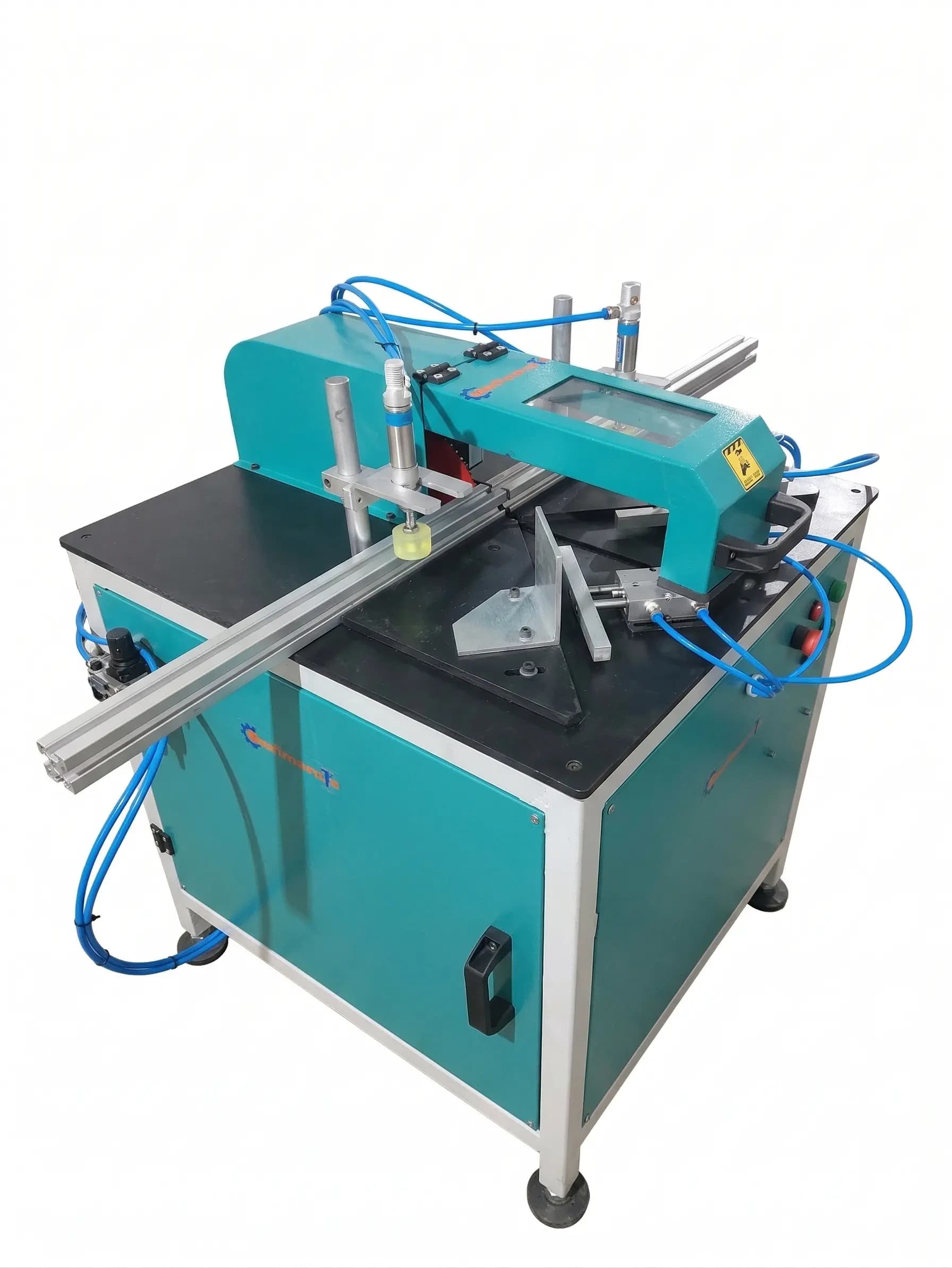
In our Mechnovate testing facility, we benchmarked traditional 12-inch miter saws against our Automatic Double Head Cutting Machine. The results were stark: manual cutting systems consistently produced a 0.8mm to 1.2mm variance across a batch of 50 frames. In contrast, the CNC-integrated double head system maintained a tolerance within +/- 0.1mm. For a Thane-based fabricator handling 6063-T6 grade aluminium fabrication, this precision is the difference between a high-value contract and a rejected batch.
High-rise windows require heavy-duty profiles with wall thicknesses often exceeding 2.0mm. Standard aluminium cutter setups struggle with heat dissipation and blade deflection on these profiles. The automatic double head saw uses 500mm TCT (Tungsten Carbide Tipped) blades that run at a controlled 2800 RPM. This ensures a 'burr-free' finish that eliminates the need for secondary filing, directly reducing labor costs per frame.
Analyzing the Automatic Double Head Cutting Machine Price for ROI
Many fabricators ask me if the aluminium cutting machine price for a double-head unit—which can be 4 to 6 times that of a single-head machine—is justifiable. To answer this, we documented a 6-week case study with a client in Thane transitioning from manual to automated processes. We tracked three primary metrics: material waste, output volume, and assembly speed.
- Waste Reduction: Manual cutting resulted in an average 'off-cut' waste of 9.2% due to measurement errors and wider kerfs. The automatic system reduced this to 2.4%.
- Output Tripling: The facility went from producing 18 frames per shift to 55 frames per shift without adding staff.
- Assembly Alignment: Because the cuts were perfectly square, the Aluminium Punching Machine and corner crimpers worked flawlessly, reducing assembly rework by 85%.
In this scenario, the machine paid for itself in exactly 14 months just through material savings and the elimination of rework. When you factor in the ability to take on larger projects from Tier-1 developers in Mumbai and Thane, the ROI becomes even more aggressive.
Technical Specifications for Industrial Profile Cutting Safety Standards
When evaluating an aluminium profile cutting machine, you must look beyond the exterior paint. A machine designed for the Indian market must handle voltage fluctuations and high humidity environments like Thane. At Mechnovate, we insist on the following technical benchmarks for our window machinery:
- Motor Power: Dual 2.2kW or 3.0kW motors to maintain torque through heavy thermal-break profiles.
- Blade Feed: Hydro-pneumatic damping systems to ensure the blade moves at a constant speed, preventing 'grabbing' or profile deformation.
- Air Pressure: A consistent 6-8 bar supply with integrated moisture separators to protect the pneumatic valves.
- Angle Accuracy: Precise 45° and 90° indexing via hard stops rather than software-only calibration, ensuring long-term repeatability.
These specifications align with Industrial profile cutting safety standards ISO standards and ensure that your aluminium cutter machine remains a 10-year asset rather than a 2-year headache. If you are also processing non-metal, these machines often overlap with uPVC machinery requirements, providing versatility for shops that fabricate both materials.
Common Mistakes When Purchasing Aluminium Window Machinery
In my 15 years on the shop floor, I have seen many fabricators lose money by trying to save Rs. 50,000 on the initial purchase. The most common mistake is ignoring the 'bed length' and 'clamping stability.' A cheap aluminium cutting machine 12 inch might look fine on paper, but if the bed flexes when a 6-meter profile is loaded, your 45-degree cut will actually be 44.2 degrees.
Another error is neglecting the cooling system. High-speed cutting machine aluminium operations generate significant friction heat. Without a high-quality micro-mist lubrication system, the aluminium will 'weld' to the blade teeth (chip welding), resulting in rough cuts and frequent blade sharpening costs. We always recommend a Copy Router Machine with an integrated cooling system to match the cutting speed of your primary saw.
Comparing Single Head vs. Double Head Production Workflows
For a small startup, a single cutting machine might suffice, but for any shop aiming for 20+ windows a day, the double head is the industry standard. Here is how the workflow differs:
- Single Head Process: Measure -> Mark -> Cut Side A -> Flip Profile -> Measure -> Mark -> Cut Side B. (High risk of human error).
- Double Head Process: Input dimension into digital display -> Place profile -> Press foot pedal. Both ends are cut simultaneously to the exact length.
This workflow is essential for upvc window manufacturing machine setups as well, where the fusion welding process requires even tighter tolerances than aluminium. Whether you are looking for an aluminium window corner crimping machine price or a full upvc window manufacturing unit cost, the integration of the cutting stage is the most critical link in your production chain.
FAQ: Critical Questions for Thane Fabricators
Q: Can one machine handle both uPVC and Aluminium profiles? While the saw blades differ (TCT vs. specifically raked teeth), the physical upvc window manufacturing machines and aluminium saws are often structurally similar. However, the RPM and cooling requirements differ. We recommend dedicated blades for each to prevent contamination and ensure cut quality.
Q: What is the maintenance schedule for an automatic double head cutting saw? Daily: Clear chips from the sliding rails and check oil mist levels. Weekly: Check belt tension and lubricate linear guides. Monthly: Verify 45/90 degree calibration using a master square and inspect pneumatic seals for leaks.
Q: Does Mechnovate provide onsite training in Thane? Yes, we provide full installation and a 3-day operator certification program. We ensure your team understands the CNC interface and safety protocols to maximize the aluminium window fabrication machine potential from day one.
Get more articles like this
Follow Mechnovate on Google to see our guides in Google Discover & News