Optimizing Mumbai Workshops: Double Head Cutting Saw Analysis
The Mumbai Fabricator’s Dilemma: Speed vs. Square Footage
In Mumbai's space-constrained industrial zones like Sakinaka, Goregaon, and Vasai, the cost of floor space often exceeds the cost of machinery. If you are operating a 500–800 sq. ft. unit, every square inch must generate maximum revenue. For years, the default setup has been the manual 12-inch aluminium cutter machine, but as demand for high-precision thermal break windows and slim-profile sliding systems rises, these manual setups fail on three fronts: precision, speed, and material wastage. Transitioning to an Automatic Double Head Cutting Saw is no longer a luxury for growing firms; it is a tactical necessity to maintain margins.
Our data from 15+ years in the field shows that an automated setup can recover its capital expenditure within 14 to 18 months solely through scrap reduction and labor optimization. In a recent pilot study we conducted in a Mumbai-based facility, switching from a single-head manual saw to a 45-degree double head cutting machine reduced cutting waste from 12% to under 3%. This was achieved by eliminating the 'trial-and-error' cuts often required with manual degree setting. When you are processing high-value 6063-T6 aluminium or multi-chamber uPVC profiles, a 9% savings in raw material directly impacts your bottom line.
Case Study: Throughput Gains in a 750 sq. ft. Andheri Workshop
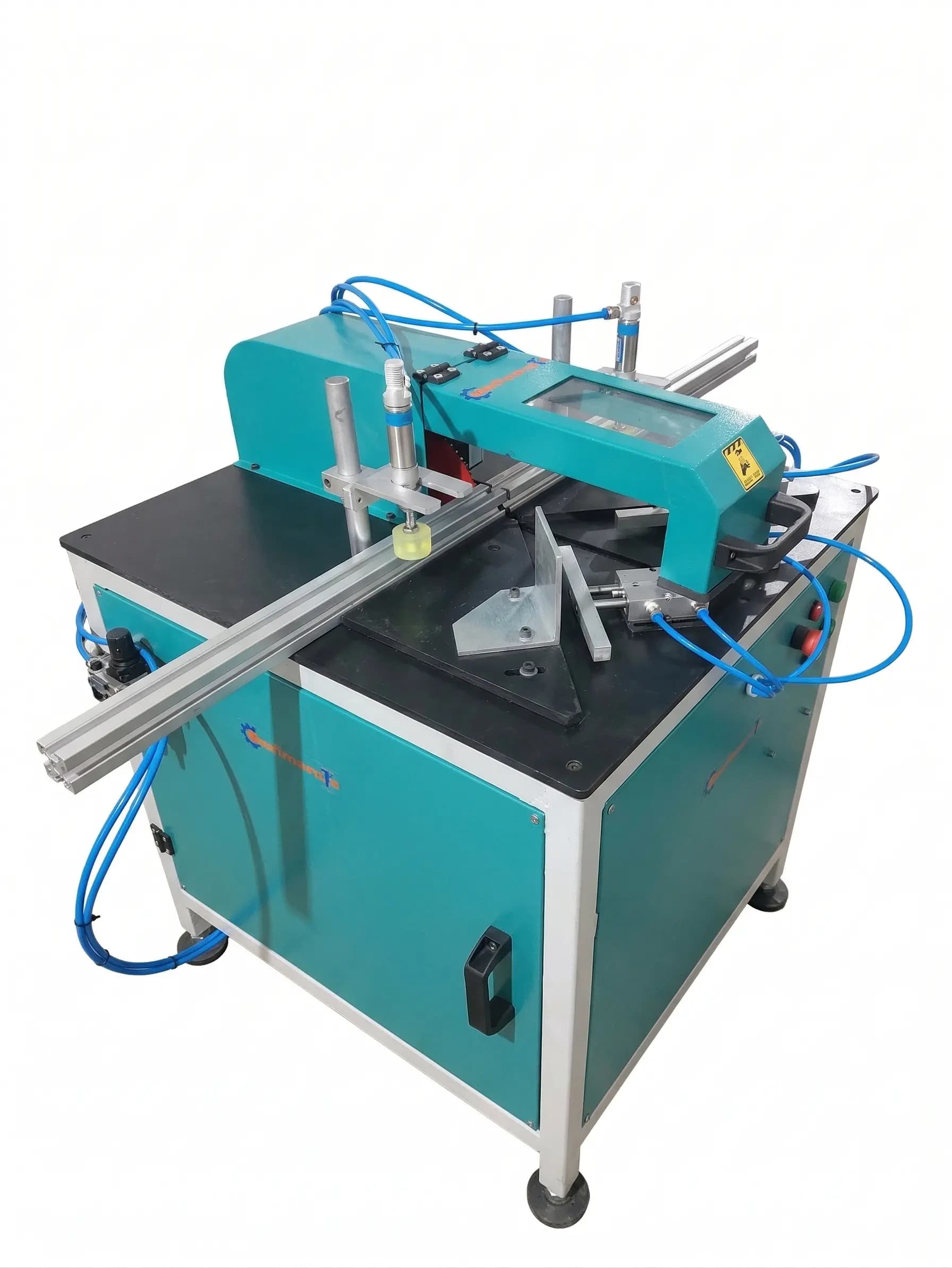
In early 2023, we assisted an aluminium fabrication unit in Andheri that was struggling to meet a 200-window-per-week deadline for a redevelopment project. They were using three manual 12-inch aluminium cutting machines. The floor was cluttered with work-in-progress (WIP) frames waiting for second-end cuts. We replaced two manual stations with one Automatic Double Head Cutting Saw and integrated a Copy Router Machine for hardware slotting.
The Results:
- Output: Daily frame output increased from 18 units to 44 units with the same headcount.
- Accuracy: Rejection rates due to miter gaps dropped from 7% to zero, meeting BS EN 12020 standards for profile tolerances.
- Floor Space: Freed up 120 sq. ft. by eliminating two workbenches, allowing for a dedicated assembly and glazing area.
Technical Mastery: Engineering the Perfect Cut
To achieve precision engineering in aluminium fabrication, you must look beyond the motor’s horsepower. A high-quality aluminium cutting machine must manage three critical variables: blade stability, pneumatic clamping, and cooling. In our machines, we utilize 450mm to 500mm carbide-tipped blades that rotate at 2800 RPM. This speed, paired with a hydraulic-dampened pneumatic feed, ensures that the blade doesn't 'climb' the material, which is a common cause of dimensional error in lighter uPVC machinery.
For Mumbai’s high-humidity environment, we recommend machines with IP54-rated electronics and chrome-plated guide rails. Salt-laden air in coastal regions can lead to rapid oxidation on standard steel rails, causing the cutting heads to judder. Our double head miter saw for aluminium profiles price includes these maritime-grade enhancements, ensuring the +/- 0.1mm tolerance is maintained for years, not just months. We also integrate a double-hand safety operation system that adheres to industrial profile cutting safety standards ISO standards, preventing common workshop injuries during high-speed production cycles.
Cost-Benefit Analysis: The ROI of Automation
When evaluating the aluminium cutting machine price or the cost of setting up uPVC window manufacturing unit in India, owners often look at the sticker price rather than the Total Cost of Ownership (TCO). Let’s break down the economics for a standard automatic double head cutting machine price India:
- Labor Efficiency: A manual aluminium cutter requires two operators for long profiles to maintain support. An automatic double head saw requires one operator to load and press 'Start'. Savings: Approximately ₹3.6 Lakhs per year in Mumbai wages.
- Material Yield: By cutting both ends simultaneously with digital precision, you eliminate the 5-10mm 'safety margin' workers usually leave on manual cuts. On a ₹20 Lakh annual aluminium spend, a 5% yield improvement saves ₹1 Lakh.
- Downstream Benefits: Perfectly mitered corners mean the Aluminium Profile Punching Machine and corner crimpers perform better. There is no need for manual filing or gap-filling with silicone, which speeds up the final installation on-site.
Common Pitfalls in Workshop Upgrades
Through our decades of experience, we have seen fabricators make the same three mistakes when upgrading their window machinery:
- Underpowering the Compressor: An automatic double head cutting saw for aluminium profiles requires a stable 7-8 bar pressure with a high flow rate. If your compressor is undersized, the pneumatic clamps will lose grip during the cut, ruining the profile and potentially the blade.
- Ignoring the Dust Extraction: Aluminium chips are abrasive and conductive. Without a dedicated high-volume extractor, chips enter the electrical cabinet, causing short circuits. Always include an extractor in your upvc window manufacturing machine price list.
- Poor Calibration Training: A machine is only as good as its calibration. We provide 3 days of on-site training to ensure your team understands how to adjust the miter angle precisely using a master square, rather than relying on the digital readout alone.
Optimizing the Production Line Flow
In a compact Mumbai workshop, the layout should follow a linear 'U-shape'. The profile enters from the rack, goes to the Automatic Double Head Cutting Saw, moves to the Heavy Duty End Milling Machine for mullion preparation, and then to the punching and assembly stations. This prevents 'cross-traffic' which is the primary cause of accidents and scratches on powder-coated surfaces.
If you are a startup business, consider a portable uPVC window making machine price list for initial low-volume work, but always leave space for a double head unit. The transition from manual punching to a manual punching machine to an automatic corner crimping machine is the natural progression as your volume exceeds 30 windows a day.
FAQ: Fabricator Concerns
Q1: Can a double head saw handle thermal break aluminium? Yes, provided you use a blade with the correct tooth geometry (Triple Chip Grind) and a high-quality cooling spray system. Thermal break profiles have different densities across the section, requiring a consistent feed rate to prevent melting the polyamide strip.
Q2: What is the maintenance cycle for a CNC aluminium profile cutting machine? Daily: Clear chips and check lubrication levels. Weekly: Inspect pneumatic filter-regulator-lubricator (FRL) units for moisture. Monthly: Calibrate miter angles and check belt tension. Every 3,000 cuts: Inspect the blade for dullness.
Q3: Is it worth buying a used upvc windows manufacturing machine? Rarely. The cost of replacing worn linear bearings and pneumatic valves, combined with the lack of warranty, often exceeds the savings. For a small business, it is better to invest in a new, mid-range automatic aluminium window production line price that comes with service support.
Get more articles like this
Follow Mechnovate on Google to see our guides in Google Discover & News