Optimizing Hardware Precision for Hyderabad IT Corridor Projects
Engineering Precision for Hyderabad High-Rise Projects
High-precision hardware installation in the Hyderabad IT corridor requires more than just standard tools; it demands industrial-grade accuracy to meet the wind load and structural requirements of 20+ story buildings. For projects in Hitech City and Gachibowli, the margin for error in aluminum fabrication is effectively zero. A high-speed copy router machine is the essential component that bridges the gap between raw extrusion and a high-performance window system. This equipment ensures that lock cases, handle holes, and water slots are milled with sub-millimeter precision, maintaining the structural integrity of the profile.
In our experience across India, we have seen that manual routing often leads to micro-cracks in the 6063-T6 aluminum alloy profiles used in high-rise glazing. When working with profile thicknesses of 1.5mm to 3.0mm, the thermal dissipation during the milling process is critical. A high-frequency motor running at 12,000 RPM to 18,000 RPM allows for a 'clean' cut, preventing the metal from galling or warping. This level of precision engineering is what distinguishes top-tier fabricators from local workshops.
The Role of High-Speed Copy Routing in Modern Fabrication
The copy router machine functions as the brain of the hardware installation process. By using a 1:1 ratio template, the machine replicates complex milling patterns for multi-point locks and friction stays across hundreds of identical units. This consistency is vital for the massive commercial contracts typical of the Hyderabad IT corridor. Without this, the time spent on manual adjustments during site installation can erode your profit margins by up to 25%.
Technical Specifications for Industrial Output:
- Spindle Speed: Minimum 12,000 RPM to ensure smooth finishes on aluminum and uPVC profiles.
- Clamping System: Triple pneumatic horizontal and vertical clamps to eliminate vibration.
- Profile Capacity: Ability to handle 120mm x 100mm sections for heavy-duty commercial frames.
- Cooling: Mist spray lubrication systems are mandatory for aluminum to extend bit life and prevent melting.
Case Study: Achieving 97% Material Yield in Gachibowli
During a recent 18-month project for a major IT park in Gachibowli, our team assisted a local fabricator who was struggling with a 12% waste rate. Their initial setup relied on outdated manual punching machines which caused frequent profile deformation. We integrated a high-speed automatic double head cutting machine alongside a dual-axis copy router. This transition allowed them to process 60 frames per day compared to their previous average of 35.
By switching to precision-guided routing, the rejection rate for misaligned lock-holes dropped from 8% to under 0.5%. The measurable result was a cost saving of roughly ₹1.2 Lakhs per month on raw material alone. This efficiency is critical when calculating the aluminium cutting machine price against long-term ROI. Furthermore, using standardized templates ensured that every unit met BS EN 12020 standards for dimensional tolerances.
Avoiding Common Pitfalls in Aluminum Fabrication
One common mistake we observe in workshops from Ahmedabad to Chennai is the use of incorrect router bits. Using a bit designed for wood on an aluminum profile will cause excessive heat buildup and rapid tool wear. Always use single-flute HSS or Carbide bits specifically designed for non-ferrous metals. Additionally, many fabricators fail to maintain constant air pressure; a dip below 6 bar can cause the pneumatic clamps to loosen, resulting in a ruined profile.
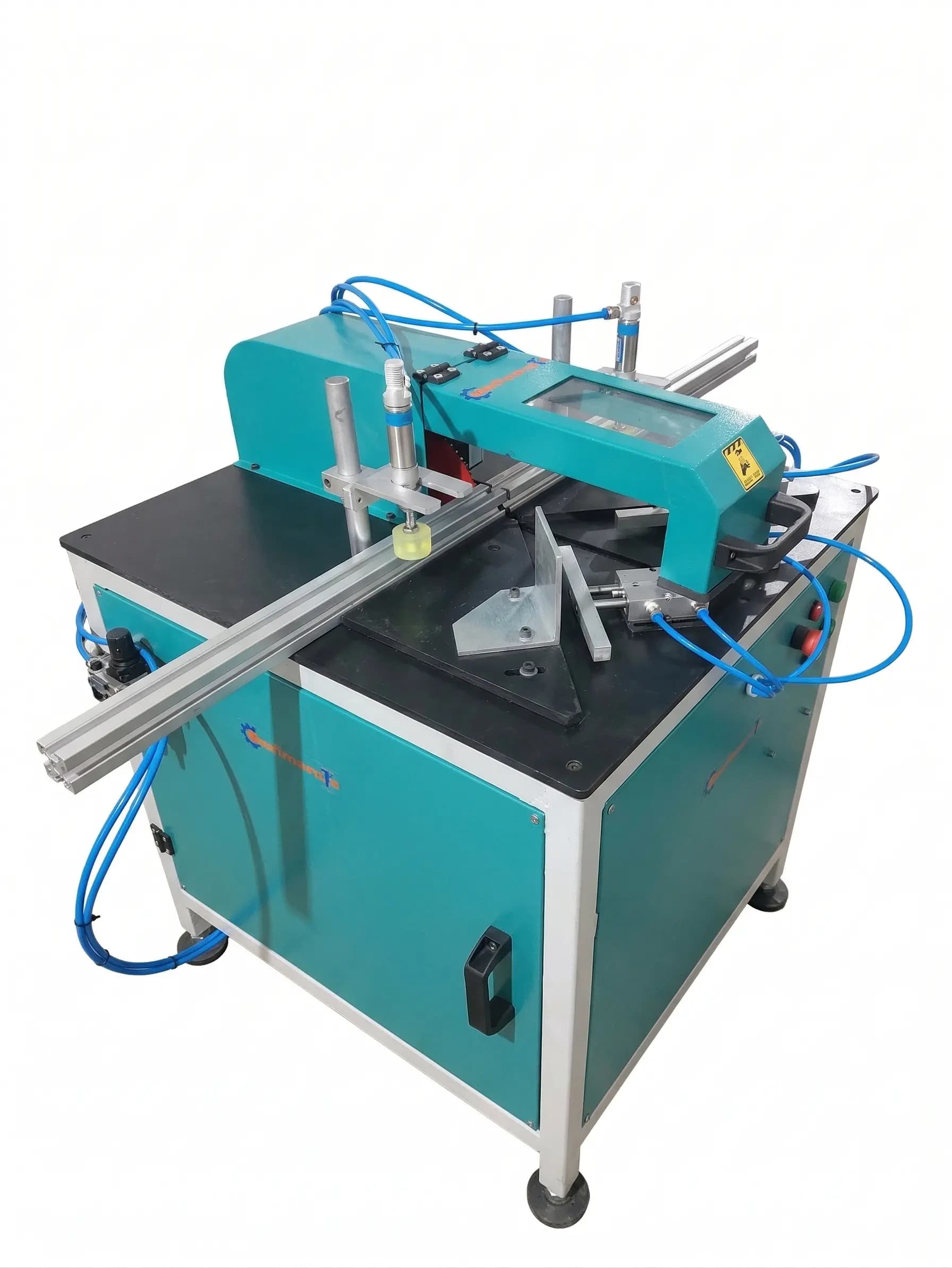
Another critical error is neglecting the calibration of the 45-degree degree cutting machine. Even a 0.5-degree deviation in the miter cut will prevent the corners from closing perfectly, even if your corner crimping is perfect. In the high-humidity environment of Hyderabad during the monsoon, poorly sealed joints lead to water ingress, which is the number one cause of warranty claims in the IT corridor.
Strategic Maintenance Checklist:
- Weekly: Check the lubrication levels in the mist spray unit to ensure the router bit stays cool.
- Monthly: Inspect the copy template for wear; even a 1mm deviation on the template will be magnified on the workpiece.
- Quarterly: Deep-clean the sliding rails of your upvc window manufacturing machines to prevent debris buildup from scratching profiles.
- Semi-Annually: Verify the spindle run-out using a dial indicator to ensure it remains within the 0.02mm tolerance.
Building a Scalable uPVC and Aluminum Production Line
For those looking to enter the Hyderabad market, the cost of setting up a uPVC window manufacturing unit in India varies widely based on automation levels. While a manual punching machine might suffice for small residential projects, high-volume commercial work demands a semi-automatic or fully automatic line. Integrating an aluminium punching machine for multi-hole drainage and handle slots can significantly reduce the load on your copy router.
As a leading uPVC machinery manufacturer, we recommend starting with a balanced line: a high-precision double head cutter, a copy router, and a single-head welding machine for uPVC. This setup allows for a scalable production capacity that can grow as you secure larger contracts in the IT corridor. Remember that the aluminium profile cutting machine is the start of your quality chain; if the cut is not square, every subsequent process will suffer.
Frequently Asked Questions (FAQ)
What is the difference between a copy router and a CNC machine for aluminum?
A copy router uses a physical template to guide the milling tool, making it cost-effective for high-volume standard designs. A CNC machine is programmable and better for varied, bespoke designs but comes at a significantly higher initial investment.
Can I use the same copy router for uPVC and aluminum?
Yes, but you must adjust the spindle speed and the cooling system. Aluminum requires lubrication (mist spray) and higher torque, while uPVC can often be milled dry but requires effective dust extraction to prevent clogs.
Why is my copy router bit breaking frequently?
This is usually caused by either excessive feed speed, lack of lubrication, or using a bit with too many flutes. For aluminum, a single-flute bit is recommended to allow for efficient chip evacuation, which prevents the bit from 'binding' and snapping.
Get more articles like this
Follow Mechnovate on Google to see our guides in Google Discover & News