Miter Inconsistency Solution: 2024 Double Head Cutting Machine ROI
For a precision-driven Pune fabricator, an automatic double head cutting machine price in India ranges from ₹4,50,000 for entry-level pneumatic units to over ₹12,00,000 for high-end CNC variants. Miter gaps and light leaks in aluminium or uPVC profiles are rarely the result of operator error; they are engineering failures caused by pivot-point flex, blade run-out, and inconsistent pneumatic clamping pressure. This guide breaks down the technical root causes of miter inconsistency and provides a concrete ROI framework for scaling your workshop.
The Engineering Root of Miter Inconsistency
In my 15 years on the shop floor, I have seen hundreds of fabricators struggle with the 'daylight gap' in their corners. When using a standard aluminium cutting machine 12 inch or manual saws, the blade often deflects as it enters the profile. This deflection occurs because the motor spindle or the pivot bearing has a tolerance exceeding 0.15mm. In high-volume aluminium fabrication, even a 0.5-degree deviation leads to a 2mm gap on a large window frame.
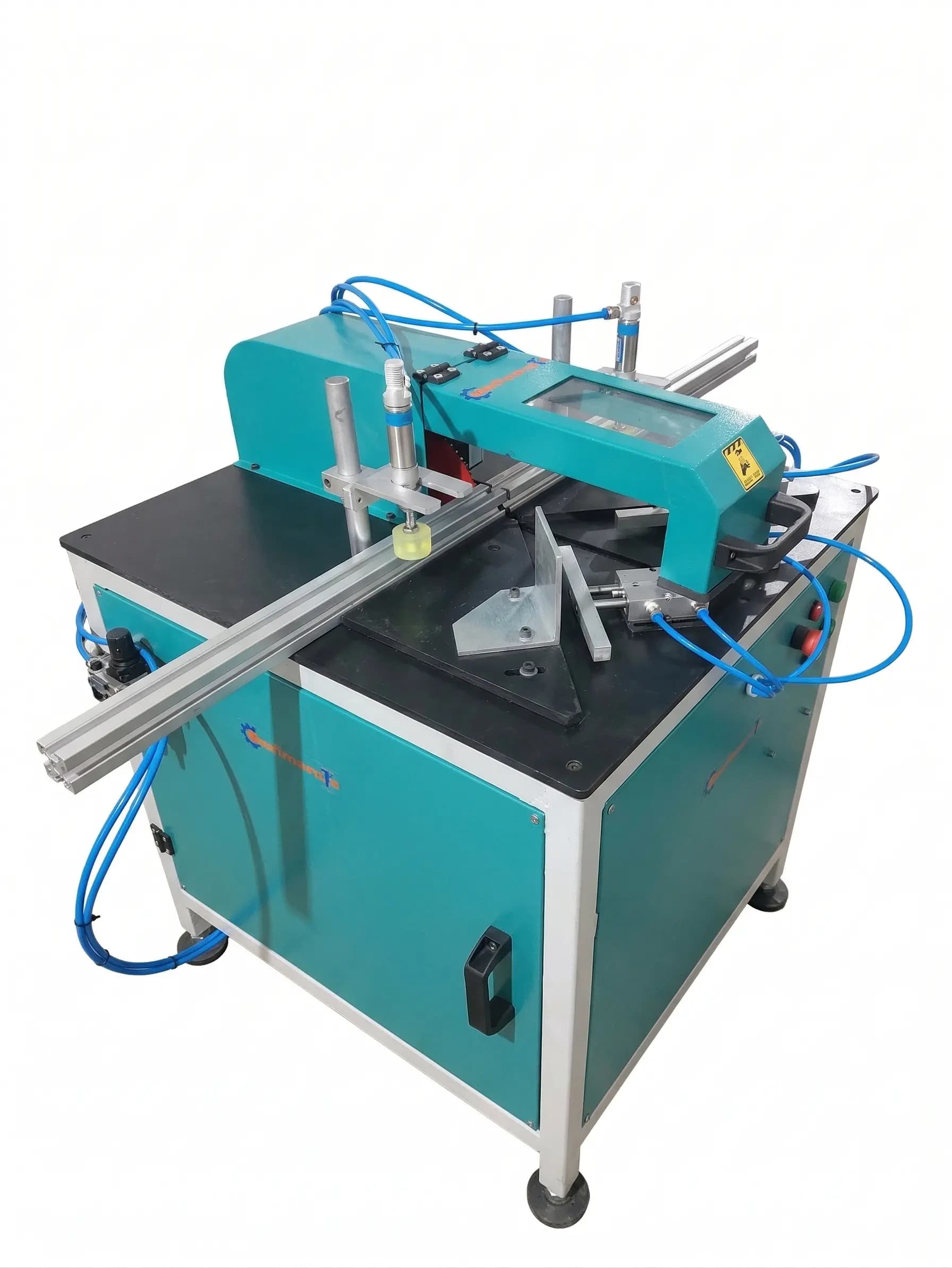
To solve this, a Double Head Cutting Machine 450mm utilizes a heavy-duty cast iron base and linear guide rails that ensure the blade moves on a perfectly fixed axis. Unlike a single cutting setup where the profile is moved manually, the double head system keeps the profile stationary while both ends are cut simultaneously. This eliminates the 'cumulative error' that occurs during manual measurement and repositioning.
Case Study: Efficiency Gains in a Pune-Based Facility
In early 2023, we worked with a window fabrication unit in Chakan, Pune, that was struggling with a 14% material wastage rate. They were using three manual 45-degree degree cutting machines. After analyzing their workflow, we replaced those units with a single automatic double head cutting saw for aluminium profiles.
- Baseline (Before): 40 frames/day, 14% scrap rate, 3 operators.
- Implementation: Installed a 450mm blade unit with a digital display and 3-meter bed.
- Results (After 3 Months): 110 frames/day, 2.5% scrap rate, 1 operator.
- ROI Timeline: The machine paid for itself in exactly 7 months through labor savings and material recovery alone.
The critical factor was the precision engineering of the pneumatic feed system. By controlling the feed rate at a constant 2 meters per minute, the 'burr' on the edges was eliminated, reducing the post-processing time at the Aluminium Corner Crimping Machine stage.
2024 Price Comparison for uPVC and Aluminium Machinery
Understanding the cost of setting up a uPVC window manufacturing unit in India requires a clear look at the machinery tiers. Prices fluctuate based on the blade diameter (350mm to 500mm), the degree of automation (PLC vs. manual), and the motor power (typically 1.5kW to 3kW per head).
| Machine Type | Approx. Price (INR) | Best For |
|---|---|---|
| Semi-Auto Double Head (450mm) | ₹4.8L - ₹6.2L | Growing SME fabricators |
| CNC Double Head (500mm) | ₹8.5L - ₹13L | High-rise project suppliers |
| uPVC Seamless Welding Machine | ₹3.5L - ₹5.5L | Premium aesthetic finish |
| Portable uPVC Window Making Machine | ₹1.2L - ₹2.5L | On-site startup work |
When evaluating an aluminium profile cutting machine price, do not just look at the sticker cost. Factor in the 'Total Cost of Ownership' (TCO). A cheaper machine with a thin bed will warp under the weight of heavy architectural profiles, leading to inconsistent cuts within 18 months of operation.
Technical Specifications and Industry Standards
To compete in the 2024 market, your profiles must meet IS 1285 and ISO 9001 standards for dimensional accuracy. Here are the specifications you should demand from your uPVC machinery manufacturer:
- Positioning Accuracy: Should be ±0.1mm to ±0.2mm per 1000mm length.
- Cutting Angle Range: 90°, 45°, and sometimes intermediate angles like 22.5°.
- Blade Speed: 2800 – 3200 RPM for clean cuts in 6063-T6 aluminium.
- Air Consumption: 60-100 L/min at 6-8 bar pressure.
- Feed System: Hydro-pneumatic damping cylinders are essential to prevent blade 'jumping' during the initial contact with the profile.
Whether you are looking for uPVC window machinery manufacturers in Chennai or aluminium window fabrication machine suppliers in Pune, ensure the machine features a safety hood with an interlock mechanism. High-speed aluminum machinery manufacturers in Ahmedabad often skimp on these safety features to lower the price, but this increases industrial profile cutting liability.
Common Mistakes to Avoid When Upgrading
I have seen many startups buy a upvc window manufacturing machine without considering the profile length support. If your bed length is only 3500mm, you will struggle with modern balcony sliders that require 4000mm+ tracks. Always opt for a machine that can be extended or has an integrated roller support system.
Another mistake is ignoring the cooling system. If you are an aluminium cutter machine user, you must have a micro-mist lubrication system. Cutting dry leads to 'weld-back' where the aluminium chips fuse to the blade teeth, causing the blade to dull prematurely and ruining the miter finish.
Frequently Asked Questions (FAQ)
1. What is the difference between a 450mm and 500mm blade for double head cutting? Generally, a 450mm blade can cut profiles up to 120mm x 200mm at 90 degrees. A 500mm blade is necessary for heavy-duty commercial curtain walls or wide multi-track sliding windows, providing a larger cutting envelope and deeper reach.
2. Can I use the same machine for both uPVC and Aluminium? Technically yes, but the blade tooth geometry (TPG vs. ATB) and the cutting speeds differ. If you switch materials frequently, you must change blades to avoid melting the uPVC or chipping the aluminium. Most high-volume upvc windows manufacturers machine units are dedicated to one material.
3. How often does the miter angle need calibration? On a Mechnovate-grade machine, we recommend checking the 45-degree angle every 500 cutting hours or every 3 months. If you notice even a 0.2mm gap, it is time to inspect the pneumatic cylinders and the limit switches.
4. Is a CNC double head cutting machine worth the investment? A CNC system is worth it if you process more than 150 windows per day. The ability to import cutting lists via USB or Wi-Fi eliminates manual data entry errors, which accounts for nearly 30% of wastage in traditional workshops.
5. What are the electrical requirements for a double head cutter? Most industrial units require a 3-phase, 415V power supply. If you are a small business, check if the upvc windows machine manufacturer offers a single-phase conversion, though this may limit the motor torque available for thick-walled profiles.
Get more articles like this
Follow Mechnovate on Google to see our guides in Google Discover & News