Maximizing Workshop Uptime: Nagpur uPVC Machine Guide
Maximizing Workshop Uptime in Nagpur: The Core Maintenance Strategy
To maximize workshop uptime in Nagpur's high-heat environment, your maintenance strategy must focus on three critical variables: heating plate temperature consistency (maintained strictly between 245°C and 255°C), pneumatic pressure stability at 6-8 bar, and the physical integrity of your 0.12mm Teflon heating sheets. In my 15 years as a senior engineer at Mechnovate, I have seen that 85% of weld failures in Maharashtra are caused not by machine defects, but by poor calibration of the thermocouple sensors. When the Nagpur summer hits, the ambient temperature in a metal-roofed workshop can exceed 45°C, causing standard PID controllers to drift if not housed in a cooled electrical cabinet.
Effective uPVC welding machine maintenance begins with daily cleaning of the heating plate. Any carbonized uPVC residue left on the surface will create uneven heat distribution, leading to 'cold welds' that fail during the corner strength test (EN 514). Fabricators should use a non-marring wooden spatula for cleaning while the plate is hot; never use metal scrapers which can damage the Teflon coating or the underlying heating element. If you are operating a double head seamless welding machine for uPVC windows, ensuring both heads are synchronized in their melting and cooling cycles is paramount for structural integrity.
uPVC Window Welding Machine Maintenance Guide: Technical Protocols
Maintaining your upvc window manufacturing machinery requires a rigorous schedule that goes beyond simple oiling. For precision engineering results, follow this technical protocol based on industrial profile cutting safety standards and ISO standards.
- Pneumatic System Optimization: Drain the moisture separators every 4 hours during the monsoon season. Accumulated water in the cylinders of a upvc windows manufacturing machine leads to jerky movements and inconsistent clamping pressure, which ruins the weld bead consistency.
- Heating Element Calibration: Use an external infrared thermometer or contact probe to verify that the PLC display matches the actual plate temperature at nine different points across the plate surface. A variance of more than ±2°C indicates the element needs replacement.
- Teflon Sheet Management: Replace the Teflon film every 500-700 cycles. Do not wait for it to tear. Worn Teflon causes the profile to stick, creating 'strings' of molten plastic that compromise the next weld.
- Linear Guide Lubrication: Use ISO VG 32 or 46 grade hydraulic oil for the linear rails. Avoid grease in dusty environments as it attracts uPVC swarf, which acts as an abrasive and destroys the bearing blocks.
Case Study: Optimizing a Nagpur-Based Fabrication Unit
Last year, we worked with a facility in Wadi, Nagpur, that was experiencing a 12% rejection rate on their 60mm casement series. Their upvc windows machine was producing uneven corners, and the cycle time was lagging. Our audit revealed that their pneumatic lines had a 1.5 bar pressure drop between the compressor and the upvc welding machine due to undersized piping.
We implemented a three-step overhaul: we upgraded the air lines to 1-inch PPR, recalibrated the heating cycles for Nagpur’s high humidity, and trained the operators on the 'Zero-Gap' clamping method. Over six weeks, the results were measurable: the weld failure rate dropped from 12% to under 0.5%, and the output increased by 40 frames per day without adding extra shifts. This demonstrates that even the best uPVC window making machine for small business performs only as well as its maintenance regime.
Troubleshooting Common Fabrication Mistakes
A common mistake I see among newer fabricators is over-pressurizing the join. While it might seem that more pressure equals a stronger bond, excessive pressure on your upvc window manufacturing machine actually squeezes the molten plastic out of the joint too quickly. This results in a thin, brittle weld bead that lacks the structural depth required by BS EN 12608 standards.
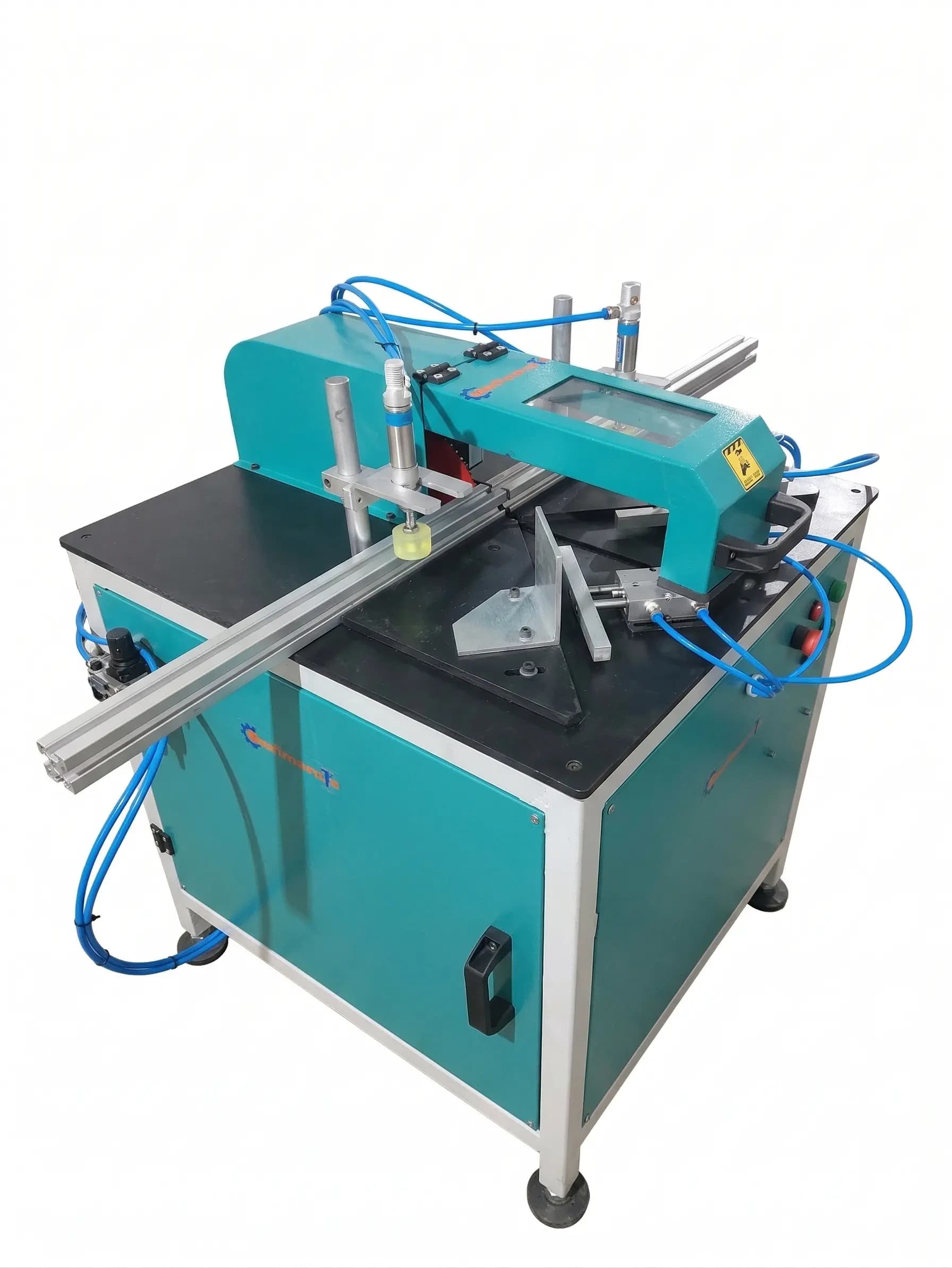
Another critical error involves using generic upvc machine price list components for repairs. Always use genuine Mechnovate sensors and solenoid valves. I have personally tested third-party thermocouples that had a 10% error margin at 250°C; that 25°C difference is the difference between a high-quality window and a structural hazard. Furthermore, always ensure your 45 degree double head cutting machine is perfectly square before welding; no amount of welding pressure can compensate for a poor miter cut from a low-quality aluminium cutting machine 12 inch.
Advanced Maintenance for High-Volume Plants
For those running a fully automatic uPVC window manufacturing unit cost model, maintenance includes checking the PLC logic and communication cables. Vibrations from high-speed operation can loosen the RS232 or Ethernet connections between the heads of an automatic double head cutting machine price India or a multi-point welder. At Mechnovate, we recommend a full electrical torque check every six months to ensure no terminals have loosened due to thermal expansion and contraction.
When considering the upvc window manufacturing machines setup, always factor in the voltage stability. In regions like Nagpur, voltage fluctuations can fry the expensive solid-state relays (SSRs) used for heat control. A dedicated 3-phase servo stabilizer is not an option; it is a necessity for protecting your investment in uPVC window machinery manufacturers in Chennai or anywhere else in India.
FAQ: Expert Answers for Window Fabricators
Q: How often should I change the heating element in my single head welder?
A: On average, a high-quality heating element lasts 18-24 months of single-shift operation. However, you should monitor the 'Time to Heat' metric. If the plate takes 20% longer to reach 250°C than it did when new, the internal resistance has increased, and failure is imminent.
Q: Why is my welding bead thicker on one side?
A: This usually indicates a misalignment in the clamping jigs or the guide rails. Check the parallelism of the upvc window machine tables using a precision feeler gauge. Even a 0.5mm deviation can cause uneven pressure distribution during the joining phase.
Q: Can I weld different uPVC profile brands with the same settings?
A: No. Different profiles use different chemical stabilizers (Lead-based vs. Calcium-Zinc). Each has a unique 'melting point window.' You must run a corner strength test and adjust your heating time (usually between 25-35 seconds) whenever you switch profile suppliers.
Get more articles like this
Follow Mechnovate on Google to see our guides in Google Discover & News