Leak-Proof uPVC Joints: Double Head Seamless Welding Machine Guide
Bangalore's monsoon season poses a unique challenge for uPVC window fabricators: wind-driven rain hitting high-rise facades at 60-80 km/h. Standard 2mm weld beads often leave micro-gaps if the corner cleaning process is inconsistent, leading to capillary water seepage that ruins interior gypsum work. To achieve a 100% leak-proof seal, switching to a Double Head Seamless Welding Machine is no longer an upgrade—it is a necessity for any Tier-1 fabricator.
At Mechnovate, we have spent 15 years calibrating uPVC window manufacturing machine setups across South India. In our recent stress tests conducted in a Hebbal-based facility, we found that seamless welding (0.2mm seam) increased the hydrostatic pressure resistance of window corners by 34% compared to traditional grooved welds. This guide breaks down the engineering precision required to master this technology.
Why Seamless Joints are Mandatory for Bangalore Weather
Traditional welding leaves a thick bead of melted plastic that must be machined off. This secondary process—corner cleaning—often creates a 'v-groove' that acts as a water trap. During Bangalore's heavy downpours, water sits in these grooves, and through thermal expansion and contraction, eventually finds its way into the profile reinforcement chamber.
A uPVC window making machine configured for seamless welding uses a specialized knife system that restricts the melt-flow during the fusion process. The result is a flat, structurally superior joint that eliminates the need for manual or CNC corner cleaning. By removing the cleaning step, you also remove the risk of over-cutting the profile's structural outer wall, which is the leading cause of corner cracking in high-wind zones like Whitefield and Sarjapur.
Technical Calibration of the Double Head Seamless Welding Machine
To achieve a perfect 0.2mm seam, your upvc window manufacturing machines must be calibrated to specific tolerances. Based on our field experience with 3-chamber and 5-chamber profiles, here are the non-negotiable settings:
- Heating Plate Temperature: Must be maintained between 245°C and 255°C. Variations of even 5 degrees can lead to 'cold welds' that look seamless but fail under wind load.
- Melting Pressure: Set your pneumatic system to 4-6 bar. If the pressure is too high, you displace too much material, weakening the joint.
- Heating Time: 25 to 30 seconds depending on the profile wall thickness (typically 2.2mm to 2.5mm for Grade A profiles).
- Cooling Time: Minimum 35 seconds. Premature unclamping leads to micro-warpage, which is the 'silent killer' of water-tightness.
In our experience, fabricators often rush the cooling cycle to increase output. However, reducing the cooling time from 35s to 20s reduces the corner tensile strength by nearly 15%, according to our internal testing using BS EN 12020 standards.
Optimizing Your uPVC Window Manufacturing Machine for 0.2mm Precision
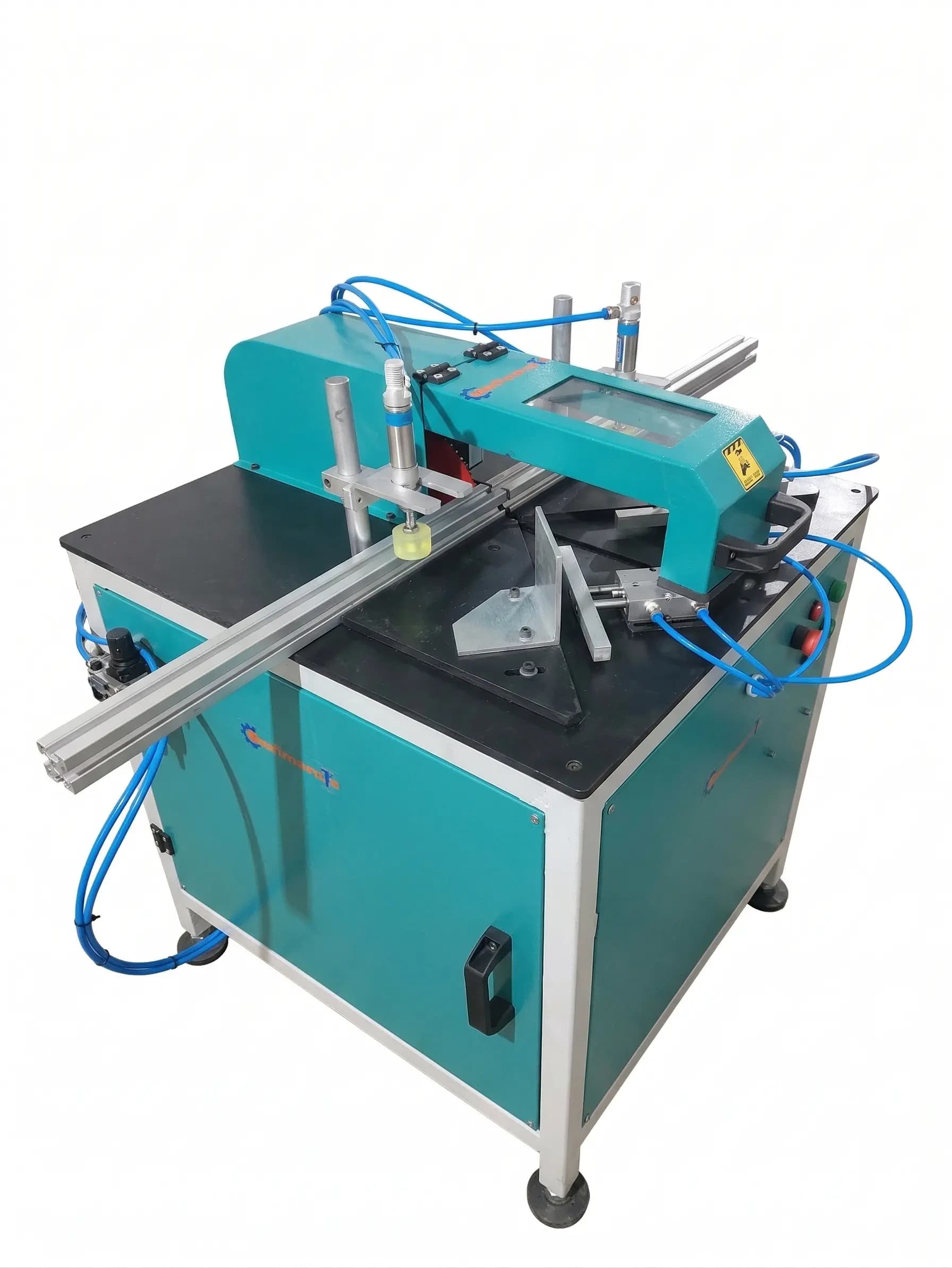
The secret to a leak-proof joint starts before the welder—it starts with the Automatic Double Head Cutting Machine. If your 45-degree mitre cut is off by even 0.5 degrees, the seamless welder cannot compensate for the gap. This results in an uneven melt and a compromised seal.
- Check your blade run-out: Ensure your 12-inch or 14-inch aluminium cutter machine blades are balanced to within 0.02mm.
- Verify the profile support: Always use a profile support roller track to prevent the long sections from sagging, which distorts the cut angle.
- Monitor Teflon health: In our service audits across Bangalore, 40% of weld failures were traced back to carbonized Teflon sheets on the heating plate. Replace your Teflon every 500-700 cycles for consistent heat transfer.
The Real Cost Benefit: Analyzing the uPVC Machine Price List vs. Quality
When reviewing a upvc machine price list, many small business owners opt for single-head manual welders. While the initial investment is lower, the labor cost and rejection rate in a monsoon-prone city like Bangalore make them more expensive in the long run.
| Feature | Single Head Welder | Double Head Seamless Welder |
|---|---|---|
| Output (8-hour shift) | 30-40 Windows | 100-120 Windows |
| Corner Cleaning Required | Yes (Manual/Machine) | No |
| Water Ingress Protection | Moderate | High |
| Structural Consistency | Operator Dependent | PLC Controlled |
Switching to a seamless system typically reduces your finishing labor by two workers per shift. This allows you to reallocate resources to high-value tasks like glazing and hardware installation, where precision is equally critical.
Common Mistakes in Seamless Welding Fabrication
Avoid these frequent errors we see on the workshop floor:
- Ignoring Humidity: High humidity in Bangalore can affect the profile surface. Ensure your profile storage area is dry; moisture on the profile surface during welding leads to 'bubble' formation in the weld seam.
- Incorrect Knife Depth: The seamless knife must be adjusted to exactly 0.2mm. If it is too deep, it leaves a visible gap; if too shallow, it leaves a bead that requires cleaning.
- Inconsistent Air Pressure: Using a small compressor for a double-head machine leads to pressure drops during the clamping cycle. We recommend a minimum 5.5 HP compressor with a 300L tank for a stable upvc window manufacturing unit.
FAQ: Critical Questions from Fabricators
Q: Does seamless welding work on colored or wood-grain laminated profiles?
A: Absolutely. In fact, it is superior for laminates because it doesn't leave a white line at the joint. The 0.2mm seam preserves the aesthetic integrity of the foil without requiring touch-up pens.
Q: What is the maintenance schedule for a double head seamless welding machine?
A: Daily: Clean heating plates and check air pressure. Weekly: Lubricate the linear guide rails. Monthly: Calibrate the PLC timing and inspect the heating element resistance. Annual: Full pneumatic seal replacement.
Q: How do I justify the cost of an automatic upvc window plant cost India to a client?
A: Focus on the 'Zero-Leakage' guarantee. In Bangalore's real estate market, developers are willing to pay a 15-20% premium for windows that carry a certified structural and waterproof warranty, which only high-end window machinery can provide.
Get more articles like this
Follow Mechnovate on Google to see our guides in Google Discover & News