Double Head Mitre Saw for Jaipur Aluminium Fabricators: Slimline Sections and Precision
Jaipur's aluminium fabrication market operates under conditions no other Indian city quite replicates. The heritage zone creates a sustained demand for slimline aluminium profiles — typically System 28 to 35mm sections — that harmonise with centuries-old sandstone facades without the visual bulk of standard 45mm or 60mm sections. At the same time, the Jaipur Development Authority's residential expansion across Pratap Nagar, Jagatpura, and Mansarovar extension is generating high-volume orders for fabricators who cannot afford wasted material or lost time. For workshops running both segments simultaneously, cutting equipment is not a background decision — it directly determines whether your sections are square, your corner joints are tight, and your rework rate stays near zero.
Why Slimline Sections Demand Higher Cutting Precision
Standard 60mm or 70mm aluminium profiles are forgiving. A 0.3-degree deviation on a 70mm section produces a visible but manageable gap at the corner joint. Run that same 0.3-degree error on a 28mm slimline section and the proportional gap becomes dramatically larger relative to the section width — visible to the naked eye and impossible to conceal with silicone. This is the core engineering reality every Jaipur fabricator cutting heritage-compatible profiles must internalise.
Slimline sections also carry thinner walls — sometimes as little as 1.2mm — which flex slightly under clamp pressure if the cutting machine's vice is not precisely calibrated. Any micro-movement during the cut introduces a compound error: angle deviation plus a fractional shear displacement that destroys the mating surface. A rigid, zero-backlash vice combined with a fine-tooth blade is not optional for slimline work — it is the baseline requirement.
The luxury heritage resort and hotel segment in Rajasthan intensifies this requirement further. Mughal arch profiles require compound angle cuts — typically 22.5° or custom angles — that must be consistent across an entire facade run. One miscut section in a series of forty arch frames forces a rework whose cost can exceed the machine's purchase price.
Double Head Mitre Saw: The Production Advantage for Jaipur Volume
A double head (twin head) mitre saw cuts both ends of an aluminium profile simultaneously at preset angles. For a fabricator running JDA residential colony orders out of Pratap Nagar or Jagatpura, this translates directly into throughput: a single operator can process three to four times more window frame sections per shift compared to a single-head setup that requires re-fixturing the profile for each end cut.
The accuracy advantage compounds over high volume. Because both cuts are made in a single clamping operation, the accumulated positioning error of double-handling is eliminated entirely. For slimline 28–35mm sections destined for heritage facades, this single-clamping discipline is as consequential as the machine's angle calibration mechanism.
See our Single head vs double head cutter comparison for a detailed breakdown of when the upgrade makes financial sense at different monthly production volumes.
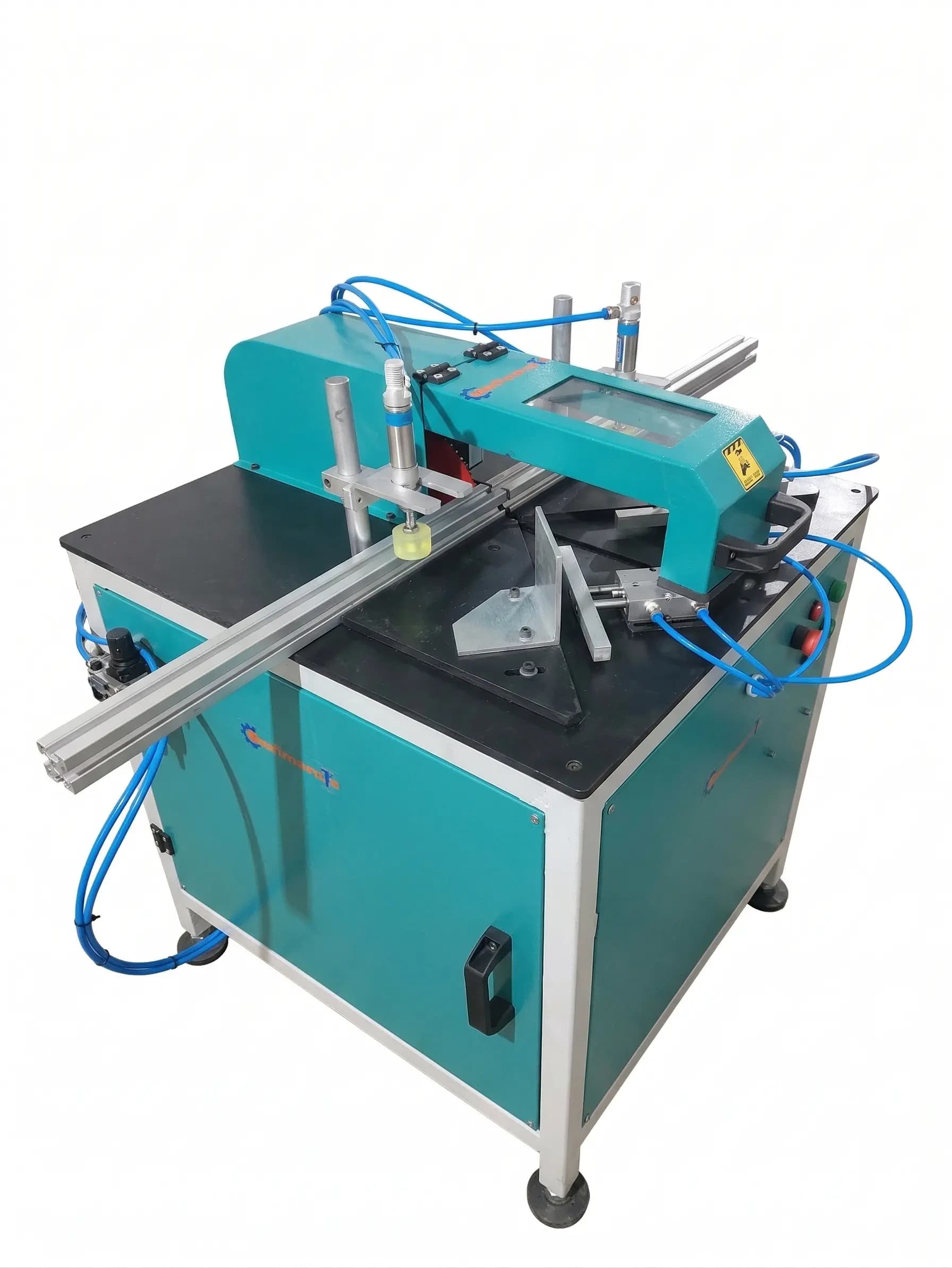
Mechnovate's 45/90 Degree Cutting Machine — starting at ₹55,000 — is engineered for precision angle repeatability. The machine's rigid aluminium fence and hardened mitre stops hold their set position under continuous production use, which matters when you are running hundreds of slimline frames per week for a residential development. Compatible profiles include Domal, Jindalinium, Dumal, Hindalco, and Alumil.
Blade Selection for Slimline Aluminium Sections
Most Rajasthan fabricators use standard 80-tooth or 100-tooth TCT blades supplied with their machines. For standard sections, this is adequate. For slimline sections below 35mm, the correct specification is a 120-tooth or higher TCT blade with a negative hook angle — typically -5° to -8°. The higher tooth count reduces the chip load per tooth, producing a cleaner shear on thin walls rather than a torn edge.
Follow these steps when specifying blades for slimline profile cutting:
- Confirm wall thickness before ordering blades. Sections with walls thinner than 1.5mm require a minimum 120-tooth blade to prevent chatter and burring at the cut face.
- Verify blade diameter against machine guard clearance. An undersized blade that cannot reach full section height will deflect under load and produce an angled cut face.
- Apply wax stick lubricant on every production run. Jaipur's dry air — workshop humidity frequently drops below 20% — means aluminium chips carry no moisture to cool the blade. Wax reduces heat buildup significantly in thin-wall cuts.
- Inspect blade set between large production batches. Fine-tooth blades lose set faster when profiles carry construction dust or desert particulate. A blade that is 60% worn will produce intermittently bad cuts on slimline sections.
- Replace at the first sign of torn edges on cut faces. On a 40-frame heritage hotel order, one rework costs more than the blade replacement several times over.
For complete machine and blade compatibility guidance, see our Cutting machine buying guide.
Dust Management in Jaipur Fabrication Workshops
Jaipur sits at the eastern margin of the Thar Desert. Construction dust from the city's rapid outward expansion combines with desert sand particulate to create one of India's most abrasive workshop environments. Humidity routinely falls below 20% during summer months, causing fine dust to become electrostatically charged — it clings to machine bearings, blade arbours, and fence faces rather than settling to the floor.
For cutting machines processing slimline aluminium, the consequences are direct. Dust entering the blade arbour bearing accelerates wear and introduces spindle runout — a small but measurable wobble that widens the effective kerf and degrades cut quality on thin-wall sections. A machine producing clean 0.1mm cuts in March may show marginal joint quality by September if dust control is not part of the daily routine.
Practical workshop measures for Jaipur conditions: fit a cyclonic pre-filter before any dust extraction unit, seal machine cabinet vents with closed-cell foam gasket tape, and blow down the cutting head with compressed air at the start of each shift before the first cut. These steps preserve blade arbour bearing life and maintain the precision that slimline section work requires.
FAQ
How long does delivery from Ahmedabad to Jaipur take?
Mechnovate despatches from Ahmedabad, Gujarat. Jaipur falls within the Rajasthan delivery zone, and standard transit time is 2–3 working days. Machines are packed in reinforced wooden crates with corner protection rated for road freight. Commissioning support and setup guidance are available by phone at +91-9265699061 on the day of delivery.
Which aluminium profiles is the cutting machine compatible with?
The 45/90 Degree Cutting Machine is tested and compatible with Domal, Jindalinium, Dumal, Hindalco, and Alumil profiles. Slimline System 28 and System 35 sections from these manufacturers are within the machine's cutting envelope. If you work with a less common extruder's profile, contact the Mechnovate sales team before placing an order to confirm compatibility.
What warranty does the cutting machine carry?
Cutting machines carry a 6-month warranty covering manufacturing defects in the frame, gearbox, and angle-stop mechanism. Blades, vice rubbers, and other consumable wear items are excluded. Warranty claims are handled directly by Mechnovate — there is no third-party service network delay. The Cutting machine buying guide covers maintenance intervals and lubrication schedules that keep machines within specification throughout the warranty period.
Should a new Jaipur fabricator start with a single-head or double-head cutter?
For fabricators starting with mixed residential orders across standard and slimline sections, a single-head machine is adequate and carries a lower entry cost. Once monthly throughput consistently crosses 200–250 window frames, a double-head setup typically pays back the upgrade cost in reduced labour time within six to eight months. Use our Single head vs double head cutter comparison to model the payback at your specific production volume before committing.
Ready to Upgrade?
Mechnovate supplies cutting and fabrication machinery to aluminium fabricators across Rajasthan, with 2–3 day delivery direct to Jaipur. Whether you are setting up a new workshop in Pratap Nagar or upgrading cutting precision for heritage hotel contracts, our engineering team can advise on the right machine specification for slimline section work at your production volume.
Call us at +91-9265699061 or contact us to discuss your section types, monthly throughput, and budget. ISO 9001:2015 certified, CE marked, and trusted by 500+ fabricators across 20+ Indian cities.
Get more articles like this
Follow Mechnovate on Google to see our guides in Google Discover & News