Indore Lead Time ROI: Automatic Double Head Cutting Machine Cost Analysis
Investing in an automatic double head cutting machine reduces lead times by approximately 65% for a typical mid-sized Indore workshop. In our 15 years of commissioning plants across Madhya Pradesh, we have found that the transition from manual single-head saws to high-precision double-head systems is the single most impactful change a fabricator can make. While the initial capital expenditure seems high, the reduction in labor costs per frame and the near-elimination of material wastage (down from 8% to under 2%) usually results in a full ROI within 14 to 18 months. This analysis explores the technical and financial feasibility of this upgrade specifically for the Indore industrial context.
Quantifying ROI: Why Lead Times Matter in Indore
The current fabrication landscape in Indore, particularly around Pithampur and Sanwer Road, is shifting toward high-volume residential projects. Using a standard uPVC window making machine of the manual variety limits a workshop to roughly 15-20 windows per 8-hour shift. In contrast, an automatic double head cutting machine allows for the simultaneous cutting of both ends of a profile at precise 45 or 90-degree angles, pushing output to 50-60 windows per shift with higher accuracy. This throughput is critical when competing for large-scale contracts where delivery penalties are steep.
Productivity Metrics: Manual vs. Automatic
- Setup Time: Manual machines require individual measurement for every cut. Automatic systems use PLC-controlled positioning, reducing setup from 120 seconds to 15 seconds per profile.
- Cutting Accuracy: Digital linear scales ensure a tolerance of +/- 0.1mm. Manual errors often lead to 2-3mm deviations, requiring costly rework during the welding or assembly stage.
- Labor Efficiency: One operator can manage a CNC-linked double head saw, whereas manual setups often require a helper to support long profile lengths, effectively doubling your labor cost per cut.
The Technical Reality: Engineering Specifications That Drive Value
When evaluating the automatic double head cutting machine price in India, you are not just buying a saw; you are buying a precision engineering system. For aluminium fabrication and high-end uPVC work, the spindle motor quality and the guide rail mechanism are paramount. Most entry-level machines use basic induction motors, but for industrial-grade output, you should look for high-torque motors running at 2800-3200 RPM with a 3.0 kW rating.
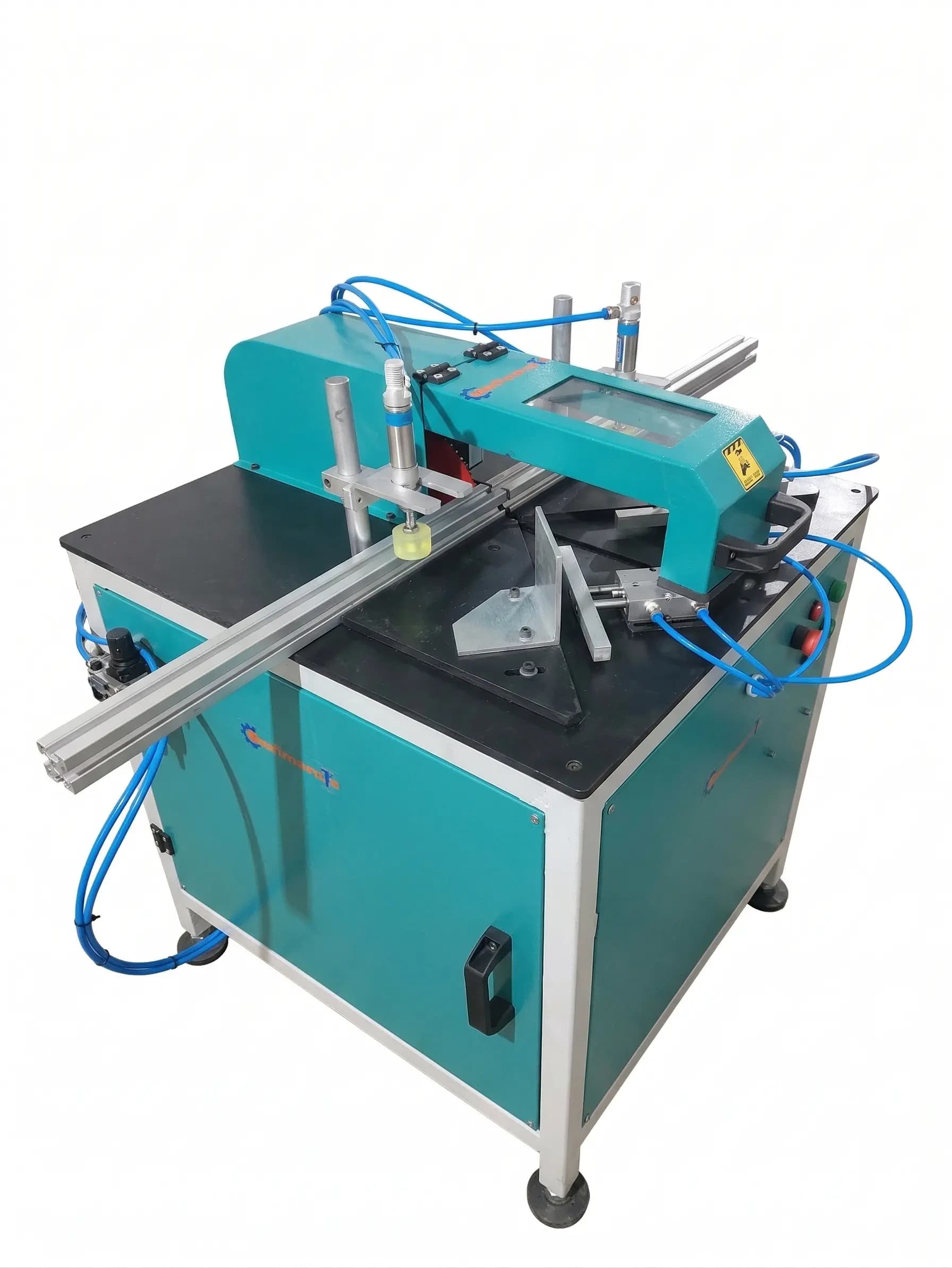
In our Mechnovate testing labs, we compared a standard 12-inch aluminium cutting machine against a 500mm blade double-head system. The larger blade diameter allows for cutting wider multi-chamber profiles used in soundproof glazing, which are increasingly popular in Indore's high-end townships. Furthermore, the use of TCT (Tungsten Carbide Tipped) blades with a hydro-pneumatic damping cylinder ensures a smooth feed rate, preventing the 'burr' effect common in cheaper manual machines.
Case Study: Pithampur Industrial Area Implementation
Last year, we assisted an Indore-based fabricator who was struggling with a 12% scrap rate using a basic aluminium profile cutting machine. Their lead time for a 50-window villa project was 14 days. After installing a fully automatic upvc window manufacturing machine setup including a double-head miter saw and an automatic aluminium corner crimping machine, the results were immediate:
- Total Production Time: Dropped from 14 days to 5 days.
- Material Waste: Reduced from 12% to 2.8% due to optimized cutting lists.
- Assembly Speed: Because the cuts were perfectly square/45-degrees, the upvc welding machine cycle times improved by 20% as there was no need for manual filing of edges.
Common Mistakes to Avoid in Machine Selection
Many fabricators in the Indore region prioritize the lowest sticker price, often opting for unbranded upvc machinery that lacks local service support. This is a critical error. A machine that is down for three days due to a faulty solenoid valve or a crashed PLC program will cost you more in lost production than you saved on the purchase price.
What to Watch Out For:
- Undersized Motors: A 1.5 kW motor will struggle with heavy-duty aluminium profiles, leading to overheating and blade deflection.
- Poor Casting Quality: Ensure the machine base is made of heavy-duty aged cast iron or thick-walled steel. Lightweight frames vibrate, which ruins cutting precision over time.
- Lack of Safety Interlocks: Industrial profile cutting safety standards (ISO standards) require two-hand operation and protective shields. Never bypass these for 'speed'.
- Inadequate Clamping: Look for vertical and horizontal pneumatic clamps. Without firm 6-8 bar pressure, the profile will move, resulting in a 'stepped' cut.
Integrating Automation: Beyond the Cutting Stage
While the head cutting machine is the heart of the workshop, its efficiency is limited by the surrounding equipment. To truly reduce lead times, consider the flow to the copy router machine and the aluminium punching machine. A bottleneck at the hardware hole routing stage will negate the gains made at the cutting station.
For those starting a new unit, the cost of setting up uPVC window manufacturing unit in India can range significantly. However, a balanced line—where the cutting speed matches the welding and corner cleaning speed—is more important than having one ultra-fast machine and three slow ones. We recommend a CNC uPVC window corner cleaning machine to complement your automatic saw for the best finish.
FAQ: Critical Questions for Indore Fabricators
1. Can I use the same machine for both Aluminium and uPVC? Yes, but you must change the blade and potentially the lubrication system. Aluminium requires a cooling mist system to prevent the alloy from melting onto the TCT teeth, whereas uPVC is typically cut dry. Most automatic double head cutting saw for aluminium profiles are built with the rigidity required for both materials.
2. What is the power requirement for an automatic double head system? Typically, these machines require a 3-phase 415V supply with a total power consumption of 4-6 kW. You also need a stable air compressor capable of delivering 150-200 Liters/Minute at 8 bar pressure to operate the pneumatic clamps and blade feed.
3. How often do the blades need sharpening? In a high-volume Indore workshop cutting 8 hours a day, TCT blades should be professionally sharpened every 3-4 months. Using dull blades increases motor strain and produces poor edge quality that will fail ISO 9001 quality checks during assembly.
4. Is there a service center for uPVC window machines in Central India? Mechnovate provides direct service support across Madhya Pradesh, including Indore, Bhopal, and Jabalpur. Choosing a provider with local technicians is vital for maintaining your upvc window manufacturing machines and ensuring 99% uptime.
Get more articles like this
Follow Mechnovate on Google to see our guides in Google Discover & News