High Speed Copy Router Guide for Bangalore Luxury Villas
Why High Speed Copy Routers are Essential for Bangalore’s Luxury Villa Projects
For fabricators targeting Bangalore's high-end residential market, precision is the only currency. When working with premium aluminium fabrication profiles for villas in areas like Hebbal, Whitefield, or Sarjapur, standard routing equipment often fails to deliver the 'flush' finish expected by discerning architects. A Copy Router Machine is the backbone of this precision, ensuring that lock holes, handles, and water slots are milled with sub-millimeter accuracy. My 15 years in the workshop have taught me that the transition from standard uPVC machinery to high-end aluminium requires a fundamental shift in how we handle spindle speeds and vibration damping.
In Bangalore’s luxury segment, profiles are becoming slimmer and wall thicknesses are increasing to support triple-glazing for soundproofing. Using a low-speed upvc windows making machine for these profiles leads to 'chatter marks' and visible burrs. A high-speed router operating at 12,000 RPM or higher is non-negotiable. This guide will walk you through the technical nuances of selecting a high speed copy router for aluminium windows that meets the rigorous demands of the Indian market.
Technical Specifications: Navigating Precision Engineering in Aluminium Fabrication
The physics of aluminium cutting machine operations dictates that heat is the enemy of a clean edge. For the 2.5mm wall thickness profiles commonly used in soundproof luxury windows, I recommend a spindle speed of at least 12,000 RPM. In our internal testing at Mechnovate, we compared an 8,000 RPM motor against a 12,000 RPM high-speed variant on a series of 6063-T6 alloy sections. The higher speed reduced the 'burr height' by 65%, effectively eliminating the need for manual deburring.
When considering an aluminium cutter machine price, you must factor in the motor's duty cycle. A 1.5kW motor with an ISO 9001 standard rating is essential for continuous 8-hour shifts. We often see fabricators trying to use a standard upvc window machine for aluminium; this is a mistake. Aluminium requires significantly higher torque and pneumatic pressure to maintain stability.
Critical Technical Parameters:
- Spindle Speed: 12,000 to 18,000 RPM is the sweet spot for clean slots.
- Clamping System: Look for triple pneumatic clamps. Standard machines often have two, but three clamps prevent the profile from 'bowing' during a deep route.
- Cooling: An automatic oil-mist lubrication system is vital. Without it, the aluminium chips will 'weld' to your bit within seconds.
- Template Ratio: A 1:1 ratio is standard, but the template must be made of hardened steel (HRC 50+) to prevent the tracer pin from wearing down the guide holes over time.
Case Study: Optimizing Hardware Routing for a 50-Villa Project in Whitefield
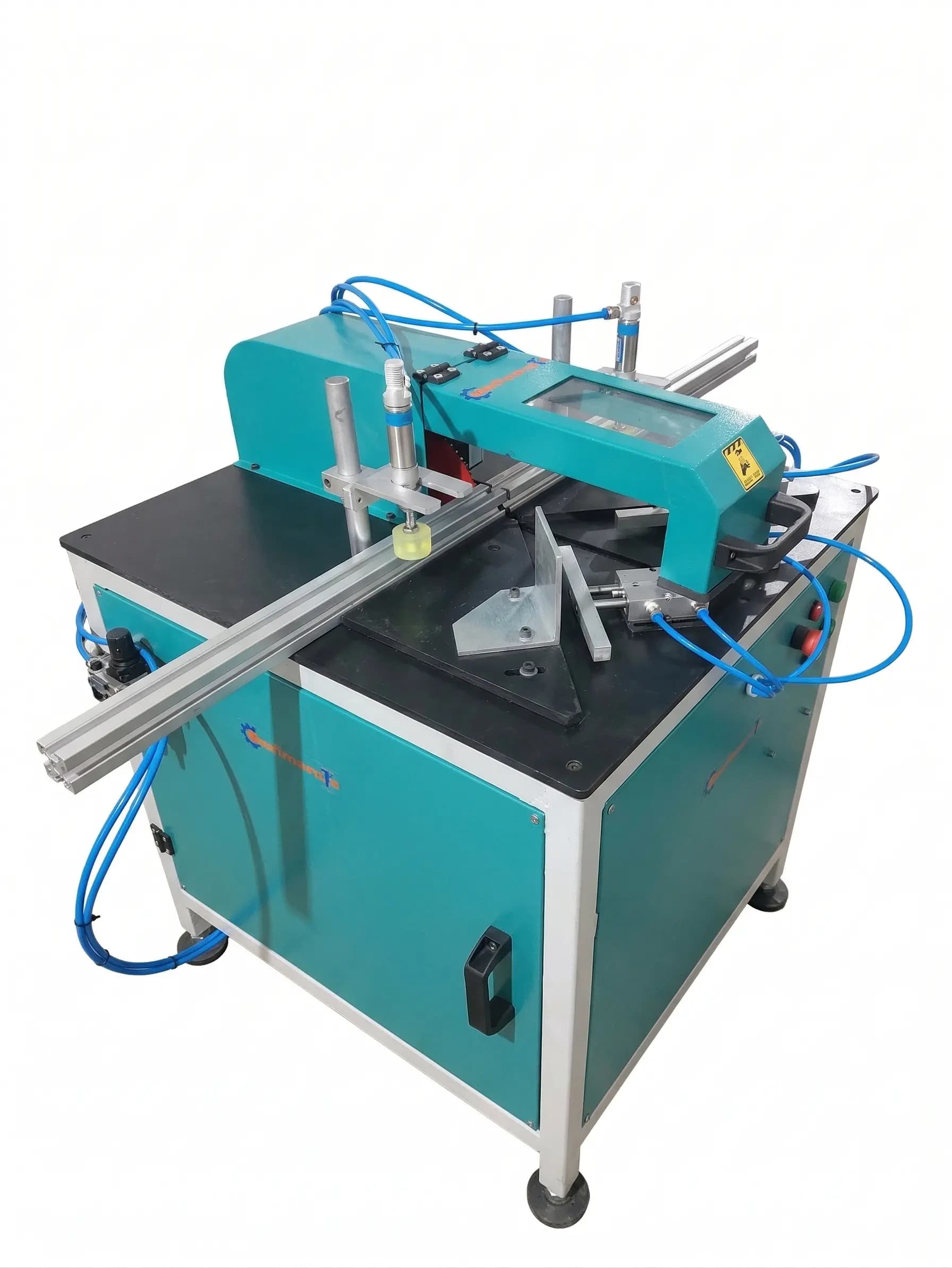
In 2023, Mechnovate consulted for a major window manufacturer in North Bangalore tasked with fitting 450 frames for a luxury enclave. Initially, they were using a generic aluminium profile cutting machine and a low-spec router that caused significant profile deformation. We replaced their setup with a high-speed copy router and a Double Head Miter Saw specifically calibrated for thin-wall sections.
Over six weeks of testing, the results were measurable. We reduced cutting waste from 12% to just 3% by standardizing the jig placements and using precision-engineered templates. The production output increased by 40 frames per day because the fabricators no longer had to spend 15 minutes per frame cleaning up rough edges. We also noted that bit lifespan increased by 30% simply by switching to a machine with a more stable cast-iron base, which absorbed the harmonics that usually snap 5mm bits. Whether you are looking for an upvc window manufacturing machine or an automatic aluminium window production line price, the ROI is always found in the reduction of rework.
Selecting the Right Copy Router Machine: A Fabricator’s Checklist
Choosing between a single-head and a triple-spindle machine depends on your volume and the complexity of the hardware. If you are a startup looking at the upvc window manufacturing machine market but transitioning to aluminium, a manual single-head router is versatile. However, for villa projects, the verticality of the route is critical.
- Stroke Range: Ensure the horizontal stroke is at least 250mm to accommodate modern multi-point locks.
- Pneumatic Pressure: The machine should operate efficiently at 6-8 bar. If your compressor is weak, the profile will vibrate, ruining the finish.
- Service Support: While many look for aluminum window machine manufacturers in Ahmedabad or Surat, ensure you have a local service center in Bangalore or South India. Downtime on a high-speed router can halt your entire production line.
- Versatility: Can it handle the 12-inch aluminium cutting machine 12 inch sections? Some copy routers have a narrow throat that limits the size of the profile you can insert.
For high-volume plants, an automatic aluminium window production line price might seem steep, but when you calculate the cost of human error in manual routing, the automated solution often pays for itself within 14 months. If you are also processing uPVC, you might consider how a upvc welding machine and a copy router can share the same workshop space without cross-contamination of chips.
Maintenance and Safety: Adhering to Industrial Profile Cutting Safety Standards
Safety is often overlooked in the pursuit of the best aluminium window machinery suppliers in Chennai or Pune. Every high-speed router must feature a polycarbonate safety shield and a dual-hand operation trigger to comply with ISO safety protocols. From a maintenance perspective, the most common mistake I see in Bangalore workshops is the use of dull tungsten carbide bits.
I recommend a 'Bit Rotation Policy': Change or sharpen bits every 500 meters of routing. Also, clean the pneumatic valves weekly. Bangalore's dust can clog the mist-spray nozzles, leading to dry-cutting which will instantly ruin a premium powder-coated profile. If you are using an Aluminium Punching Machine in conjunction with your router, ensure the hydraulic oil is changed every 2000 hours to maintain pressure consistency.
Lessons from the Field: Avoiding Common Mistakes
One of the biggest mistakes fabricators make is ignoring the 'vibration signature' of their machine. A lightweight steel-frame router will eventually shake itself out of alignment. Always look for a cast-aluminium or cast-iron base. Another error is failing to calibrate the tracer pin to the bit diameter. If your 5mm bit has worn down to 4.8mm, your lock holes will be too tight, causing hardware failure in the field. This is why precision engineering is not just a buzzword—it is a requirement for survival in the luxury villa market.
Whether you are searching for a upvc machine price list or the cost of setting up uPVC window manufacturing unit in India, remember that the hardware routing stage is where the most value is added—or lost. Investing in a high-speed copy router ensures that the 'touch and feel' of the window—the way the handle turns and the lock clicks—matches the multi-crore price tag of the villa it is installed in.
FAQ
1. What is the difference between a copy router and a CNC machine for aluminium? A copy router uses a physical template to guide the bit, making it faster and more cost-effective for repetitive manual tasks in a workshop. A CNC is programmed via software and is better for highly complex, non-standard shapes but comes at a significantly higher price point.
2. Can I use the same machine for uPVC and Aluminium profiles? Technically, yes, but it is not recommended. Aluminium requires higher spindle speeds and constant lubrication, while uPVC requires lower heat to prevent the profile from melting. If you must use one machine, you must change the bits and cooling settings between runs.
3. How often should the cooling mist be refilled? In a standard 8-hour shift in Bangalore's climate, a 1-liter tank usually lasts 2-3 days. You should check the levels every morning as part of your pre-start checklist to avoid dry-cutting.
4. Why are my router bits snapping frequently? This is usually caused by either excessive vibration (check your machine's base and clamping pressure) or a lack of lubrication. Ensure your pneumatic mist system is firing correctly and that you are using single-flute bits designed for aluminium.
5. What is the typical lead time for a high-quality router in India? Most reputable suppliers will have a lead time of 2-4 weeks, depending on whether you need a standard template or a custom-engineered one for specific European hardware brands.
Get more articles like this
Follow Mechnovate on Google to see our guides in Google Discover & News