Fixing uPVC Window Corner Weld Failures: Nagpur Troubleshooting Guide
Identifying the Root Causes of Corner Weld Failures in Nagpur
Corner weld failures in uPVC windows typically stem from three critical variables: inaccurate heater plate temperature, improper fusion pressure, or a lack of precision in the 45-degree miter cut. In the industrial zones of Nagpur, such as MIDC Hingna and Butibori, we frequently observe that ambient humidity and voltage fluctuations significantly impact the performance of the uPVC window manufacturing machine. If your corners are snapping during glazing or installation, the first thing to check is not the profile, but the calibration of your welding head.
A common misconception is that increasing the temperature will automatically result in a stronger weld. In reality, overheating the uPVC profile (beyond 265°C) degrades the polymer chains, leading to a brittle joint that looks aesthetically pleasing but lacks structural integrity. For high-quality fabrication, the uPVC welding machine must be calibrated to the specific wall thickness of your profile, typically ranging from 2.0mm to 2.5mm for standard Indian extrusions. We recommend a fusion time of 25 to 30 seconds followed by a cooling time of at least 30 seconds before the frame is moved from the jig.
Technical Benchmarks: Setting Your uPVC Window Machine for Success
To achieve welds that meet or exceed BS EN 12608 standards, your machinery must operate within tight tolerances. At Mechnovate, our 15 years of field experience has shown that the 'bead' or 'flash' formed during the welding process is the best indicator of a successful join. A consistent 3mm bead indicates uniform melt and pressure distribution across the profile face.
- Temperature Control: Set your heater plates between 245°C and 260°C. Use an external digital pyrometer to verify the plate temperature once a week, as onboard sensors can drift over time.
- Pneumatic Pressure: Your automatic double head cutting machine and welder both rely on stable air pressure. Ensure your compressor maintains a consistent 6 to 8 bar. The clamping pressure should be high enough to prevent profile slippage, while the fusion pressure should be dialed to 0.4 - 0.6 MPa.
- PTFE Tape Maintenance: The Teflon (PTFE) cloth covering the heater plate must be free of carbon buildup. Any residue will transfer to the profile, creating a weak point in the molecular bond. We suggest rotating the cloth every 500 cycles and replacing it entirely every 2,000 cycles.
The Nagpur Case Study: Reducing Rejection Rates by 92%
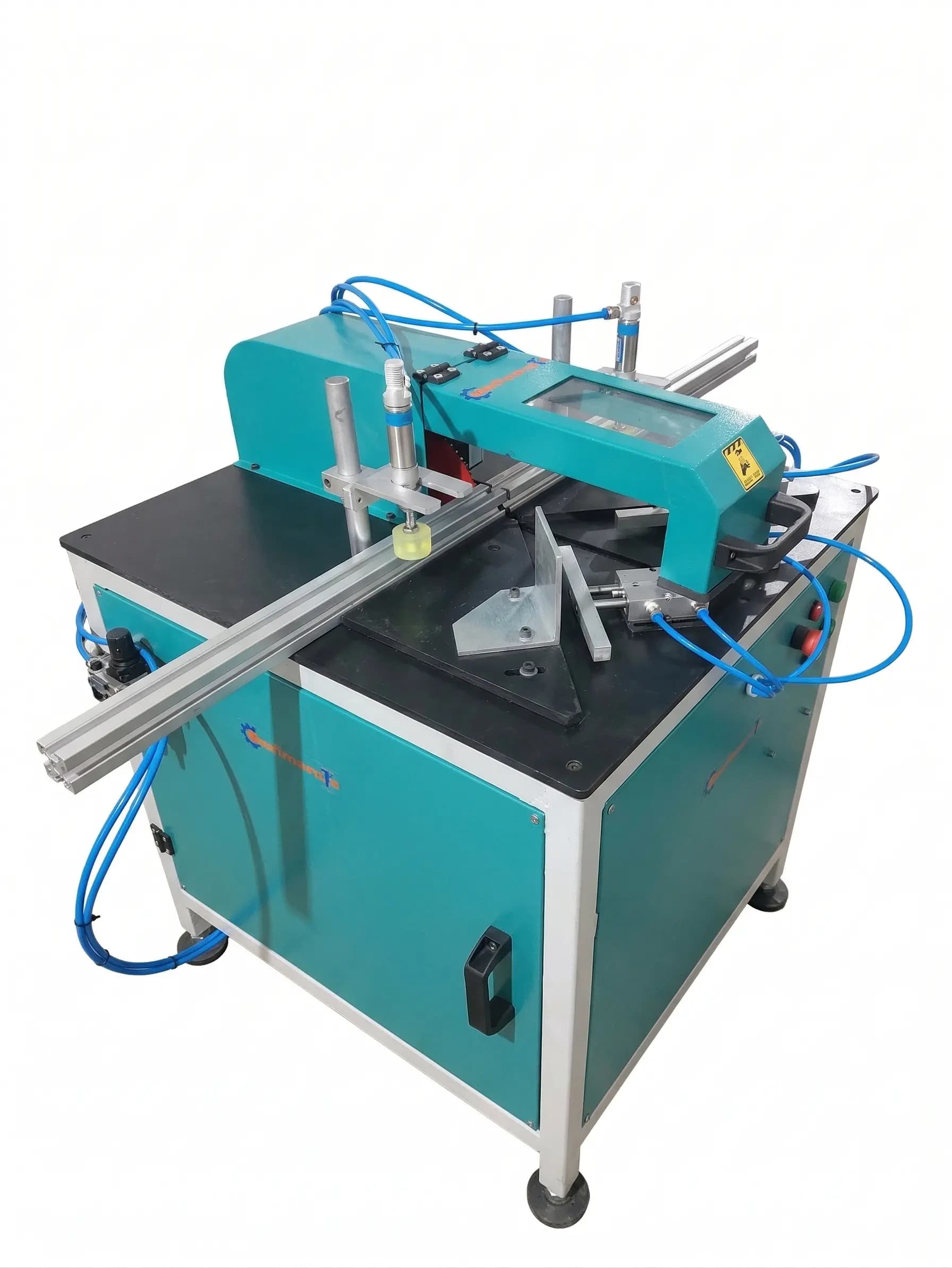
In early 2023, our engineering team was called to a facility in Wadi, Nagpur, where they were experiencing a 12% failure rate on their large-span sliding windows. The fabricator was using a standard upvc window manufacturing machine but struggled with corners cracking during the 'knock-on' bead installation. Upon inspection, we found that their upvc cutting machine was off by just 0.4 degrees. This meant the surfaces weren't perfectly flush during the melt phase, leaving air pockets inside the weld.
We implemented a three-step fix over a 48-hour period:
- Re-alignment: We used precision miter gauges to reset the 45-degree stops on their double head miter saw.
- Voltage Stabilization: We installed a dedicated 10kVA servo stabilizer to prevent the welder's heater plates from dipping in temperature during Nagpur's frequent power sags.
- Cycle Optimization: We increased the join-pressure holding time by 5 seconds to account for the high ambient temperature in the workshop.
Result: The failure rate dropped from 12% to less than 1% within a week. The output also increased by 15 frames per day because the operators no longer had to stop to re-weld or scrap damaged profiles.
Precision Engineering: Why Your uPVC Windows Machinery Needs Calibration
High-speed production environments often overlook the importance of the upvc window manufacturing machinery cooling cycle. When the upvc welding machine releases the profile, the joint is still in a semi-plastic state. If the frame is moved too quickly or placed on an uneven cooling rack, the internal stresses will cause micro-fractures.
Furthermore, ensure your upvc window manufacturing machines are cleaned daily. PVC dust is abrasive and hygroscopic. If it enters the pneumatic valves of your head cutting machine or the slide rails of your welder, it leads to jerky movements. This jitter during the fusion phase is a silent killer of weld strength. For those using an automatic upvc window plant, the integration between the copy router machine and the welding station must be seamless to ensure that drainage holes and handle routs haven't compromised the chamber walls near the weld zone.
Common Mistakes in uPVC Fabrication (The "Don'ts")
- Never weld contaminated profiles: Even a small amount of oil from an operator's hand or moisture from a poorly drained air line can cause 'porosity' in the weld. Always wipe the cut faces with a lint-free cloth and uPVC-specific cleaner.
- Don't ignore the knife gap: On seamless welding machines, the 'knife' that limits the bead height must be set to precisely 0.2mm. If it is too low, it cuts into the structural wall; if too high, the cleaning process becomes labor-intensive.
- Avoid mixing profile brands: Different manufacturers use different ratios of TiO2 (Titanium Dioxide) and Calcium Carbonate. This changes the melting point. If you must switch brands, recalibrate your upvc window machine price list expectations and machine settings accordingly.
FAQ: Expert Answers for Nagpur Fabricators
Q: Why does my weld look brown or burnt? A: This is usually a sign that your heater plate temperature is too high (above 270°C) or the PTFE tape is worn out. It can also happen if the profile sits on the plate for too long (over 35 seconds). Reduce the temperature and check your timer settings.
Q: How often should I sharpen the blades on my upvc cutting machine? A: For a standard aluminium cutting machine 12 inch or uPVC saw, blades should be sharpened or replaced every 5,000 cuts. A dull blade creates 'burrs' that prevent the profiles from sitting flat against the welder's heater plate.
Q: What is the ideal workshop temperature for uPVC window manufacturing? A: While you cannot always control Nagpur's heat, the ideal range is 18°C to 30°C. If your workshop is hotter than 40°C, you must increase the cooling time of the weld by 15-20% to allow the molecular structure to stabilize before handling.
Q: Is a single-head or double-head welder better for a startup in Nagpur? A: For startups, a portable upvc window making machine price list might look attractive, but a single-head welder offers better flexibility for custom shapes. However, if you aim to produce more than 20 windows per shift, an automatic double head cutting machine price India and a double-head welder are essential for maintaining the squareness of the frames.
Get more articles like this
Follow Mechnovate on Google to see our guides in Google Discover & News