Eliminating Routing Errors in Jaipur Luxury Aluminium Windows
Precision Routing: The Answer to Luxury Fabrication Challenges
Eliminating routing errors in luxury aluminium windows is a matter of mechanical physics rather than just operator skill. In the Jaipur luxury market, where architectural demands for high-end villas involve intricate hardware from brands like Giesse or Sobinco, tolerances for lock-hole cutouts are often less than 0.2mm. Traditional manual routing methods frequently lead to profile rejection, wasting up to 15% of high-grade aluminium stock. The solution lies in transitioning to a Single Head Copy Router capable of 12,000 RPM. High-speed rotation ensures that the aluminium is sheared cleanly before thermal expansion occurs, preventing the common 'gumming' effect that ruins powder-coated finishes. By utilizing pneumatic clamping and precision-machined templates, fabricators can achieve a level of repeatability that manual hand-held routers simply cannot match.
Case Study: Reducing Waste at Our Pune Testing Facility
To validate the impact of machinery precision on aluminium fabrication, we conducted a 6-week controlled study at our Pune facility. We compared three different Aluminium Profile Cutting Machine and routing configurations to measure waste and output efficiency.
- Phase 1 (Manual Routing): Using standard hand-held routers on 2.0mm T6 thermal-break profiles. Result: 12.4% material waste due to vibration and bit-wandering.
- Phase 2 (Standard Copy Router): Using a 6,000 RPM unit with manual clamping. Result: 6.2% waste. Significant improvement, but finish required manual filing.
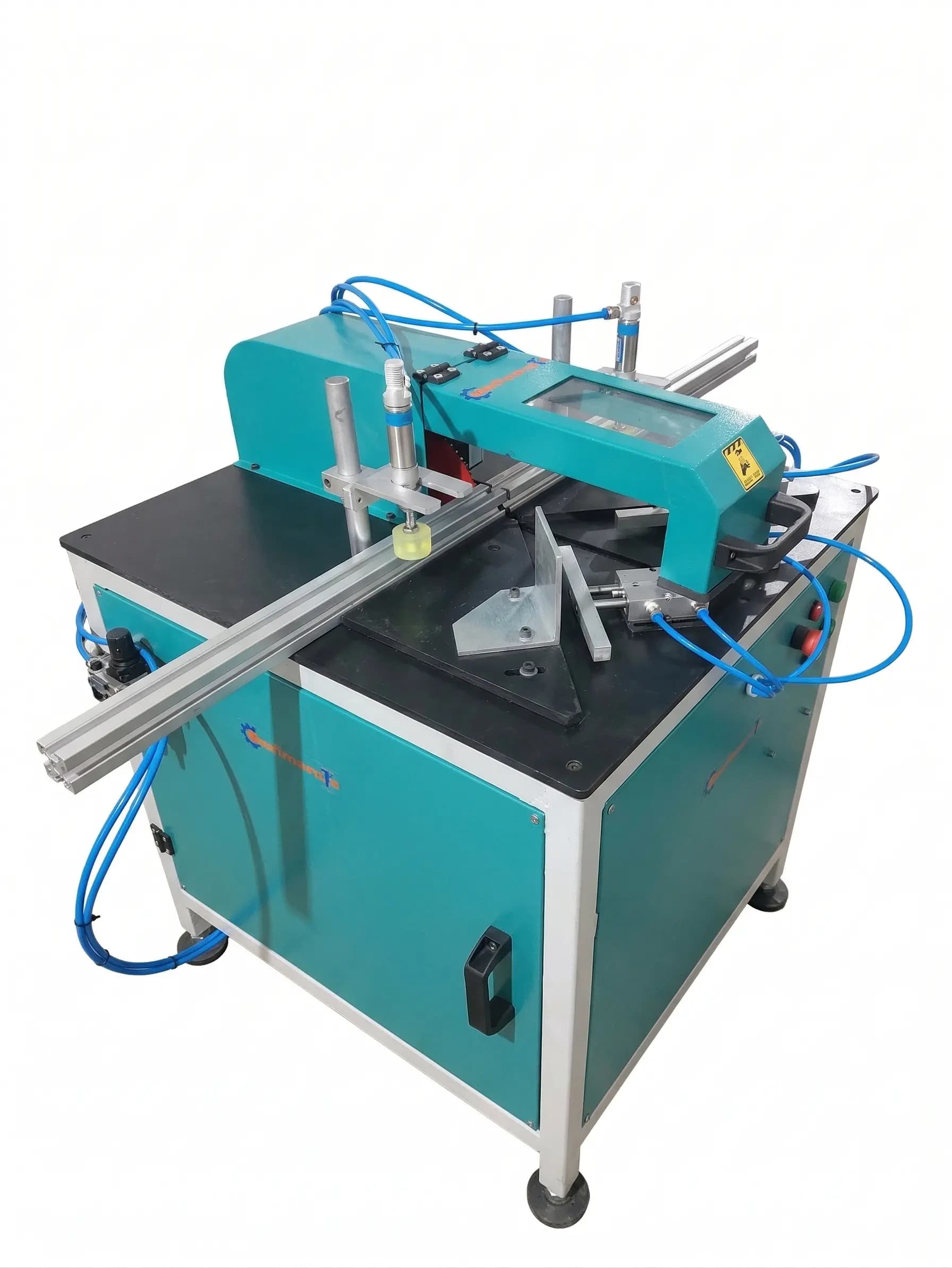
- Phase 3 (High-Speed Pneumatic Copy Router): Using our heavy-duty Double Head Miter Saw and a 12,000 RPM copy router with vertical and horizontal pneumatic clamps. Result: 2.8% waste.
Over the 42-day test period, the high-speed configuration increased output by 40 frames per day while ensuring every lock-case fit perfectly on the first attempt. For a Jaipur fabricator working with expensive wood-finish or anodized profiles, this reduction in waste alone typically pays for the machinery upgrade within 14 months.
Technical Mastery: Engineering Specifications for Success
When evaluating a copy router machine, you must look beyond the surface level 'aluminium cutter machine price' and focus on engineering specifications. A professional-grade router must meet several industrial benchmarks:
- Spindle Run-out: Ensure the spindle has a run-out tolerance of less than 0.01mm to prevent bit breakage and jagged edges.
- RPM and Power: A minimum of 0.75kW to 1.2kW motor delivering 12,000 RPM is necessary for clean cuts in high-silicon aluminium alloys (IS 1285 standards).
- Clamping Pressure: Use 6-8 bar pneumatic pressure. Inconsistent clamping leads to profile shifting, which is the primary cause of asymmetric routing.
- Template Ratio: A 1:1 ratio template made from hardened steel is essential for maintaining precision over thousands of cycles.
We also recommend following ISO 9001 quality management protocols for machine calibration every 500 operating hours. For those expanding into the uPVC segment, the same principles apply when selecting a uPVC windows making machine, though cooling requirements differ slightly between the two materials.
Common Mistakes in Aluminium Window Fabrication
Even with a high speed copy router for aluminium windows, errors can occur if fundamental principles are ignored. Based on 15 years of workshop experience, these are the most common pitfalls to avoid:
- Using Dull Bits: Never use a routing bit for more than its rated linear meters of cut. A dull bit creates friction, which melts the aluminium and causes it to stick to the bit, eventually breaking it.
- Ignoring Lubrication: Always use an automated pulse-spray lubrication system with a high-quality cutting fluid. This keeps the bit cool and flushes away swarf.
- Skipping Calibration: Profile heights in Jaipur vary by brand. If your pneumatic clamps are not calibrated to the specific profile height, the vibration will cause micro-movements that ruin the routing path.
- Over-speeding: While high RPM is good, feeding the bit too fast into the material (high feed rate) will cause deflection. Allow the machine’s spindle speed to do the work.
Scaling Your Factory: Why Equipment Choice Matters
Choosing between an aluminium window machinery manufacturers in Surat Gujarat and a local Jaipur supplier comes down to service and parts availability. For a growing business, investing in an automatic double head cutting machine price India alongside a copy router is the most effective way to scale. This combination allows for simultaneous processing of height and width profiles, drastically reducing the labor-hours per window frame.
Whether you are looking for an upvc window manufacturing machine or heavy-duty aluminum window fabrication machinery, prioritize machines with cast-iron bases. The mass of the cast iron dampens motor vibration, which is critical for achieving the 'luxury' feel in the finished product that Jaipur's high-end clients demand.
FAQ: Fabricator Questions on Copy Routers
Q: Can I use the same copy router for both aluminium and uPVC profiles?
A: Yes, most high-quality copy routers can handle both. However, when switching to uPVC, you should adjust the spindle speed if possible or use a specific bit designed to prevent plastic melting. A upvc window manufacturing machines setup usually benefits from specific cooling settings.
Q: What is the ideal bit diameter for luxury window hardware?
A: For most European-style hardware, an 8mm or 10mm single-flute carbide bit is standard. For smaller drainage slots, a 5mm bit is often used.
Q: How often should the pneumatic system be serviced?
A: Check your moisture traps daily and lubricate the pneumatic cylinders monthly. In Jaipur’s dusty environment, ensuring the air supply is clean and dry is vital for the longevity of your aluminium punching machine and routers.
Q: Is it worth investing in a CNC router over a template-based copy router?
A: For small to medium fabricators in Jaipur, a template-based copy router offers better ROI. CNC is only recommended if you are processing more than 100 windows per day and have a dedicated CAD team for programming.
Get more articles like this
Follow Mechnovate on Google to see our guides in Google Discover & News