Eliminating Miter Joint Gaps in Pune’s High-Rise Window Projects
Why Miter Gaps Are Failing Pune High-Rise Window Inspections
If you are a fabricator in Pune dealing with high-rise residential projects in Baner or Hinjewadi, you know that a 1mm gap in a miter joint is more than an aesthetic flaw—it is a structural failure. In the wind-tunnel conditions of a 30th-floor balcony, a poorly joined 45-degree cut leads to whistling, water seepage, and eventual corner cracking. Most aluminium window fabrication machine suppliers Pune provides focus on price, but for high-rise compliance, the focus must shift to spindle run-out and bed rigidity. To eliminate gaps, you must maintain a tolerance of +/- 0.1mm, a feat impossible with manual or low-end local machines.
The Engineering Reality: Why 45 Degrees Is Not Always 45
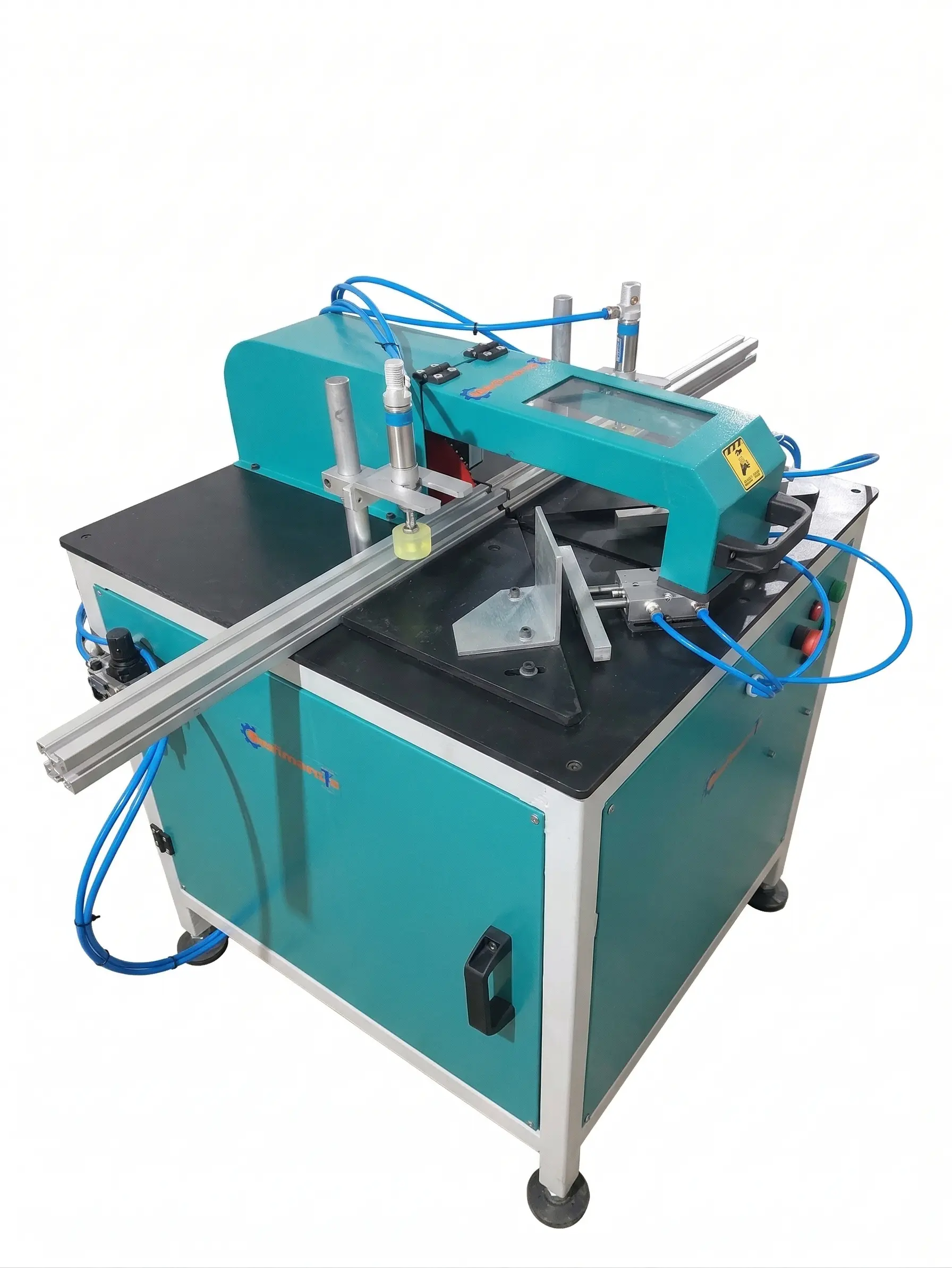
Achieving a perfect 90-degree corner starts with the precision of your aluminium profile cutting machine. In my 15 years on the shop floor, I have observed that most 'gapping' issues stem from blade deflection during the final 5mm of the stroke. When the blade enters a 2.5mm thick Hindalco or Jindal profile, the heat generation causes micro-expansions. If your machine lacks a heavy-duty cast-iron base, the vibration translates directly into the cut face, resulting in a 'wavy' surface that prevents a flush fit.
To ensure structural integrity according to IS 1285 and BS EN 12020 standards, consider these technical requirements:
- Spindle Speed: For aluminium, you need a minimum of 2800 to 3200 RPM. Anything lower causes 'tearing' of the metal rather than a clean shear.
- Blade Diameter: A 500mm carbide-tipped blade is the standard for high-rise profiles to ensure the blade center remains stable during the cut.
- Clamping Pressure: Pneumatic clamps must deliver at least 6-8 bar of consistent pressure. If the profile shifts even 0.5mm, your miter is ruined.
- Coolant Delivery: A mist spray system is non-negotiable to prevent aluminum chips from welding to the blade teeth.
Technical Comparison: Local Suppliers vs. Precision Engineering
When evaluating an aluminium cutting machine price, many Pune-based SMEs make the mistake of comparing sticker prices without looking at the 'Total Cost of Quality.' A local manual aluminium cutter machine 12 inch might cost less upfront, but the rework rate on a 500-window project will eat your margins. In contrast, an automatic double head cutting saw for aluminium profiles ensures that both ends of the sash are cut simultaneously, eliminating the cumulative error found in single-head machines.
We recently compared three common configurations used in Maharashtra workshops:
- Manual 12-inch Cutters: High operator fatigue, 1.5mm variance, suitable only for low-end residential repair.
- Semi-Automatic Single Head: Better precision (+/- 0.5mm), but slow throughput for large-scale Pune projects.
- CNC Double Head Saws: The gold standard for high-rise work, offering +/- 0.1mm accuracy and integrated digital length positioning.
Hands-on Case Study: Reducing Waste in our Pune Testing Facility
In our Mechnovate facility, we conducted a 6-week controlled test comparing a standard local aluminum cutting machine against our high-precision automatic aluminium window production line price setups. We processed 1,000 meters of thermal-break aluminium profile, simulating a typical Pune luxury apartment contract.
The results were measurable and immediate:
- Cutting Waste: Reduced from 12% to 3% because we eliminated the 'trial cut' phase usually required to calibrate manual angles.
- Output Speed: We increased output from 25 frames per day to 65 frames per day with a single operator.
- Joint Quality: 98% of joints passed the 'feeler gauge' test (0.05mm gap max) on the first attempt, compared to only 60% on the legacy equipment.
Checklist for Purchasing High-Rise Ready Machinery
Before signing a contract with any aluminium window fabrication machine suppliers Pune, walk through this technical checklist to ensure the equipment can handle 20+ story wind loads:
- Check the Bed Weight: A machine weighing less than 800kg will vibrate too much for precision miter cuts.
- Verify the Linear Guides: Ensure the machine uses HIWIN or equivalent high-precision linear rails for the moving head.
- Inspect the Milling Capability: If you are also doing uPVC, look for a heavy duty aluminium profile end milling machine that handles multi-stack profiles to save time.
- Safety Standards: Ensure the machine meets ISO or CE standards for blade guarding and emergency stops.
- After-Sales Support: Ask for the location of their service technicians in Pune. A machine down for two days during a site handover is a financial disaster.
Common Mistakes in Pune Workshops
One of the most frequent errors I see is using the same blade for uPVC and aluminium. A upvc cutting machine blade has a different tooth geometry than an aluminium cutter. Using a uPVC blade on aluminium causes 'burring,' which prevents the miter joint from closing perfectly. Furthermore, many workshops neglect the aluminium punching machine calibration. If your corner cleat holes are off by even 0.2mm, the cleat will pull the miter open when tightened, regardless of how perfect the cut was.
FAQ: Critical Questions for Pune Fabricators
Q: Can I use a 12-inch blade for high-rise window profiles? A: No. High-rise profiles are typically wider and thicker to handle wind pressure. A 12-inch aluminium cutter machine lacks the depth of cut and stability. We recommend a minimum of 450mm or 500mm blades for industrial-grade work.
Q: What is the ROI on an automatic double-head saw compared to a single-head? A: In a typical Pune workshop processing 40 windows a day, the labor savings and waste reduction usually pay for the machine within 14 to 18 months. This doesn't include the value of winning higher-margin contracts that require precision certification.
Q: Do you provide training for operators in Pune? A: Yes, precision machinery requires an understanding of feed rates and material handling. Most reputable suppliers will provide 3-5 days of onsite technical training to ensure your team isn't just 'using' the machine, but 'optimizing' it for the specific profiles you use.