Eliminating Milling Inaccuracies in Thane Aluminium Workshops
The Financial Impact of Milling Inaccuracies in Thane Fabrication
In the competitive landscape of Thane’s industrial hubs, from Wagle Estate to Ghodbunder Road, precision is the only way to protect your margins. Many fabricators are currently losing 8% to 15% of their raw material—premium 6063 T5 aluminium profiles—due to avoidable milling errors. When a lock hole is misaligned by even 1.2mm, or a water drainage slot is 'chattered' rather than cut, that entire profile often becomes expensive scrap. If you are still relying on manual slotting or low-speed routers, you are essentially throwing money onto the workshop floor.
A copy router machine is designed specifically to eliminate these variables. By using a 1:1 ratio template and high-frequency motors, these machines provide the repeatability that manual fabrication lacks. In this guide, we will analyze the engineering behind these machines and how they solve the specific waste challenges faced by aluminium workshops in Thane.
Case Study: Reducing Waste from 12% to 2.8% in a Thane Workshop
Last year, we partnered with a mid-sized fabrication unit in Thane that was struggling with high rejection rates on a large-scale commercial project involving high-performance thermal break profiles. They were using traditional drilling methods and a low-speed (6,000 RPM) domestic router. The rejection rate on their lock-hole processing was 12%, largely due to 'smearing'—where the aluminium melts rather than chips because the bit speed is too low.
We implemented a high-speed copy router with an 18,000 RPM spindle and integrated pneumatic misting. Over a 6-week testing period, we recorded the following metrics:
- Waste Reduction: Material waste dropped from 12% to 2.8%.
- Output Increase: The workshop moved from 25 frames per day to 65 frames per day with the same staff.
- Quality Consistency: The rejection rate from the site's quality control (QC) team fell to near zero because the holes were perfectly burr-free.
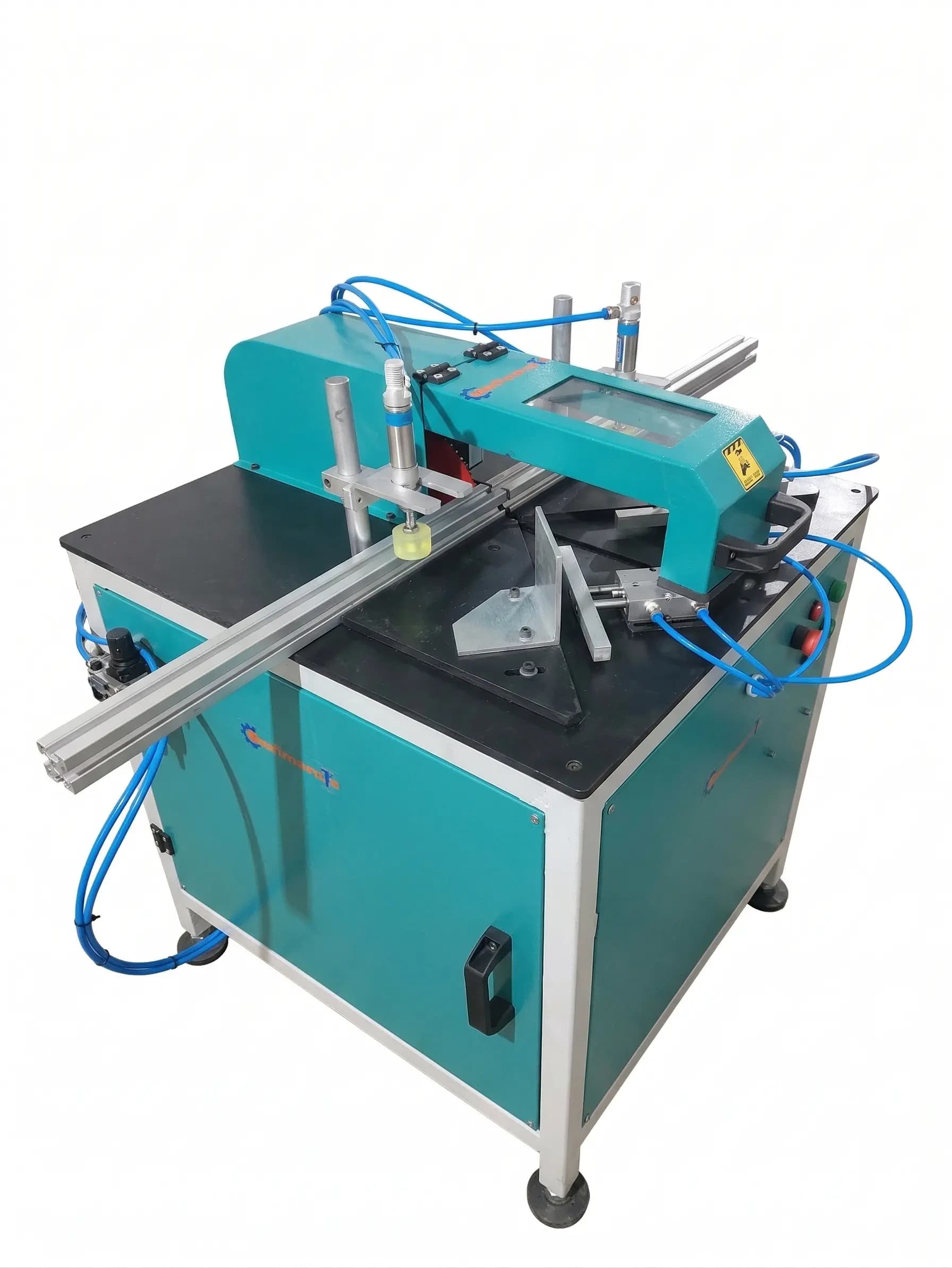
This shift wasn't just about speed; it was about the physics of the cut. By increasing the RPM and utilizing a dedicated aluminium profile cutting machine for the initial sizing, the fabricator ensured that every subsequent milling operation was performed on a perfectly square substrate.
Technical Mastery: Why 12,000 RPM is the Magic Number for Aluminium
To understand why a high speed copy router for aluminium windows is superior, you must understand 'Chip Load.' Aluminium has a high thermal conductivity. If your tool rotates too slowly, it dwells in the material too long, generating heat that fuses the swarf back onto the profile. This leads to broken bits and inaccurate holes.
- Motor Specifications: We recommend spindles between 0.75kW and 1.5kW. These should be high-frequency motors capable of maintaining 12,000 to 18,000 RPM even under load.
- Collet Precision: Use ER16 or ER20 collets to minimize spindle runout. Any runout in the spindle will be amplified at the tip of the bit, leading to oversized slots.
- Pneumatic Clamping: Manual clamps allow the profile to vibrate. High-speed routers use dual pneumatic vertical and horizontal clamps (operating at 6-8 bar) to solidify the workpiece, ensuring the cut follows the template exactly.
- Cooling Systems: A pressurized misting system using a vegetable-based lubricant is essential. This not only cools the bit but also flushes the chips out of the slot, preventing double-cutting of chips which causes surface finish degradation.
Essential Standards: IS 1285 and BS EN 12020 Compliance
In the Indian market, particularly when bidding for government or high-end residential contracts, your output must meet specific standards. IS 1285 covers the specifications for wrought aluminium and aluminium alloy extruded round tube and hollow sections for general engineering purposes. Furthermore, BS EN 12020 defines the tolerances on dimensions and form for precision profiles.
If your milling process is imprecise, you cannot guarantee compliance with these standards. A high-speed copy router ensures that the wall thickness integrity of the profile is maintained. When you use a blunt tool or low RPM, you risk micro-fracturing the area around the cut, which can lead to structural failure under wind-load stress—a critical factor for high-rise developments in Thane.
Avoiding Common Operator Mistakes with Copy Routers
Even with the best machinery, operator error can introduce inaccuracies. In my 15 years on the shop floor, I’ve identified four common mistakes that lead to material waste:
- Dirty Templates: A single aluminium chip trapped between the tracer pin and the template will translate into a 1mm or 2mm error on the profile. Always clean templates with compressed air between every cycle.
- Incorrect Bit Length: Using a bit that is too long for the depth required increases 'deflection.' Use the shortest bit possible for the job to maintain maximum rigidity.
- Forcing the Feed: Operators often try to 'muscle' the router through the profile. You should let the high RPM do the work. If the operator has to push hard, the bit is likely blunt or the RPM is too low.
- Neglecting the Aluminium Punching Machine: For standard weep holes or handle holes, a punching machine is often more accurate and faster. Use the copy router for more complex, non-standard shapes where a punch die isn't available.
Comparing High-Speed Copy Routers vs. Manual Slotting
| Feature | Manual Slotting (Drill + File) | High-Speed Copy Router |
|---|---|---|
| Time per Lock Hole | 8-12 Minutes | 45-60 Seconds |
| Accuracy Tolerance | +/- 2.0 mm | +/- 0.1 mm |
| Finish Quality | Rough/Burred | Mirror Finish |
| Waste Probability | High (Human Error) | Low (Template Guided) |
| Operator Fatigue | High | Low |
FAQ: Real Questions from Thane Fabricators
Q: Can I use my uPVC copy router for aluminium? A: Generally, yes, but only if the motor supports the higher RPM required for aluminium and you have installed a mist-cooling system. uPVC is often routed at lower speeds to prevent burning, whereas aluminium requires high speed to prevent melting.
Q: What is the typical life expectancy of a carbide bit? A: With a proper misting system and 12,000+ RPM, a high-quality solid carbide bit should last for 600-800 cycles. Without cooling, this drops to less than 100 cycles.
Q: Is it worth investing in a double-head copy router? A: If you are processing a high volume of profiles that require identical milling on both sides (like certain curtain wall sections), a double-head machine can cut your processing time by 50%. However, for most residential window fabrication in Thane, a single-head high-speed unit is the most cost-effective aluminum cutting machine price investment.
Get more articles like this
Follow Mechnovate on Google to see our guides in Google Discover & News