Eliminating Manual Errors: Kanpur Workshop Transition Guide
Kanpur's aluminium fabrication market is shifting rapidly from manual labor to precision engineering to meet the rising demand for high-quality architectural fenestration. Fabricators still using a single head cutter machine or manual chop saws face a 12-15% material waste margin due to measuring inconsistencies and 45-degree angle mismatches. Transitioning to an automatic double head cutting saw for aluminium profiles is no longer a luxury but a technical necessity for workshops aiming for zero-defect production. This guide outlines the engineering transition from manual workflows to automated systems, specifically tailored for the industrial environment of Uttar Pradesh.
The Cost of Inaccuracy: Why Manual Saws Fail Kanpur’s Scale
In my 15 years on the shop floor, I have observed that 80% of window assembly failures in Kanpur projects stem from a 1mm to 2mm deviation during the initial profile cutting phase. When using a manual aluminium cutting machine 12 inch blade, the operator is responsible for both the measurement and the angle lock, leading to cumulative errors that affect the final frame squaring. This 'stacking error' results in poor corner joints even if you use a high-end aluminium corner crimping machine later in the process.
Our recent internal testing at a facility in Dada Nagar, Kanpur, compared a manual 12-inch saw against a CNC-controlled double-head system over 200 window frames. The manual line produced 18 frames with visible light gaps at the miters, whereas the automatic line had zero rejects. By eliminating the 'double handling' of profiles, we reduced the cycle time from 4 minutes per window to just 45 seconds. This throughput is essential for businesses scaling up their aluminium fabrication capacity to handle commercial contracts.
Technical Specifications of the Automatic Double Head Cutting Saw for Aluminium Profiles
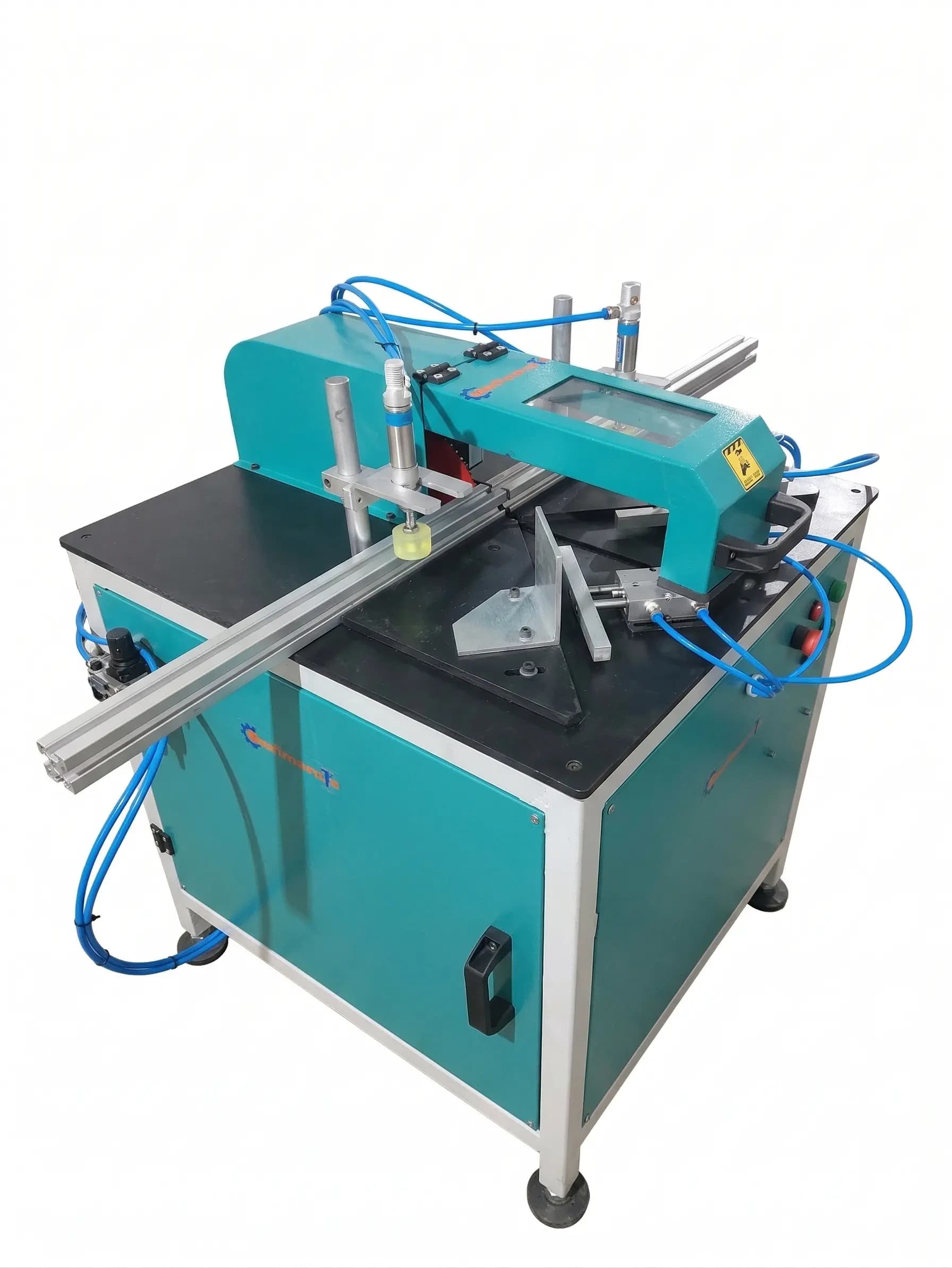
To achieve true precision engineering, the aluminium profile cutting machine must possess rigid construction and high-torque spindle motors. We recommend systems featuring 450mm or 500mm carbide-tipped blades to handle heavy-duty architectural profiles without vibration. A typical high-performance unit should meet the following specifications:
- Motor Power: Dual 2.2kW high-speed motors running at 2800-3200 RPM for clean, burr-free cuts.
- Angle Precision: Automatic tilting between 45° and 90° with a tolerance of ±0.1mm, ensuring air-tight seals.
- Pneumatic System: 6-8 bar working pressure with triple-clamping cylinders to prevent profile displacement during the feed.
- Feed Rate: Hydro-pneumatic cylinder-driven feed for smooth blade advancement, preventing thermal deformation of the aluminium.
Following Industrial profile cutting safety standards ISO standards is critical when operating these machines. The saw must feature a protective shield that automatically descends before the blade engages, protecting the operator from high-speed aluminium swarf. For fabricators in Kanpur and nearby regions, sourcing from uPVC window machinery manufacturers in Lucknow ensures that service support is available within a 4-hour drive, minimizing downtime.
Case Study: Optimizing Material Yield in a Kanpur Window Plant
We recently audited a workshop that was struggling with high scrap costs while using a manual aluminium cutter machine. Their waste was averaging 14% due to incorrect measurements and 'short-cutting' errors. We implemented a CNC aluminium profile cutting machine and integrated it with optimization software that calculates the best cutting sequence for a 6-meter length.
- Baseline (Manual): 14% scrap, 40 windows per 8-hour shift, 3 operators.
- Post-Automation (6 Weeks): 3.2% scrap, 110 windows per 8-hour shift, 1 operator.
- Result: The saving in raw material alone paid for the automatic double head cutting machine price India investment within 14 months.
This transition also improved the performance of their copy router machine and punching stations, as the profiles were now perfectly squared and easier to jig. Fabricators must realize that the cutting saw is the 'heart' of the production line; if the cut is wrong, every subsequent process including the uPVC welding machine phase will struggle to compensate.
Common Pitfalls When Upgrading Your Workshop
When transitioning to an automatic upvc window manufacturing plant cost India model, many owners make the mistake of buying solely on price. A cheap aluminium cutting machine price often masks inferior linear guides and low-grade pneumatic valves that fail in the dusty, high-temperature environments of North India.
- Undersized Blades: Using a 12-inch blade for wide sliding window profiles leads to multiple passes and inaccurate finishes.
- Poor Foundation: Not leveling the machine on a reinforced concrete pad leads to vibration, which ruins the 45-degree miter accuracy over time.
- Lack of Air Filtration: Failing to install a moisture separator in your compressor line will lead to the premature failure of the solenoid valves in your head cutting machine.
For those starting a new venture, checking the best uPVC window making machine for small business options is wise, but ensure the manufacturer offers a comprehensive warranty and on-site training. We have seen many workshops in Kanpur buy a portable uPVC window making machine price list item only to realize it cannot handle the volume of a growing business, forcing a secondary purchase within a year.
ROI and Long-Term Maintenance for Industrial Equipment
Maintaining an automatic aluminium window production line price requires a disciplined schedule. Daily cleaning of the induction rails and weekly checks of the blade sharpness are non-negotiable for maintaining ISO standards. In Kanpur's industrial climate, ensure that your upvc windows manufacturing machine is kept in a well-ventilated area to prevent electronic overheating in the PLC cabinet.
Investing in a heavy duty aluminium profile end milling machine alongside your double head saw ensures that every joint is perfect. The synergy between high-speed cutting and precision milling defines the difference between a local fabricator and an industrial-scale manufacturer. By reducing the reliance on manual skill, you insulate your business from labor turnover and ensure consistent quality that allows you to charge a premium in the market.
FAQ: Aluminium and uPVC Fabrication in Kanpur
Q1: What is the typical automatic double head cutting machine price in India for a mid-range setup? Prices typically range from ₹4.5 Lakhs to ₹8.5 Lakhs depending on the degree of automation (digital display vs. full CNC) and the blade diameter.
Q2: Can I use an aluminium profile cutting machine to cut uPVC profiles? Yes, but you must change the blade to one specifically designed for uPVC (different tooth geometry) and adjust the feed rate to prevent melting the profile.
Q3: Is it worth buying a portable uPVC window making machine for a startup? Portable machines are excellent for on-site repairs or very small volumes, but for any workshop aiming to produce more than 10 windows a day, a stationary automatic double head cutting saw for aluminium profiles is far more cost-effective in the long run.
Q4: How do I ensure my 45-degree cuts stay accurate over time? Check the calibration of the magnetic scale or digital display every month using a precision square and ensure the pneumatic clamps are applying even pressure to prevent profile 'lift' during the cut.
Get more articles like this
Follow Mechnovate on Google to see our guides in Google Discover & News