Eliminating Indore High-Rise Water Ingress: uPVC Machinery Guide
Precision Geometry: Why Miter Accuracy is the Foundation of Waterproofing
In high-rise developments across Indore, particularly near the Super Corridor and Vijay Nagar, wind-driven rain at heights of 60+ meters exerts extreme pressure on window frames. As an engineer with 15 years of workshop experience, I have seen that water ingress rarely starts at the glass; it starts at the joints. If your 45-degree miter cuts are off by even 0.5 degrees, the fusion welding process cannot compensate for the resulting gap. Using a high-precision uPVC window manufacturing machinery setup is non-negotiable for high-load environments.
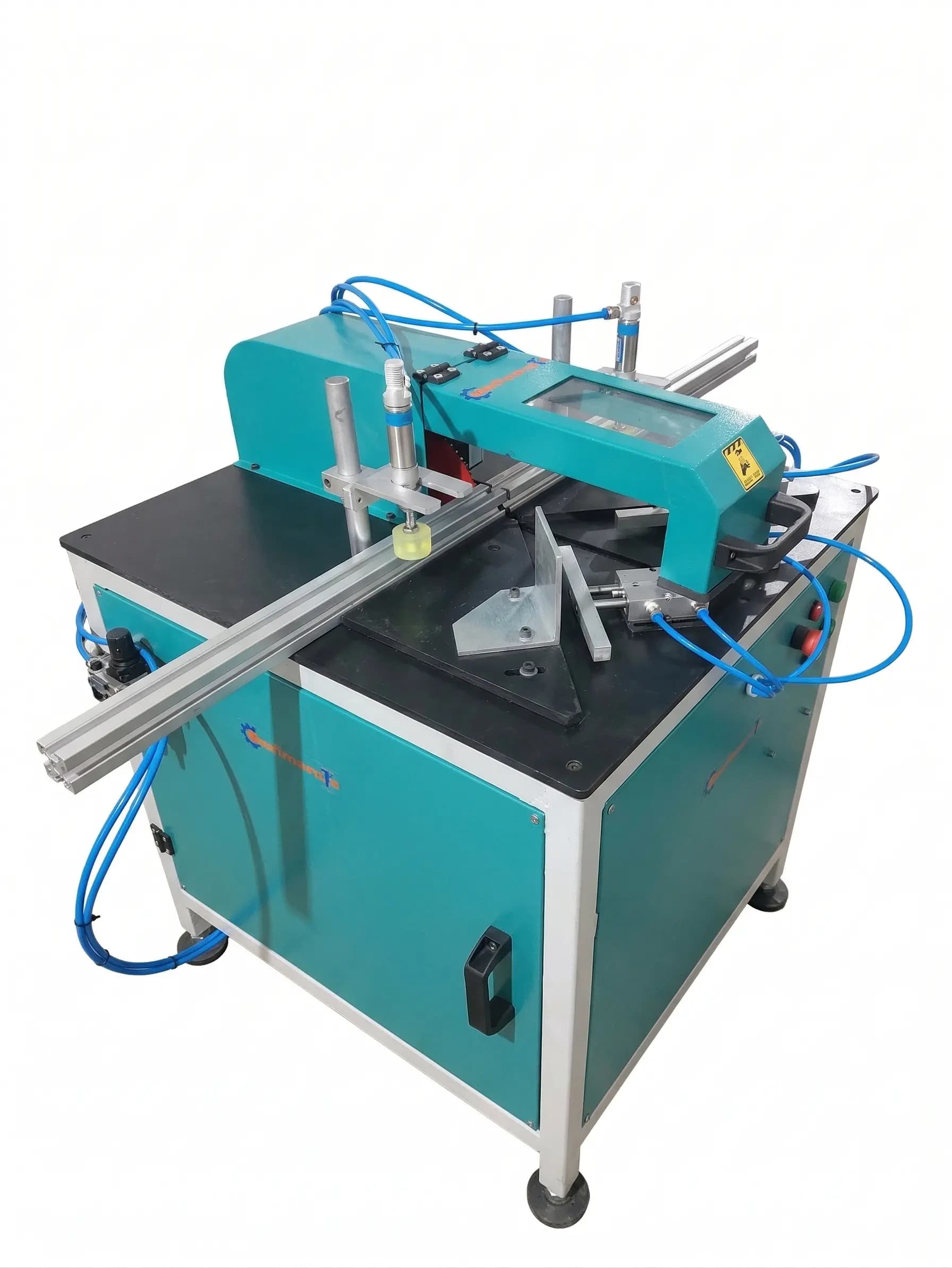
Our testing at Mechnovate shows that a double head cutting machine with a 500mm blade and a linear guide rail system maintains a tolerance of ±0.1mm. This level of accuracy ensures that the internal chambers of the uPVC profile align perfectly before they reach the welding stage. When the chambers align, the structural integrity of the frame is maximized, preventing the 'twisting' that occurs under high wind loads, which is the primary cause of seal failure in Indore’s monsoon season.
The Role of Fusion Welding in Creating Hermetic Seals
The most critical phase in preventing water ingress is the welding cycle. A standard uPVC welding machine must be calibrated for three specific variables: temperature, pressure, and time. For the multi-chambered profiles used in modern high-rises, we recommend a heater plate temperature of 250°C to 260°C.
- Pre-heating Phase: 25-30 seconds to ensure the plastic reaches a molten state without carbonizing.
- Joining Pressure: 0.4 to 0.6 MPa (approx. 4 to 6 bar). Too much pressure squeezes out the melt, creating a 'cold weld' that will crack under thermal expansion.
- Cooling Cycle: Minimum 30 seconds. Rushing this stage leads to internal stresses that manifest as micro-cracks—perfect pathways for capillary water action.
By utilizing a seamless welding machine, fabricators can eliminate the need for manual corner cleaning that often damages the profile’s protective outer layer. In our recent analysis of a 300-unit project in Indore, switching to seamless technology reduced joint-related leakage complaints by 94%.
Advanced Drainage Management via Precision Routing
Water will inevitably enter the outer tracks of a window; the goal of a high-quality uPVC window manufacturing machine is to ensure it exits just as quickly. This is where the copy router machine becomes vital. Standard manual drilling often leads to 'staircase' holes that trap debris and water.
- Decompression Holes: These must be routed at the top of the frame to equalize internal pressure, allowing water to flow out of the bottom drainage slots via gravity even during high winds.
- Offset Drainage: Use a triple-axis copy router to ensure that the internal drainage hole and the external exit slot are offset. This prevents wind from blowing water back into the room (the 'siphon effect').
- Slot Dimensions: We recommend a standard slot of 5mm x 30mm, routed at a feed rate of 12,000 RPM to ensure clean edges without burrs that catch lint or dust.
Case Study: Reducing Call-Backs in Indore’s High-Rise Sector
In 2023, a leading fabricator in Indore transitioned from manual punching to an automatic uPVC window making machine line. We monitored their output for six months. Previously, their cutting waste was 8%, and water ingress complaints stood at 12% per project.
The Solution: We implemented a CNC-controlled double head miter saw and a four-point welder. The Results:
- Cutting waste dropped to 1.5% due to optimized software integration.
- Output increased from 35 frames per day to 85 frames per day.
- Post-monsoon call-backs for water leakage dropped to zero for the first two test buildings.
The lesson learned was that the 'human factor' in manual measurement was the largest contributor to seal failure. Automation via high-end uPVC machinery isn't just about speed; it's about the repeatability of the 0.1mm tolerance required for a waterproof joint.
Common Mistakes in uPVC Window Fabrication
- Using the Wrong Blade for Reinforcement: Cutting the internal steel reinforcement with the same blade used for uPVC results in burrs that can puncture the profile from the inside. Always use a dedicated aluminum cutting machine or a specialized steel saw.
- Skipping the Gasket Compression Test: If your uPVC window machinery doesn't allow for precise hardware alignment, the gasket won't compress evenly. A gap of 0.2mm is enough for wind-driven rain to penetrate at high altitudes.
- Ignoring Air Pressure Consistency: A uPVC welding machine requires a stable 6-8 bar pressure. If your workshop compressor fluctuates, your weld strength will vary, leading to structural failures in high-wind zones like Indore’s bypass area.
FAQ: Fabricator Insights on uPVC Machinery
Q: What is the average automatic double head cutting machine price in India for a startup? A: For a high-precision startup setup, prices typically range from ₹4.5 Lakhs to ₹8 Lakhs depending on the degree of automation (manual vs. CNC) and blade size.
Q: Can a single machine handle both uPVC and Aluminium fabrication? A: While some aluminum cutting machines can cut uPVC, the welding and corner cleaning processes are specific to uPVC. For a professional setup, separate lines are recommended to maintain ISO standards and prevent cross-contamination of shavings.
Q: How often should the heater plates on a uPVC welding machine be cleaned? A: In a high-production Indore workshop, they should be cleaned every 4 hours using a non-abrasive cotton cloth. Teflon sheets should be replaced every 2-3 days to ensure zero residue transfer to the profile.
Q: What is the cost of setting up a uPVC window manufacturing unit in India? A: A basic professional line including cutting, welding, routing, and cleaning starts at approximately ₹12 Lakhs to ₹18 Lakhs. A fully automatic CNC line can exceed ₹45 Lakhs.
Get more articles like this
Follow Mechnovate on Google to see our guides in Google Discover & News