Eliminating Hardware Fitment Errors: High Speed Copy Router Guide
Hardware misalignment is the primary cause of post-installation service calls for window fabricators in Nagpur. When multi-point locks do not engage smoothly, it is rarely a fault of the lock itself; rather, it is an error in the routing of the handle holes and locking slots. Using a high-speed Copy Router Machine is the only engineering-grade solution to ensure that the 0.5mm tolerances required for modern hardware are consistently met. This guide breaks down the technical transition from manual errors to precision engineering in local workshops.
Why Precision Routing is Mandatory for Nagpur Fabricators
In the Nagpur climate, where temperatures fluctuate significantly, thermal expansion of aluminium and uPVC profiles is a critical factor. If a routing slot for a multi-point lock is even 1mm off-center, the expanding profile will cause the hardware to bind, leading to latch failure. Traditional manual methods using handheld drills or die grinders cannot maintain the perpendicularity required for deep-profile routing. High-speed copy routers solve this by using a 1:1 template ratio and a high-frequency motor that operates between 12,000 and 18,000 RPM.
At Mechnovate, we have observed that workshops using a dedicated Aluminium Punching Machine for corner joints still struggle with hardware fitment because they overlook the routing stage. A high-speed copy router ensures that the "chatter"—the vibration of the bit against the metal—is minimized. This results in a burr-free finish that allows hardware to sit flush against the internal chamber of the profile, meeting ISO 9001 quality standards for assembly.
Case Study: 40% Efficiency Increase in Kalmeshwar MIDC Facility
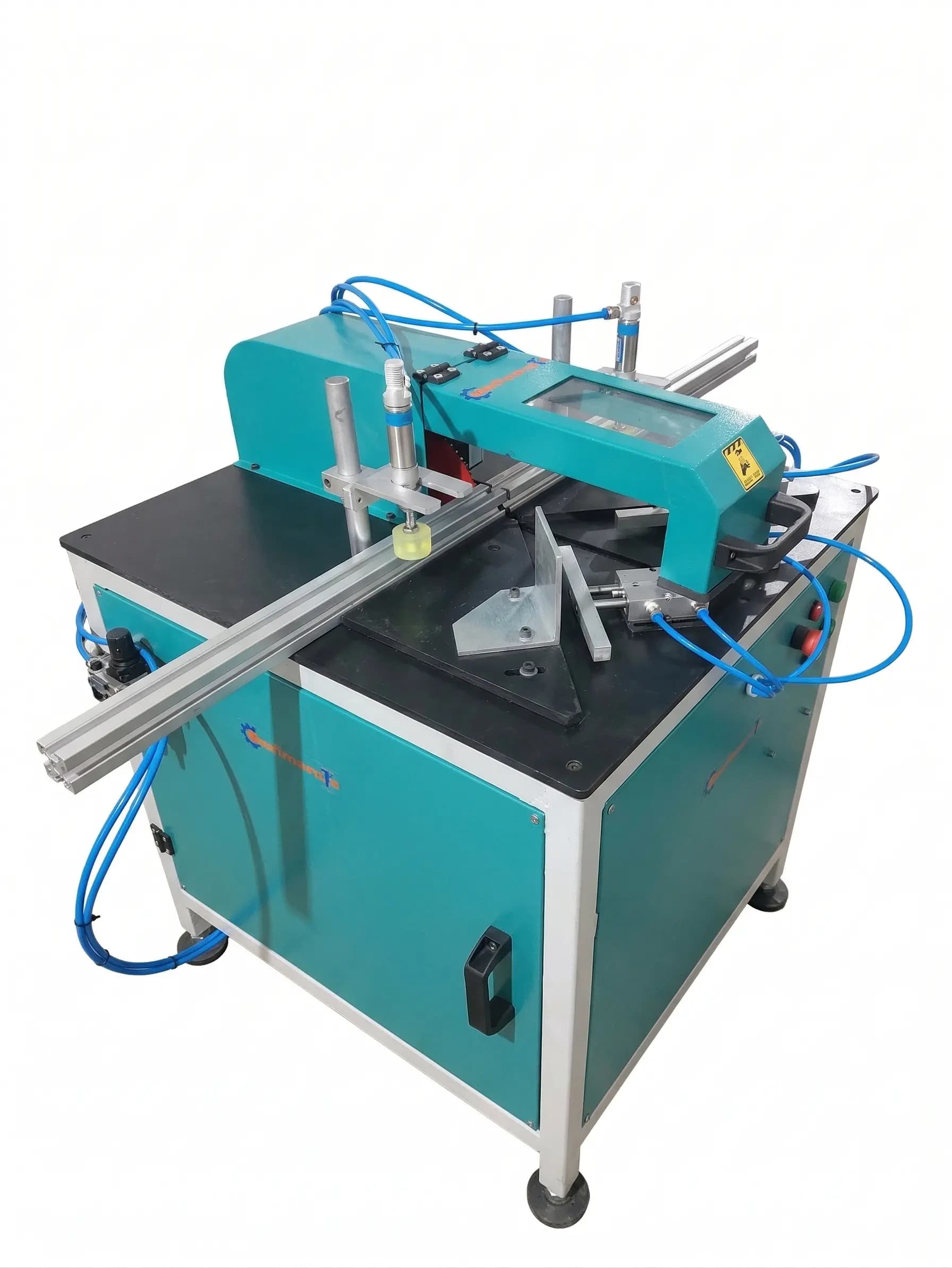
In early 2023, we worked with a large-scale fabrication unit in the Kalmeshwar MIDC area of Nagpur that was facing a 12% rejection rate on their premium casement series. The primary issue was the manual routing of the ESPAG lock slots. We implemented a high-speed Double Head Cutting Machine alongside a pneumatic copy router to standardize their workflow.
Over a six-week testing period, we recorded the following measurable results:
- Waste Reduction: Cutting and routing waste dropped from 9% to less than 2%.
- Output Growth: The facility increased its daily output from 35 frames to 58 frames without adding extra labor.
- Fitment Accuracy: Hardware installation time per window was reduced from 14 minutes to 4 minutes because no manual filing was required.
The engineering reasoning is simple: by using pneumatic horizontal and vertical clamps, the profile is held in a fixed coordinate system. This eliminates the 'human variable' that causes 99% of fitment errors in Indian workshops.
Technical Specifications for Multi-Point Locking Success
To achieve professional results, you must look beyond basic motor power. When comparing an aluminium cutter machine price or a upvc machine price list, the spindle run-out (eccentricity) is the most important metric. For multi-point locking, follow these engineering parameters:
- Spindle Speed: Minimum 12,000 RPM. Lower speeds cause the bit to 'grab' the aluminium, resulting in jagged edges and broken bits.
- Bit Material: Use solid carbide bits for uPVC and HSS (High-Speed Steel) with cobalt for aluminium profiles.
- Cooling System: An automated spray mist lubrication system is essential for aluminium to prevent the metal from melting onto the bit.
- Template Thickness: Ensure your templates are at least 3mm hardened steel to prevent the tracer pin from wearing down the pattern over time.
While many fabricators look toward aluminium window machinery manufacturers in Ahmedabad Gujarat for budget options, the local support for calibration in Nagpur is often missing. Our experience shows that a machine is only as good as its last calibration. We recommend checking the belt tension and spindle alignment every 200 operating hours to maintain precision.
Common Mistakes in Industrial Profile Cutting
Many workshops make the mistake of using a standard wood router for aluminium fabrication. This is a safety hazard and an engineering failure. Wood routers lack the torque and the specialized bearings required to handle the lateral load of cutting through 2.5mm thick aluminium extrusions.
Another frequent error is neglecting the 'step-cutting' process. For deep profiles, the operator should never attempt to cut through both walls of the profile in a single pass. Instead, the copy router should be used to cut the top wall, then flipped or adjusted to cut the bottom wall. This prevents bit overheating and ensures that the holes remain perfectly aligned for the lock spindle.
5 Steps to Optimize Your Routing Workflow
- Template Alignment: Secure the template using the center-line of the profile, not the edges, to account for slight extrusion variances.
- Pneumatic Pressure: Maintain a constant 6-8 bar pressure to ensure the profile does not shift during the high-torque routing phase.
- Depth Setting: Use the turret-style depth stop to set three different depths: one for the handle hole, one for the lock body, and one for the screw fixings.
- Lubrication Pulse: Set the mist sprayer to trigger 0.5 seconds before the bit touches the metal.
- Deburring: Even with high-speed machines, a quick pass with a deburring tool ensures the powder coating or anodizing is not scratched during hardware installation.
FAQ: Fabricator Concerns in Nagpur
Q1: Can I use the same copy router for both uPVC and Aluminium? Yes, most industrial copy routers are designed for both. However, you must change the bit and the RPM settings. Aluminium requires higher lubrication and slightly lower speeds than uPVC to prevent melting.
Q2: What is the average lifespan of a router bit on a high-speed machine? In a standard 8-hour shift, a high-quality carbide bit should last 3-4 weeks if the lubrication system is functioning correctly. If you see smoking or hear a high-pitched squeal, the bit is dull and will cause fitment errors.
Q3: How does a copy router compare to a CNC machine for a small Nagpur workshop? For a workshop producing 20-50 windows a day, a manual copy router is more cost-effective and faster to set up. CNC machines are excellent for 100+ frames but require specialized G-code programming that is often overkill for standard window series.
Q4: Is a single-head or double-head router better for multi-point locks? A single-head machine is sufficient if it has a triple-drill attachment for the handle holes. This allows you to drill the three handle holes and rout the lock slot in one clamping cycle, which is the gold standard for accuracy.
Get more articles like this
Follow Mechnovate on Google to see our guides in Google Discover & News