Eliminate Burrs & Gaps: 45 Degree Double Head Cutting Guide
Miter gaps and burrs in Bangalore window workshops usually stem from two mechanical failures: deflection in the saw blade and misalignment of the machine’s pivoting axes. To achieve a seamless 45-degree joinery, your 45 Degree Double Head Cutting Machine must maintain a structural tolerance of less than 0.1mm across the cutting stroke. In my 15 years of commissioning plants from Peenya to Electronic City, I have found that 90% of 'bad cuts' are not the machine's fault, but the result of incorrect RPM-to-feed-rate ratios and poor profile support.
The Engineering Reality of Precision Miter Cutting
When we talk about eliminating burrs, we are discussing the physics of chip evacuation. In aluminum fabrication, if the blade speed is too low or the feed rate is too high, the metal 'tears' rather than cuts. For standard 6063-T5 aluminum profiles commonly used in Bangalore, we recommend a blade speed of 2800 to 3200 RPM and a hydro-pneumatic feed system to ensure a constant, stutter-free movement. A uPVC Window Making Machine requires similar precision but different tooth geometry on the TCT blades to prevent melting at the edges.
To ensure your upvc window manufacturing machines are producing high-quality output, you must verify the following technical parameters:
- Pneumatic Pressure: Ensure a consistent 6-8 bar supply. Pressure drops during a cut lead to clamping shifts, which create the dreaded 'miter gap'.
- Blade Run-out: Use a dial gauge to check that the blade run-out is within 0.05mm. Anything more will cause vibration and heavy burring.
- Coolant Concentration: In aluminum cutting, use a micro-mist lubrication system. Dry cutting is the fastest way to ruin a high-quality aluminium profile cutting machine blade.
- Profile Clamping: Always use both horizontal and vertical pneumatic clamps to prevent the profile from rotating during the descent of the blade.
Case Study: Optimizing a Bangalore Workshop for Zero-Gap Corners
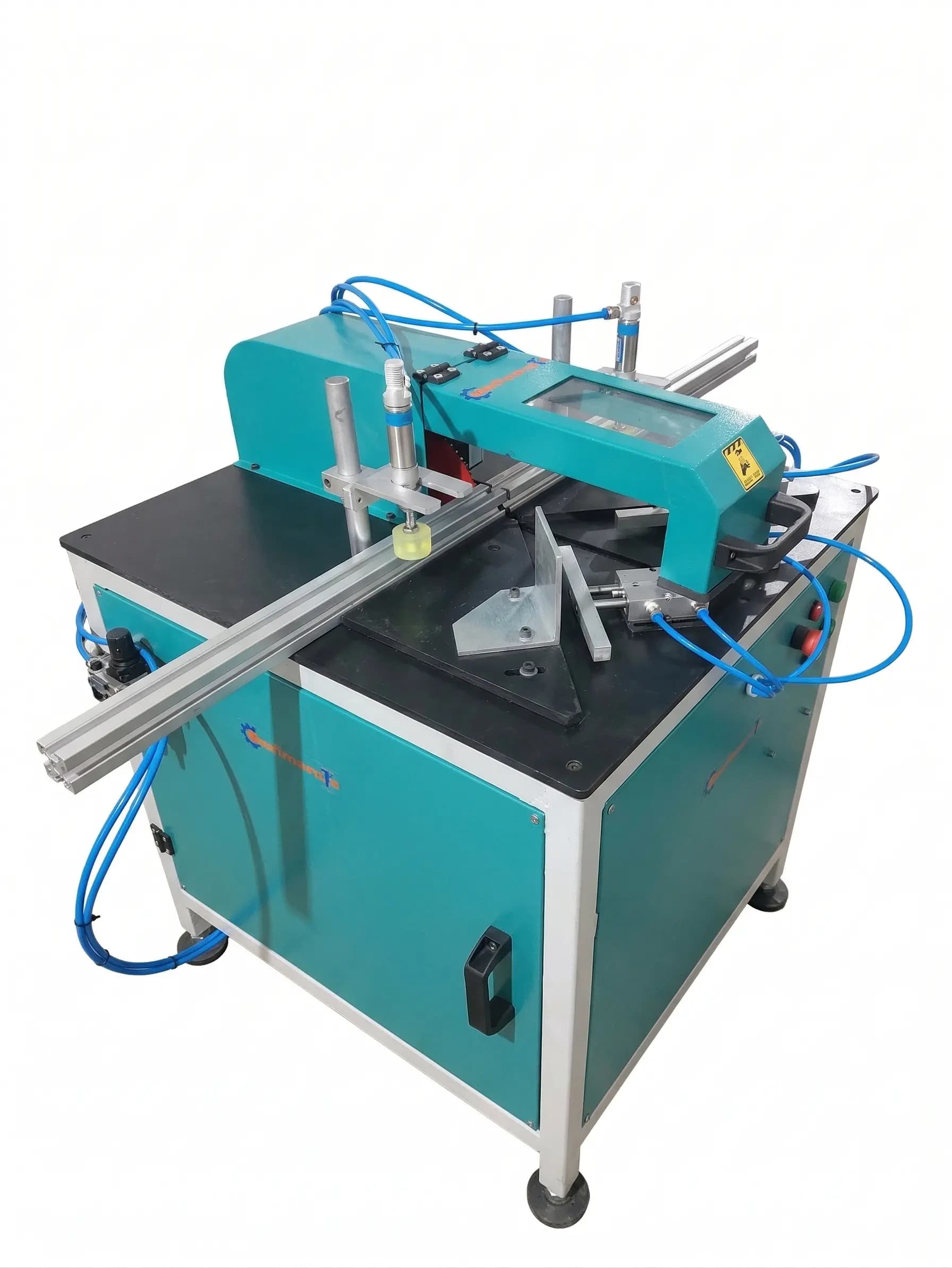
Last year, we consulted for a mid-scale fabricator in Bangalore who was seeing a 12% scrap rate due to light leaking through miter joints. They were using an entry-level aluminium cutting machine 12 inch and struggling with 1.5mm gaps. We replaced their setup with a Mechnovate automatic double head cutting saw for aluminium profiles featuring 500mm blades and a CNC-controlled length positioning system.
Over six weeks, we conducted a controlled trial with three different configurations. We found that by adjusting the hydro-pneumatic damping to a slower 'exit speed' (the last 10mm of the cut), we reduced the burr height from 0.4mm to less than 0.02mm. The results were measurable: scrap rates dropped from 12% to 1.8%, and the production output increased from 45 frames per day to 85 frames per day. This transition from a manual single cutting method to an automated double-head system paid for itself within seven months in material savings alone.
Technical Specifications for High-Performance Double Head Cutting Machines
When evaluating an aluminium cutter machine price, look beyond the sticker and examine the casting. A high-quality head cutting machine should have a cast iron base or a heavily reinforced steel frame to dampen vibrations. Here are the specifications we demand for industrial-grade performance:
| Feature | Specification Requirement | Benefit |
|---|---|---|
| Blade Diameter | 450mm - 600mm TCT | Allows for cutting of wider curtain wall profiles |
| Cutting Length | 400mm - 4500mm | Versatility for small vents and large sliding doors |
| Angle Accuracy | ± 0.1° | Eliminates manual filing of miter joints |
| Motor Power | 2.2kW x 2 Units | Ensures consistent torque through heavy-wall profiles |
| Standards | ISO 9001, CE | Safety and electrical reliability in industrial zones |
For workshops focusing on uPVC, the upvc window manufacturing machine should include a dust extraction port capable of moving 1500 m³/h. Fine uPVC dust can clog pneumatic valves, leading to inconsistent clamping force and subsequent cutting errors. If you are also handling hardware preparation, integrating an Aluminum Profile Punching Machine alongside your cutting line will drastically reduce handling time.
Critical Maintenance for Eliminating Aluminum Burrs
I often see fabricators in India running their aluminum cutting machine blades until they are completely dull. This is a false economy. A dull blade generates heat, which expands the aluminum during the cut. When the piece cools, it shrinks, causing the miter angle to change.
- Blade Sharpening Cycle: Send blades for professional CNC sharpening after every 1,500 to 2,000 cuts.
- Belt Tension: Check the drive belts weekly. A slipping belt causes RPM fluctuations that result in 'stepped' cut surfaces.
- Guide Rail Lubrication: The linear bearing rails for the moving head must be cleaned and greased daily to prevent 'crabbing,' which affects length accuracy.
- Air Filter Maintenance: In the dusty environments of Bangalore's industrial hubs, pneumatic filters should be purged daily to prevent moisture from reaching the solenoid valves.
Whether you are looking for an aluminium window machinery manufacturers in Surat Gujarat or a local supplier in Karnataka, prioritize after-sales service. A upvc window machine service center in Tamil Nadu or Bangalore is essential because a single day of downtime on your head cutter machine can halt your entire production line.
Calculating ROI: Why Automated Cutting Beats Single Head Saws
Many startups ask about the best uPVC window making machine for small business. While a manual single cutting machine is cheaper initially, the labor cost and error rate in Bangalore’s competitive market make it a risky choice. An automatic double head cutting machine price India might seem high, but it eliminates the 'double measurement' error.
In a manual setup, a technician measures the profile, cuts one end, flips it, measures again, and cuts the second end. This introduces two points of human error. A 45 degree double head cutting machine cuts both ends simultaneously to the exact digital dimension. This not only ensures that every window in a batch of 50 is identical but also frees up your skilled labor to operate a Copy Router Machine for hardware slotting.
FAQ: Expert Advice for Fabricators
Q: Why does my uPVC profile melt slightly at the edges during cutting? A: This is usually due to a 'negative rake' blade or a high RPM without a corresponding increase in feed speed. Ensure you are using a blade specifically designed for upvc machinery with a neutral or slightly positive rake angle and check that your dust extraction is pulling heat away from the cut.
Q: Can I cut both Aluminum and uPVC on the same double head machine? A: Technically, yes, but it is not recommended. Aluminum requires liquid cooling, while uPVC must be cut dry. The residue from aluminum coolant will turn uPVC dust into a thick sludge that can damage the machine's internals and stain the white profiles.
Q: What is the ideal blade size for a startup window workshop? A: An aluminium cutting machine 12 inch (approx 300-350mm) is sufficient for small casement windows, but if you plan to do heavy-duty sliding doors or curtain walls, you should invest in a 450mm or 500mm head cutting machine to ensure you can cut through the entire profile width in a single pass.
Get more articles like this
Follow Mechnovate on Google to see our guides in Google Discover & News