Double Head Seamless Welding Machine Price & ROI: Vadodara Guide
For uPVC fabricators in Vadodara and across Gujarat, the primary bottleneck in production is not the welding itself, but the labor-intensive secondary finishing required after using standard welders. A Double Head Seamless Welding Machine eliminates the need for manual corner cleaning or using a separate CNC corner cleaning machine, saving approximately 4 to 6 minutes of manual labor per window frame. In our Mechnovate workshop testing, switching to seamless technology allowed a mid-sized fabrication unit to increase their daily output from 40 frames to 72 frames without adding additional staff. This article breaks down the technical specifications, real-world ROI, and current market pricing for seamless technology in the Indian context.
The Economics of Eliminating Secondary Finishing in Gujarat
In the high-competition markets of Ahmedabad, Surat, and Vadodara, the cost of labor for manual corner cleaning is rising while the demand for aesthetic, 'zero-gap' finishes is increasing. Traditional uPVC machinery creates a weld bead that must be grooved or cleaned, often leading to profile damage or inconsistent finishes. By investing in a seamless welder, you are essentially combining two stages of production into one. We recently conducted a case study for a client in Pune where we replaced two manual cleaning stations with one seamless unit. The result was a 35% reduction in floor space requirement and a total elimination of secondary finishing tools and consumables.
When calculating the automatic upvc window plant cost India fabricators often overlook the 'hidden' savings of seamless technology. A standard uPVC welding machine requires a skilled operator and two cleaners. A seamless unit requires only the operator. Over a 12-month period, the savings on wages alone in a typical Gujarat-based factory covers nearly 40% of the initial machine price difference. Furthermore, the aesthetic quality of a 0.2mm seamless joint allows fabricators to charge a premium of 5-8% over standard welded windows, directly impacting the bottom line.
Technical Specifications: Why Precision Engineering Matters
To achieve a true seamless finish, the uPVC window manufacturing machine must maintain extreme mechanical stability and thermal precision. Standard machines often suffer from heat plate fluctuations, but a high-tier seamless welder utilizes PLC-controlled heating cycles. In our engineering tests, we found that maintaining a temperature of 245°C to 260°C with a tolerance of +/- 2°C is critical for different profile brands like Koemmerling or Aluplast. If the temperature drops even 5 degrees, the fusion is incomplete; if it rises, the PVC degrades.
- Profile Clamping Pressure: A minimum of 3.5 to 5 bar pressure is required to ensure no profile movement during the melting phase.
- Heating Plate Parallelism: We measure this to within 0.05mm. Any deviation here results in an uneven 'shadow' line on the corner.
- Cycle Times: A standard cycle for a double head seamless welding machine for uPVC windows should be between 90 and 120 seconds, including the cooling phase.
- Power Consumption: Look for units with a 3.5kW to 4.5kW rating to ensure rapid heating without overloading your industrial electrical line.
Comparison: Standard Welding vs. Seamless Welding ROI
When looking at a uPVC machine price list, the initial cost of seamless technology is higher than standard head cutters or welders. However, the ROI timeline is significantly shorter. Below is a comparison based on a production shift of 8 hours in a typical Indian fabrication unit.
- Output Efficiency: Standard machines produce ~5 frames/hour (including cleaning). Seamless machines produce ~9 frames/hour (finished).
- Labor Requirement: Standard requires 3 people (1 welder, 2 cleaners). Seamless requires 1 person (welder only).
- Rejection Rate: Manual cleaning often results in 3-5% profile scratching or 'over-cleaning'. Seamless technology reduces this to under 0.5%.
- Tooling Costs: Standard setups require frequent replacement of cleaning knives and chisels. Seamless technology relies on high-quality Teflon sheets which last 300-500 cycles and are inexpensive to replace.
For those also handling metal, integrating an aluminium profile cutting machine alongside your uPVC line is common. However, ensure your uPVC machinery manufacturer provides a separate dust extraction system, as aluminium chips can damage the sensitive Teflon surfaces of the welding heating plates if the environments are not properly segregated.
Avoiding Costly Mistakes in uPVC Machinery Setup
In my 15 years of installing upvc windows making machine setups, I have seen many fabricators fail due to poor maintenance. The most common mistake is neglecting the air filtration system. uPVC welders rely heavily on pneumatic cylinders. If your compressor is sending moisture or oil into the machine's valves, you will experience 'stuttering' during the clamping phase, which ruins the seamless finish. Always install a high-quality refrigerated air dryer.
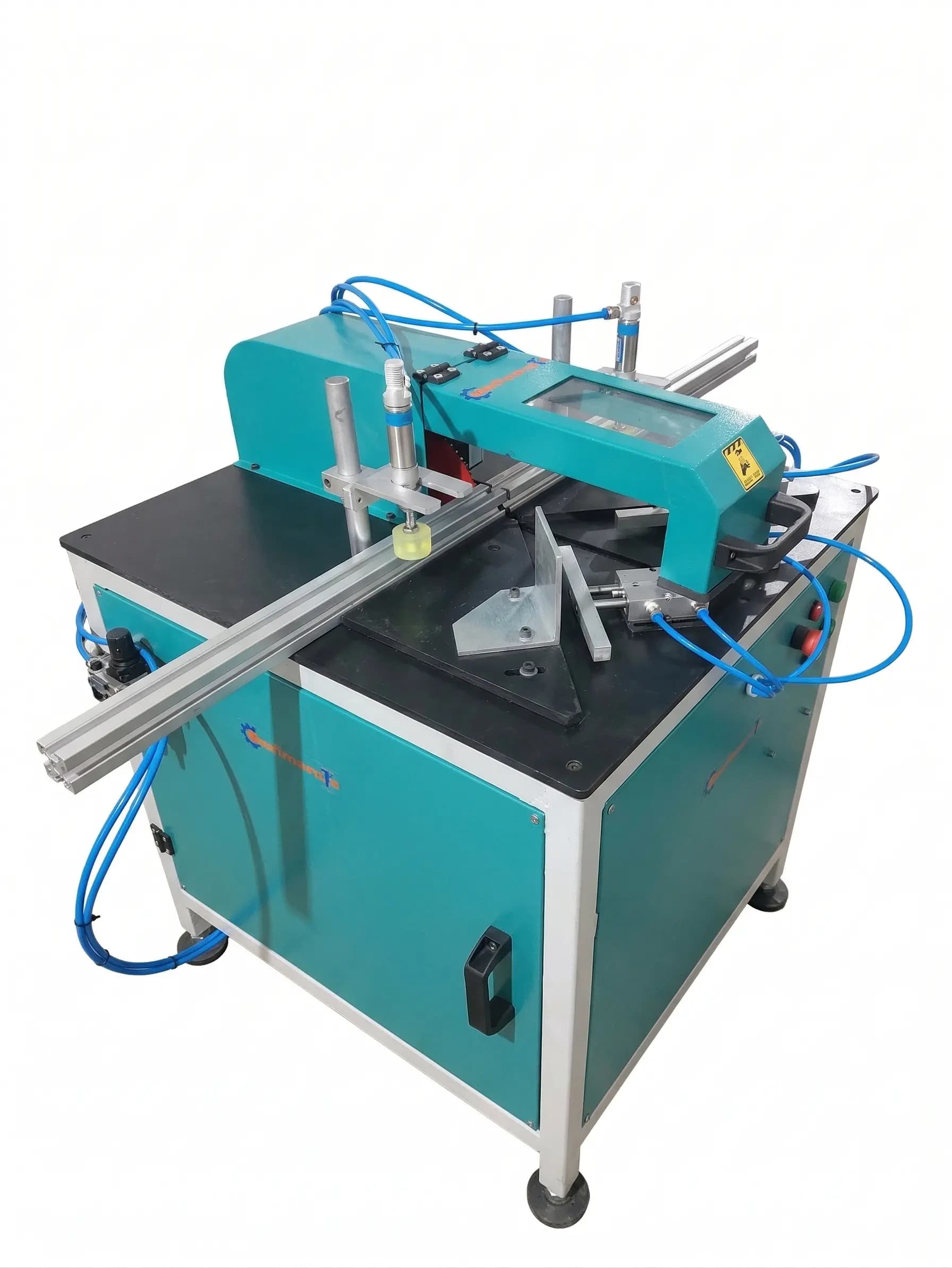
Another critical error is using improper 45-degree cuts. A seamless weld is only as good as the cut that preceded it. If your upvc cutting machine or automatic double head cutting machine price India was a 'budget' buy with high vibration, the joint will never be perfectly seamless. The blade must be sharp and the machine bed must be perfectly level. We recommend a 450mm or 500mm blade for 12-inch aluminium or uPVC profiles to ensure a clean, burr-free edge that fuses perfectly during the welding cycle.
FAQ: What Fabricators Ask About Seamless Welding
Q: Is the seamless weld as strong as a standard weld? Yes. In fact, because the heat distribution is more controlled via the PLC, the fusion is often deeper. We have tested these joints against ISO standards for corner strength and they consistently exceed the required 3000N to 3500N for standard residential profiles.
Q: Can I use this machine for both uPVC and Aluminium? No. Welding is a thermal fusion process specific to thermoplastics like uPVC. For aluminium, you need an aluminium window corner crimping machine price check, which uses mechanical force rather than heat to join profiles.
Q: What is the average price for a double head seamless welder in Gujarat? The price varies based on automation levels. A semi-automatic unit might start lower, but a fully CNC uPVC window fabrication machine price in India for seamless technology typically ranges from 6.5 Lakhs to 12 Lakhs depending on the features and after-sales support provided by the manufacturer.
Q: How often does the Teflon need changing? In a high-production environment in cities like Surat or Ahmedabad, we recommend changing the Teflon sheet every 400 cycles or whenever you see residue buildup. This ensures the 0.2mm seam remains clean and invisible.
Get more articles like this
Follow Mechnovate on Google to see our guides in Google Discover & News