Coastal Corrosion Guide: Aluminium Window Machinery Chennai
Solving the Saline Problem in Chennai Aluminium Fabrication
Fabricating in Chennai means fighting a constant battle against 85% humidity and high airborne chloride concentrations. If you are operating a fabrication unit near the ECR or OMR corridors, you know that standard maintenance routines often fail within six months. The salt-laden air doesn't just corrode the aluminium profiles; it attacks the internal pneumatic valves and high-precision guide rails of your Automatic Double Head Cutting Saw. To maintain precision engineering standards, fabricators must shift from reactive cleaning to a systemic 'Coastal Hardening' protocol.
At Mechnovate, we have observed that machines using substandard chrome plating on guide rods fail 3x faster in Chennai than in inland clusters like Coimbatore. The solution lies in choosing the right aluminium window machinery and implementing a strict chemical barrier strategy. This guide breaks down the technical requirements for machinery that survives the coast and the maintenance workflows that keep tolerances within the required 0.1mm margin.
Case Study: Performance Metrics in High-Salinity Zones
In early 2022, we commissioned a full production line for a Tier-1 fabricator located 4km from the Ennore port. Initial assessments of their previous setup showed that their copy router machine was experiencing spindle seizure every 45 days due to micro-pitting on the bearings.
We implemented a three-stage intervention over 12 weeks:
- Equipment Swap: Replaced standard mild steel fasteners with SS304/SS316 alternatives on all external machine housings.
- Pneumatic Overhaul: Installed high-capacity refrigerated air dryers to remove 99.9% of moisture before it reached the solenoid valves.
- Lubrication Shift: Moved from standard oil to a hydrophobic, marine-grade synthetic lubricant for the 45 degree double head cutting machine.
The Results:
- Downtime reduction: Decreased from 18 hours/month to 2 hours/month.
- Precision Retention: Cutting accuracy maintained at +/- 0.2mm over a 12-month cycle without recalibration.
- Component Lifespan: Solenoid valve failure rates dropped by 80%.
Essential Machinery for Chennai Coastal Units
When sourcing from the best aluminium window machinery suppliers in Chennai, you must look beyond the aluminium cutter machine price. You are buying the machine's ability to resist oxidation.
1. Heavy Duty Aluminium Profile End Milling Machine
For coastal areas, the end milling process is a primary point of failure. If the milling cutter is not running at a precise 2800 RPM with a stabilized feed rate, it creates burrs that trap salt particles, leading to rapid 'filiform corrosion' under the powder coating. Our End Milling Machine uses a reinforced spindle assembly designed to handle the 2mm+ profile thickness tolerances common in high-wind load coastal buildings.
2. Automatic Corner Crimping Machine
Structural integrity in Chennai's high-wind zones depends on the crimp. An Aluminium Corner Crimping Machine must deliver a consistent 15-20kN of hydraulic pressure. In coastal setups, we recommend machines with chrome-plated hydraulic rams to prevent the 'pitting' that destroys hydraulic seals and causes pressure drops.
3. Precision Cutting with 12 Inch Blades
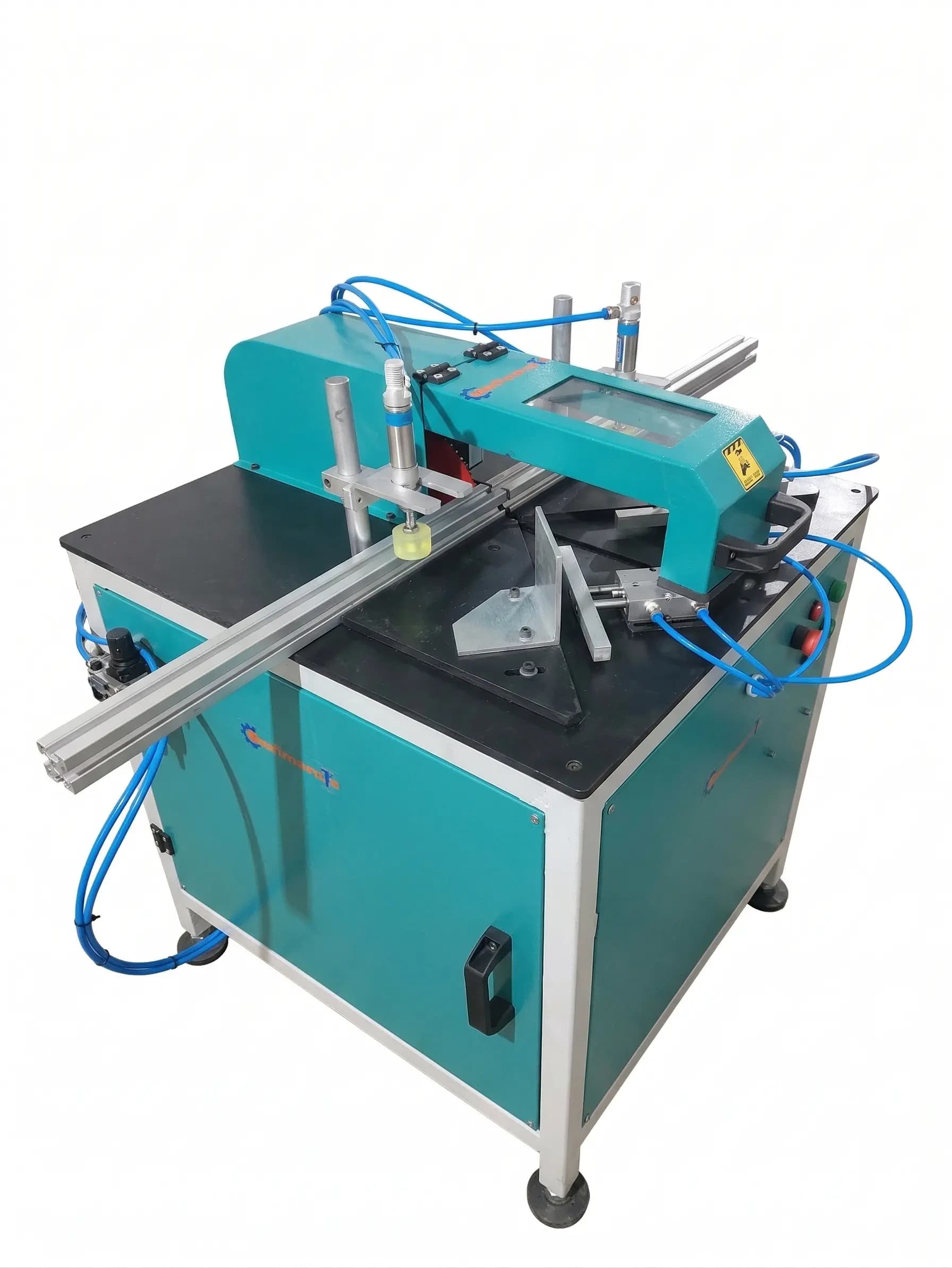
Whether you use an aluminium cutting machine 12 inch or a larger 20-inch blade, the key is the mist lubrication system. Standard water-based coolants can accelerate corrosion if not wiped clean. We recommend vegetable-based 'Minimum Quantity Lubrication' (MQL) systems that leave a protective film on the cut edge.
Maintenance Protocol: The 'Coastal Shield' Checklist
To keep your upvc window manufacturing machines and aluminium cutters in peak condition, follow this technical schedule:
- Daily Blow-Down: Use dry compressed air to clear all chips from the linear guides of your upvc cutting machine. Aluminium chips act as cathodes in a galvanic cell when moisture is present, eating into the machine bed.
- Weekly Valve Inspection: Check the exhaust ports of your pneumatic cylinders. If you see white powdery residue (aluminium oxide), your air filtration system is failing.
- Monthly Calibration: In high-heat/high-humidity environments, machine beds can experience thermal expansion. Verify the 45-degree and 90-degree stops using a digital protractor with 0.05-degree accuracy.
- Biannual Electrical Service: Saline air is conductive. Open your control panels and check for 'green growth' on copper terminals. Use a contact cleaner and apply a dielectric grease to all connections.
Avoiding Common Fabrication Mistakes in Tamil Nadu
Many fabricators focus on the upvc window machine price list but ignore the 'Total Cost of Ownership' (TCO) influenced by the environment.
- Mistake 1: Ignoring Air Quality: Using a standard piston compressor without a dryer in Chennai will pump saltwater mist directly into your expensive upvc windows making machine. Always use a screw compressor with an integrated dryer and a 0.01-micron filter.
- Mistake 2: Mixing Metals: Using zinc-plated screws on an aluminium profile in a coastal zone creates a battery. The zinc will sacrifice itself, and the resulting corrosion will expand, cracking the window frame joinery. Always use SS304 or higher.
- Mistake 3: Poor Chip Management: Allowing wet aluminium swarf to sit on the machine table overnight. This causes 'crevice corrosion' which is almost impossible to sand out without ruining the machine's flatness.
Technical Specifications for Coastal-Ready Equipment
| Feature | Requirement for Chennai Units | Engineering Reason |
|---|---|---|
| Linear Rails | Hard Chrome Plated or Induction Hardened | Prevents chloride-induced pitting |
| Pneumatics | Anodized Aluminium or Polymer Bodies | Resists external atmospheric corrosion |
| Motor Grade | IP55 or higher | Prevents salt-dust ingress into windings |
| Table Surface | Ground Cast Iron with Anti-Rust Coating | Maintains flatness despite high humidity |
| Blade RPM | Variable (2800 - 3400 RPM) | Essential for clean cuts in marine-grade alloys |
FAQ: Coastal Fabrication Questions
Q1: Which is better for Chennai: uPVC or Aluminium machinery? Both are viable, but the maintenance needs differ. uPVC window machinery requires better dust extraction to prevent 'static' salt dust from sticking to profiles, while aluminium machinery requires superior moisture control in the air lines to prevent valve sticking.
Q2: How often should I replace the blades on my aluminium cutter machine? In coastal areas, blades dull 15% faster due to the micro-oxidation on the surface of the profiles. We recommend sharpening every 2,500 cuts and replacement after 4 sharpenings to maintain ISO 9001 quality standards.
Q3: Does Mechnovate provide a uPVC window machine service center in Tamil Nadu? Yes, we maintain a dedicated technical team in Chennai that specializes in 'Coastal Hardening' of fabrication units, providing everything from head cutter machine calibration to full plant audits.
Q4: What is the average automatic aluminium window production line price in India? While prices vary based on automation levels, a coastal-ready mid-range line typically starts from ₹15 Lakhs. This includes moisture-resistant pneumatics and heavy-duty casting which are essential for longevity in South India.
Get more articles like this
Follow Mechnovate on Google to see our guides in Google Discover & News