Achieving Zero-Gap Miter Cuts: Automatic Double Head Saws
Achieving a daylight-free 45-degree joint in aluminium fabrication is not a matter of operator talent; it is a matter of machine rigidity and synchronized geometry. In the competitive landscape of Ahmedabad’s architectural market, the difference between a high-end window and a budget-tier product lies in the miter gap. A gap of even 0.3mm is enough to cause structural weakness and aesthetic rejection. For years, fabricators relied on a single aluminium cutting machine 12 inch setup, but the inherent vibration and manual positioning errors are now pushing the industry toward the Automatic Double Head Cutting Saw. This transition is driven by the need for absolute repeatability and the elimination of the 'human variable' in high-volume production.
The Engineering Behind the Zero-Gap Miter
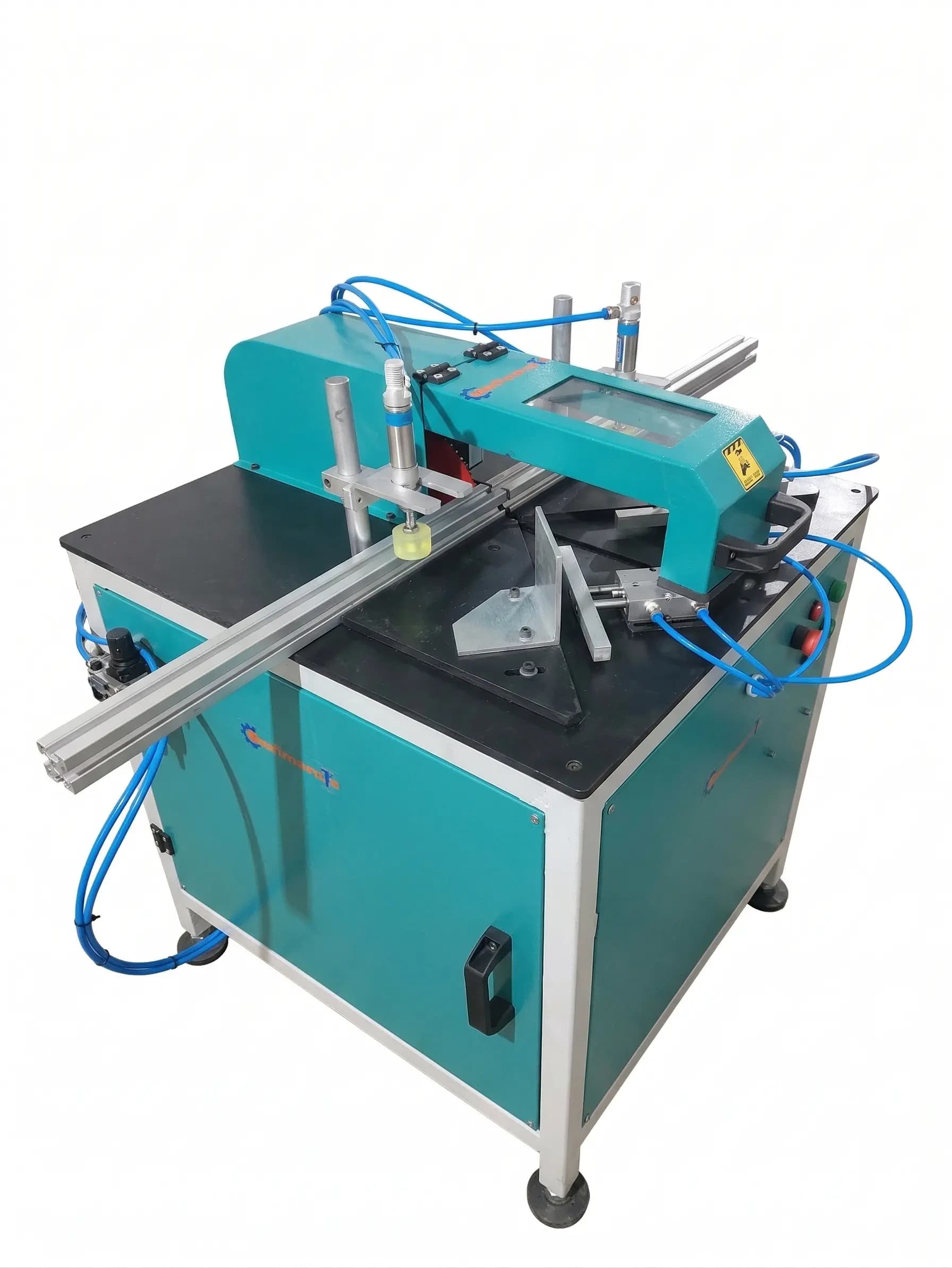
When we talk about 'zero-gap,' we are referring to a miter joint where the light-leakage is non-existent and the structural adhesive or crimping process can bond the profiles perfectly. To achieve this, the automatic double head cutting saw for aluminium profiles must manage three specific variables: blade deflection, pneumatic stability, and profile positioning. Most manual saws suffer from blade run-out because the spindle assembly lacks the mass to dampen the harmonics generated at 2800 RPM.
In contrast, professional-grade automatic saws utilize a high-precision spindle coupled with 450mm or 500mm TCT (Tungsten Carbide Tipped) blades. These blades have a specific tooth geometry designed to shear through architectural aluminium alloys (like 6063-T6) without causing 'burring' or edge deformation. The feed rate is controlled hydraulically or via a pneumatic-hydro damping system, ensuring that the blade enters the profile at a constant velocity, regardless of the wall thickness. This consistency is what prevents the 'shudder' that usually causes gaps at the heel of the miter cut.
Case Study: Performance Benchmarking in Our Pune Facility
To understand the real-world impact of upgrading, our engineering team conducted a 6-week controlled trial at our Pune testing facility. We compared three different configurations: a standard 12-inch manual miter saw, a semi-automatic single head cutter, and our latest Automatic Double Head Cutting Saw. We used standard 65mm casement window profiles with a 1.4mm wall thickness.
The Results were definitive:
- Accuracy: The manual saw showed a variance of +/- 0.8mm over 100 cuts. The automatic double head saw maintained a tolerance of +/- 0.1mm.
- Waste Reduction: By using the digital positioning system on the double head saw, we reduced cutting waste from 12% to less than 3.5%. This was achieved by optimizing the 'tail-end' of the 6-meter profiles, which is nearly impossible to do accurately on manual machines.
- Output Volume: The manual setup averaged 12 complete window frames per 8-hour shift. The automatic double head saw increased this to 52 frames per shift—a 333% increase in productivity.
- Surface Finish: Under a 10x magnifying lens, the cuts from the automatic saw showed zero micro-fractures, which significantly improved the success rate of our Aluminium Corner Crimping Machine during the final assembly phase.
Technical Specifications and Industrial Standards
For an aluminum window machine manufacturers in Ahmedabad to claim high precision, the equipment must adhere to international standards such as ISO 9001 for manufacturing quality and BS EN 12020 for aluminium profile tolerances. When sourcing an aluminium cutting machine price, fabricators should look for the following technical benchmarks:
- Motor Power: Minimum 2.2kW per head. Underpowered motors will 'bog down' during thick-walled cuts, leading to heat buildup and blade warping.
- Blade Feed: Must be 'bottom-up' or 'back-to-front' with a linear guide system. Top-down 'chop' styles are prone to more lateral movement.
- Air Pressure Requirements: The pneumatic clamping system must operate at a consistent 6-8 bar. If the pressure drops, the profile can shift by a fraction of a millimeter, ruining the 45-degree angle.
- Miter Angles: The machine should feature automatic indexing for both 90 and 45 degrees, ideally with an intermediate angle capability for specialized curtain walling projects.
Common Mistakes in Aluminium Profile Cutting
In my 15 years on the shop floor, I have seen even the best upvc windows manufacturing machine and aluminium saws fail because of three common mistakes. First is the neglect of the lubrication system. Aluminium is a 'sticky' metal; without a micro-mist cooling system (MQL), small bits of aluminium weld themselves to the blade teeth (known as 'built-up edge'). This increases the effective thickness of the blade and ruins the precision of the cut.
Second is the 'Clamping Paradox.' Many fabricators over-tighten their pneumatic clamps, thinking it increases stability. In reality, over-clamping can slightly deform thin-walled profiles. When the clamp is released, the profile 'springs back' to its original shape, but the cut angle is no longer a true 45 degrees. High-end upvc window manufacturing machinery and aluminium saws use soft-jaw clamps with adjustable pressure regulators to prevent this.
Finally, ignoring the 'Base Frame Rigidity.' If your aluminium profile cutting machine is sitting on a floor that vibrates or if the machine bed is made of light-gauge steel, you will never achieve a zero-gap cut. The bed must be heavy-duty, preferably cast iron or stress-relieved welded steel, to absorb the kinetic energy of the twin heads moving simultaneously.
Why Ahmedabad Fabricators are Scaling Up
The Ahmedabad market is seeing a surge in high-rise residential projects and commercial hubs. Developers are now demanding 'System Windows' which have much tighter tolerances than local sections. To meet these specs, the old manual aluminium punching machine and single-cut saws are no longer sufficient. Upgrading to an automatic upvc window plant cost India or an integrated aluminium line is now a prerequisite for bidding on Tier-1 contracts.
Furthermore, the double head miter saw for aluminium profiles price has become more accessible. While the initial investment is higher than a manual punching machine, the ROI is usually realized within 14 months through labor savings and material optimization. When you factor in the reduced need for rework and the ability to offer a 10-year warranty on joint integrity, the switch becomes an easy business decision.
FAQ: Critical Questions for Fabricators
Q1: Can I use the same double head saw for both uPVC and Aluminium? Technically, yes, but it is not recommended. Aluminium requires higher RPMs and cooling systems, while uPVC needs specific blade geometries to prevent melting. If you are a hybrid shop, ensure your upvc windows making machine has a variable speed drive and compatible blade sets.
Q2: What is the maintenance schedule for an automatic double head cutting saw? Daily: Clean chips from the linear rails and check the oil-mist levels. Weekly: Check the tension of the drive belts and the squareness of the fences. Monthly: Deep clean the pneumatic valves and inspect the blade for dullness or chipped teeth.
Q3: How do I calculate the ROI on an automatic cutting machine? Calculate your current 'scrap rate' (material lost to bad cuts) and your 'labor-per-window' cost. Most Ahmedabad workshops find that reducing scrap from 10% to 2% and cutting labor time by 60% pays for the machine in under 30,000 meters of profile processing.
Q4: Is a CNC-controlled saw necessary for a small workshop? Not necessarily. A digital display or 'dro' (digital read-out) system on a semi-automatic saw is often enough for small shops. However, if you plan to scale or use optimization software like LogiKal or Orgadata, a CNC aluminium profile cutting machine suppliers India can provide a fully integrated solution.
Get more articles like this
Follow Mechnovate on Google to see our guides in Google Discover & News