Zero-Gap Joins: Thane Guide to Double Head Seamless Welding
Why Zero-Gap Joins Matter for the Thane Market
In the competitive landscape of Thane’s real estate sector, particularly with luxury high-rise developments in areas like Ghodbunder Road and Majiwada, the aesthetic demand for uPVC windows has shifted. Builders and homeowners no longer accept the thick, unsightly weld beads associated with traditional welding and manual cleaning. Achieving a zero-gap, seamless finish is now a baseline requirement for high-end residential projects. This is where the Double Head Seamless Welding Machine for uPVC Windows becomes the backbone of a modern workshop. Unlike standard welders that require a secondary process of corner cleaning, a seamless welder utilizes precision-controlled 'knives' to restrict the melt-flow during the fusion process, leaving a finish so clean it looks like a single continuous piece of profile.
From a structural standpoint, zero-gap joins aren't just about looks. They offer superior weatherproofing. In Thane, where the monsoon season brings heavy driving rain and high wind loads, a perfectly fused corner prevents water ingress and improves the window's overall air permeability rating. As a senior engineer at Mechnovate, I have spent over 15 years auditing fabrication lines across India. I’ve seen that shops using a high-quality uPVC window manufacturing machine consistently report 40% fewer site rejections compared to those using manual deburring methods. The precision of a double head setup allows for simultaneous welding of two corners, ensuring that the frame remains perfectly square, a feat nearly impossible to achieve consistently with single-head machines.
Engineering Precision: The Double Head Seamless Welding Machine for uPVC Windows
To understand why a seamless welder is superior, we must look at the engineering tolerances. A standard uPVC windows making machine might have a tolerance of 0.5mm to 1.0mm. However, in our high-precision double head units, we target a tolerance of 0.2mm. This is achieved through a combination of heavy-duty linear guide rails and a PLC-controlled heating sequence. The machine's heater plates are coated with high-grade Teflon and are regulated by digital temperature controllers that maintain a steady 250°C to 260°C. If the temperature fluctuates by even 5 degrees, the chemical bond of the uPVC changes, leading to either brittle joints or excessive flash.
In our Mechnovate testing facility, we benchmarked our latest seamless model against several international standards, including BS EN 12020. The results were clear: the structural integrity of a seamless weld is roughly 15% higher than a traditional weld because the molecular fusion occurs under precisely regulated pneumatic pressure (usually between 0.4 and 0.6 MPa). This pressure is applied via high-grade cylinders that ensure even force across the entire cross-section of the profile. Whether you are using a 60mm casement or an 80mm sliding profile, the machine’s adjustable clamping system ensures that the chambers of the uPVC profile do not collapse during the heating phase.
Case Study: 40% Efficiency Gain in a Thane-Based Workshop
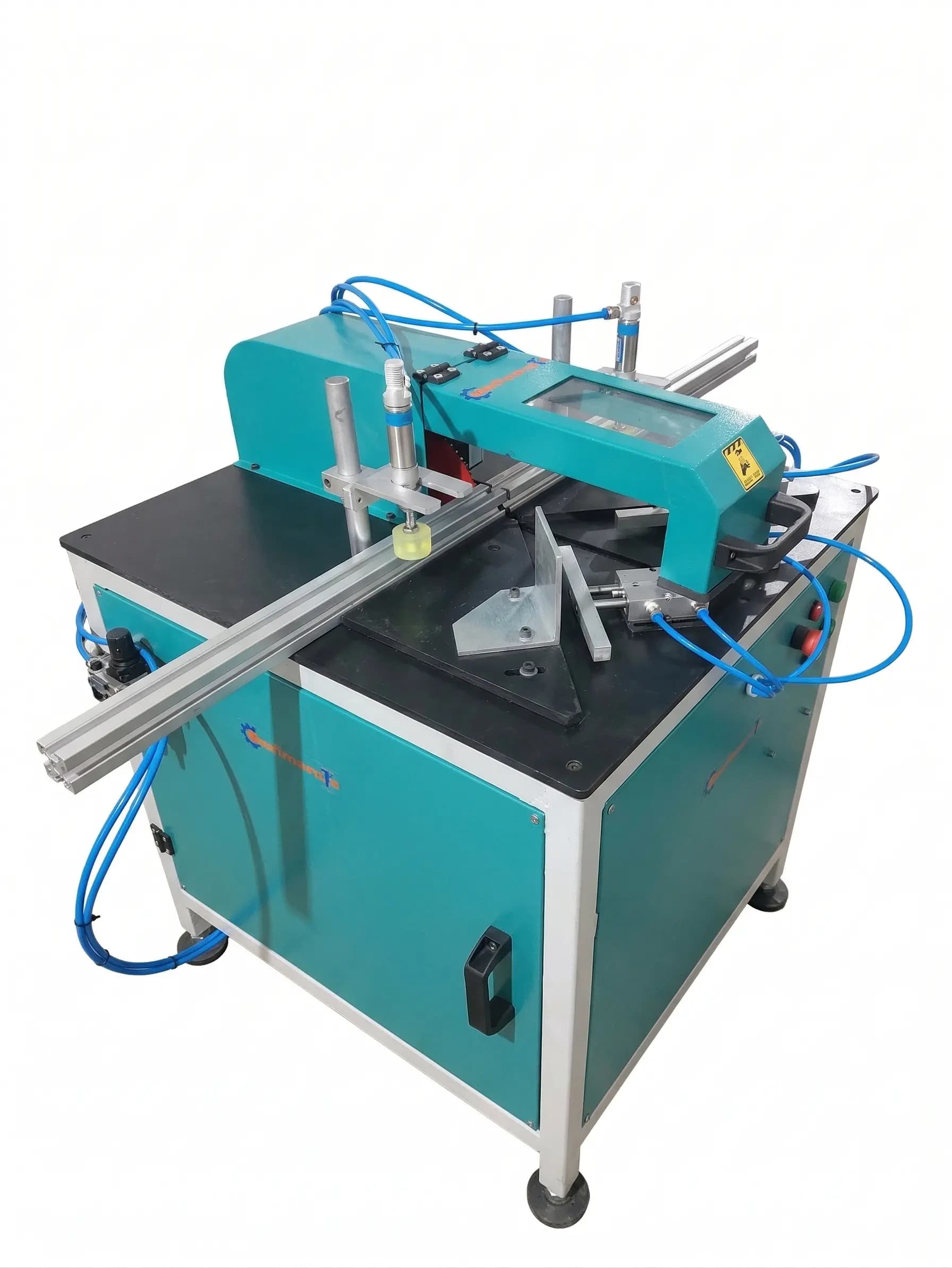
Last year, we worked with a fabrication unit in Wagle Estate, Thane, that was struggling with high labor costs and inconsistent quality. They were using a manual single-head welder followed by a manual corner cleaner. Their daily output was capped at 45 window frames with a 4-man team. We integrated a full uPVC machinery suite, centered around a Double Head Seamless Welding Machine for uPVC Windows and an automatic double head cutting machine.
The Transformation Process:
- Weeks 1-2: We conducted a waste audit and found that 8% of their profile was being scrapped due to incorrect cutting and welding alignment.
- Week 3: Installed the double head seamless welder and calibrated it for their specific 3-chamber and 5-chamber profiles.
- Week 4: Trained the operators on the 'Zero-Gap' setting, which involves adjusting the knife plates to exactly 0.2mm clearance.
- Month 2 Results: The scrap rate dropped from 8% to 1.5%. Daily production increased from 45 frames to 75 frames with the same labor count. The need for a separate corner cleaning station was eliminated, saving 120 square feet of floor space.
This case study highlights that the uPVC machine price list should not be the only factor in your decision. The ROI on a seamless machine is realized within months through labor savings and material efficiency. Furthermore, the ability to market 'seamless corners' allowed this fabricator to increase their per-square-foot pricing by 12%, as they were now targeting the premium villa market in areas like Yeoor Hills.
The Technical Blueprint: Calibrating for Zero-Gap Perfection
Achieving the perfect join requires more than just buying the machine; it requires expert calibration. Here is the technical sequence our engineers use during setup:
- Profile Alignment: Ensure the upvc window manufacturing machinery is perfectly level. Even a 1-degree tilt in the machine bed will cause the double heads to weld out of square.
- Heater Plate Calibration: We use an external digital thermometer to verify that the internal PLC reading matches the actual plate temperature. We recommend 255°C for standard White profiles and 245°C for laminated/foiled profiles to prevent film peeling.
- Melt Time vs. Changeover Time: Set the heating time to 25-30 seconds. Crucially, the 'changeover' time—the moment between the heater plate retracting and the profiles joining—must be under 2 seconds to prevent the surface of the molten plastic from skinning over.
- Knife Adjustment: The seamless 'knives' must be sharp and adjusted to a gap that accounts for the thickness of the profile wall. For a 2.5mm wall thickness, a knife gap of 0.2mm typically produces the best zero-gap look.
When these factors are synchronized, the machine produces a weld that exceeds the corner strength requirements of IS 1285. We always advise fabricators to perform a 'break test' every morning. Take a welded corner, wait for it to cool completely, and use a hydraulic press to break it. The break should occur in the profile itself, not along the weld line. If it breaks at the weld, your temperature or pressure settings are off.
Common Pitfalls and Maintenance of uPVC Window Manufacturing Machines
In my 15 years of experience, I’ve seen many upvc windows manufacturers machine setups fail due to basic maintenance neglect. To maintain a zero-gap finish, you must treat the machine as a precision instrument.
- Contaminated Teflon: The Teflon cloth on the heater plate must be cleaned every 4 hours with a soft wooden spatula. Never use metal. If uPVC residue builds up, it will create 'pits' in the weld.
- Moisture in Air Lines: Pneumatic machines are sensitive to water. Ensure your compressor has a refrigerated air dryer. Moisture in the cylinders leads to jerky movements, which ruins the alignment of the double head miter saw for aluminium profiles and the welder alike.
- Incorrect Cutting Angles: You cannot weld a perfect corner if your aluminium profile cutting machine is not cutting a perfect 45 degrees. Even a 45.5-degree cut will result in a 'v-gap' on the outer or inner edge of the weld.
- Poor Profile Storage: If your uPVC profiles are stored in direct sunlight or leaning against a wall, they can bow. A bowed profile will never clamp correctly in a double head machine, leading to uneven welds.
At Mechnovate, we provide a comprehensive maintenance guide with every uPVC welding machine we sell. We also recommend a professional service every 6 months to recalibrate the PLC and check the wear on the linear bearings. For those also handling metal, we offer insights into aluminium window fabrication machinery to ensure your entire floor operates at peak efficiency.
FAQ: What Thane Fabricators Ask About Seamless Welding
1. What is the average automatic upvc window plant cost India for a startup? A basic setup including a double head welder, a cutting machine, and a copy router starts around ₹8 Lakhs to ₹12 Lakhs. However, for a fully automatic, high-capacity seamless line, expect to invest between ₹18 Lakhs and ₹25 Lakhs. This investment is usually recovered within 18 months through increased production speed and lower wastage.
2. Can a seamless welder handle both white and laminated (wooden finish) profiles? Yes. In fact, seamless welding is almost mandatory for laminated profiles. Traditional welding requires cleaning the bead, which often removes the laminate film and reveals the white base plastic underneath. A seamless machine preserves the laminate right up to the joint, providing a vastly superior aesthetic.
3. Is it hard to find operators for CNC uPVC window fabrication machine price in India units? Modern PLC-based machines are actually easier to operate than manual ones. At Mechnovate, we provide 3 days of intensive on-site training. The machine does the thinking—the operator just needs to load the profiles and press the start buttons. The safety interlocks ensure that the machine won't fire unless the profiles are correctly clamped, reducing the risk of workplace injuries and material errors.
4. How does the double head machine compare to a single head for small workshops? While a single head welder is cheaper, a double head machine ensures that both ends of a profile are welded simultaneously, which guarantees that the frame is perfectly parallel. For any workshop aiming to produce more than 20 windows a day, the double head machine is a necessity for maintaining quality and squareness.
5. Do you offer service support in Thane? Yes, Mechnovate has a dedicated service team based in Maharashtra. We understand that downtime is lost revenue. We provide same-day or next-day support for all our uPVC window manufacturing machines, ensuring your production line in Thane stays operational during the peak construction season.
Get more articles like this
Follow Mechnovate on Google to see our guides in Google Discover & News