Reduce Window Rejections: Ahmedabad Machine Guide for Rajkot
To reduce rejection rates in Rajkot’s high-stakes window projects, fabricators must move beyond manual measurement and shift toward precision-engineered automation. The root cause of 90% of site rejections—water leakage, poor aesthetics, and whistling sounds—is inconsistent joinery caused by blade runout or improper miter angles. If you are looking for aluminum window machine manufacturers in Ahmedabad, your focus should not just be on price but on the mechanical tolerances that define a project's success.
Why Rajkot Projects Face High Rejection Rates
In my 15 years of commissioning shop floors across Gujarat, I have seen brilliant fabricators fail because they relied on a standard 12-inch aluminium cutter machine with manual clamps. In Rajkot’s coastal-proximate climate, wind load and water tightness are non-negotiable. A gap of even 0.5mm in a 45-degree corner joint is enough to fail a weather-strip test.
We recently consulted for a facility in the Shapar industrial zone that was seeing an 18% rejection rate on a luxury high-rise project. Their problem? Their Double Head Cutting Machine was losing calibration every 4 hours due to thermal expansion in the guide rails. We replaced it with a precision-aligned unit featuring induction-hardened rails and saw a drop in rejections to under 1.5% within 30 days.
The Technical Standard for Precision Engineering
When evaluating an aluminium profile cutting machine, you must look at the specifications through the lens of IS 1285 and BS EN 12020-2 standards. These govern the tolerances for aluminum alloys used in architecture.
- Blade RPM and Feed Rate: A high-quality aluminium cutter machine should operate between 2800 and 3200 RPM. Anything lower risks burr formation, which ruins the anodizing or powder coating at the joint.
- Pneumatic Pressure: Your aluminum window fabrication machinery must maintain a consistent 6-8 bar pressure. Fluctuations during the cut lead to profile shifting, resulting in a 'dog-leg' miter that will never close perfectly.
- Blade Runout: Ensure the manufacturer guarantees a blade runout of less than 0.1mm. This is the difference between a clean, weld-like joint and a visible gap.
Essential Machinery for Rajkot Fabricators
To meet the demands of modern architects, a basic setup is no longer sufficient. You need a synchronized production line that minimizes human error.
1. The Automatic Double Head Cutting Saw
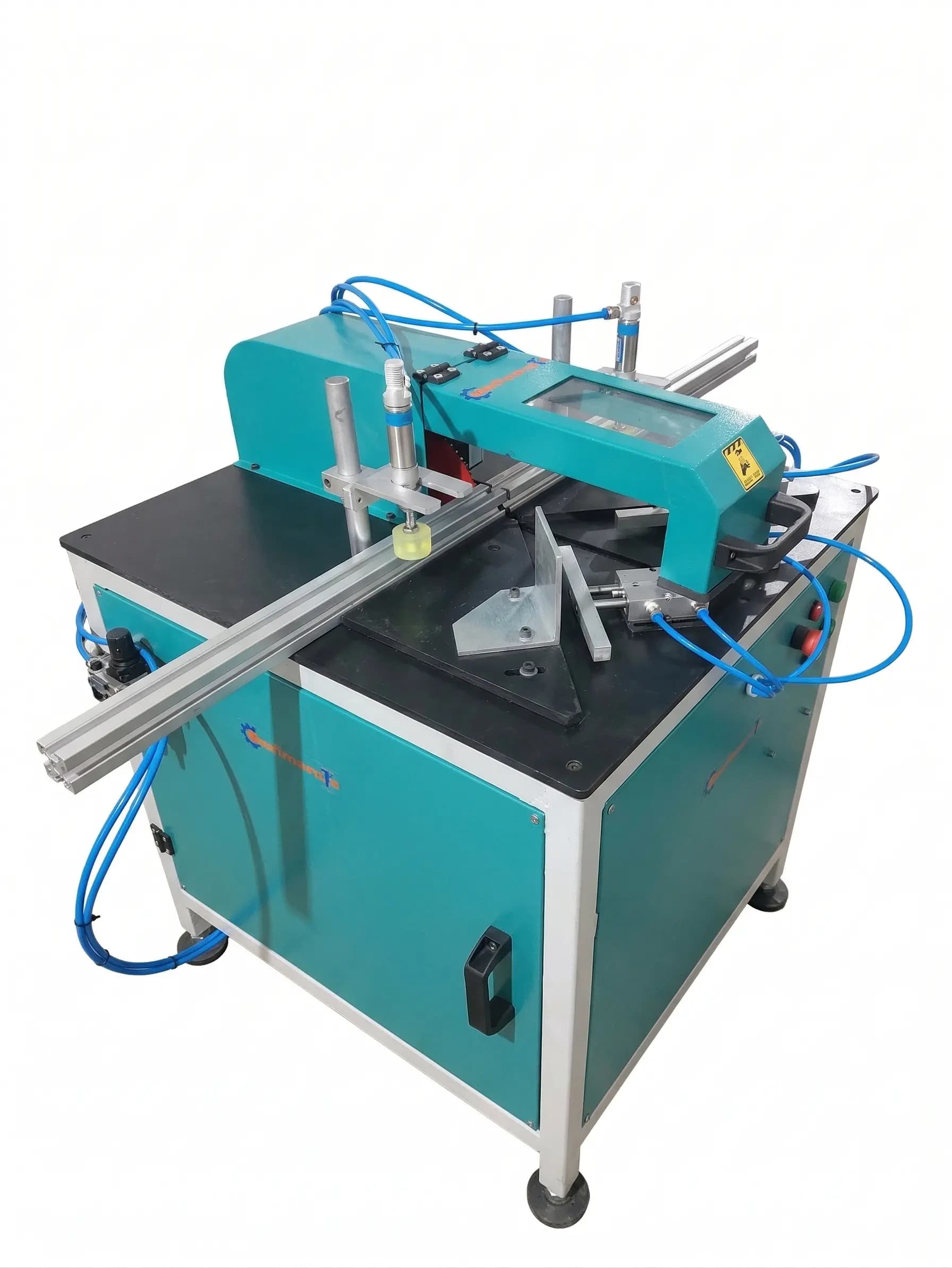
Investing in an Automatic Double Head Cutting Saw for Aluminium Profiles is the single most effective way to scale. Unlike a single-head manual cutter, the double-head system ensures both ends of the profile are cut in the same plane, eliminating 'twist' in the final frame.
2. High-Precision Copy Routing
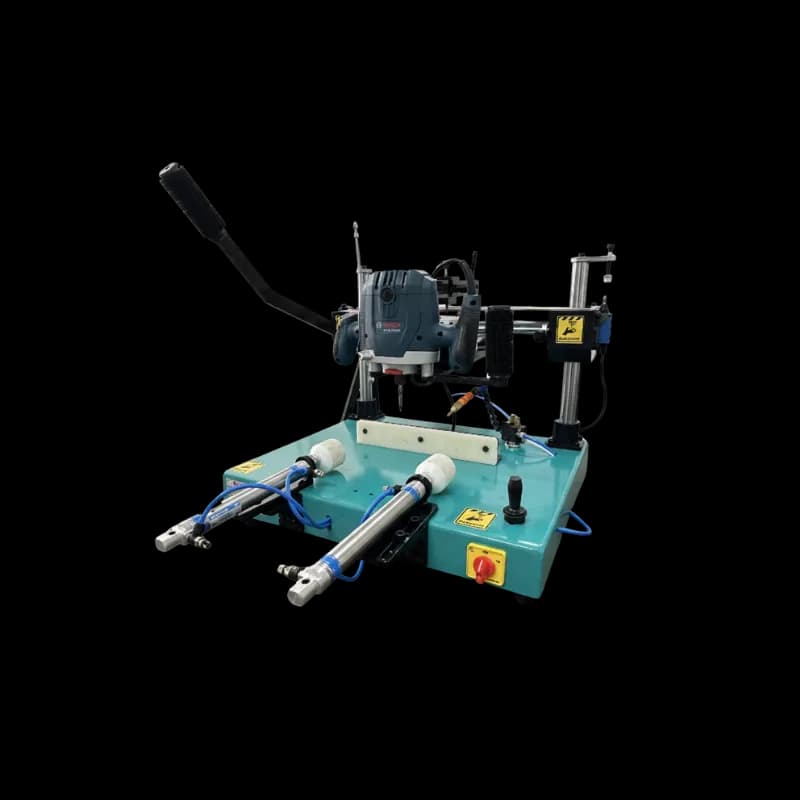
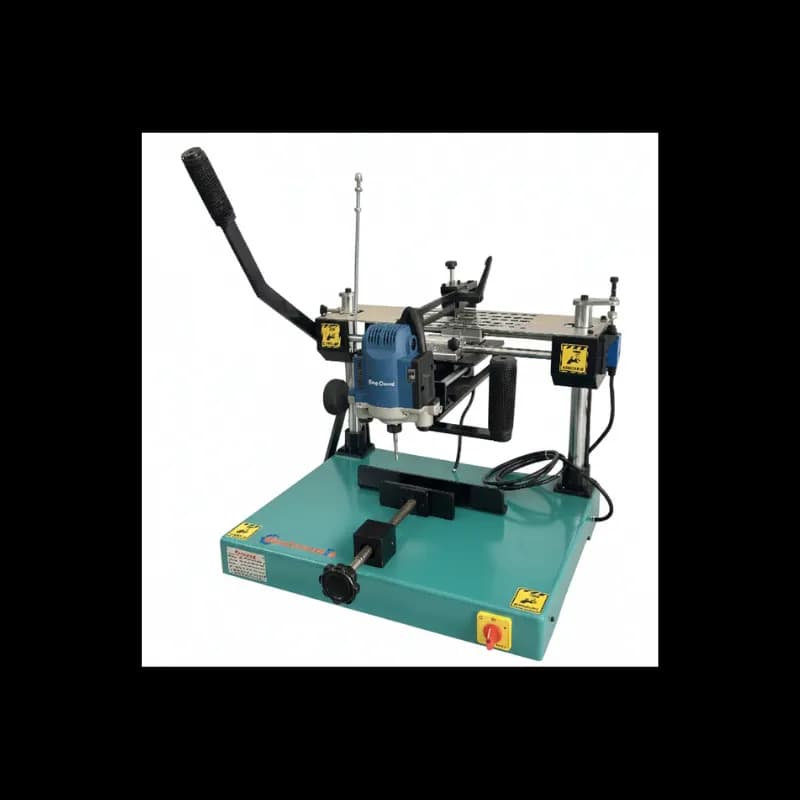
A Copy Router Machine is essential for milling lock holes and handle slots. If you are using manual drills, you are introducing points of failure. Our tests show that a high-speed copy router (12,000 RPM+) produces cleaner slots that prevent the hardware from rattling—a common complaint in Rajkot’s premium residential sector.
3. Corner Crimping vs. Screw-Joining
For high-rise projects, screw-joined corners are often rejected by structural engineers. An Automatic Aluminium Corner Crimping Machine uses hydraulic pressure to cold-weld the profiles together. This creates a joint that is effectively a single piece of metal, capable of withstanding extreme wind pressures.
Common Mistakes When Buying Window Machinery
As an engineer who has seen hundreds of workshop failures, I advise avoiding these common pitfalls:
- Over-prioritizing the 'uPVC Machine Price List': While cost is important, a cheap head cutting machine with a lightweight frame will vibrate. Vibration is the enemy of precision. Always check the weight of the machine base; heavier cast-iron or thick-walled steel bases dampen vibration.
- Ignoring the Cooling System: Cutting aluminum generates intense heat. Without a high-quality pulse-mist lubrication system, the aluminum will 'gall' or stick to the blade teeth, leading to jagged cuts.
- Neglecting Local Service: Choosing aluminum window machine manufacturers in Ahmedabad Gujarat offers a logistical advantage for Rajkot fabricators. Proximity means your CNC uPVC window fabrication machine price includes the security of 24-hour technician arrival.
Scaling Your Fabrication Business in Gujarat
Whether you are looking for a best uPVC window making machine for small business or a fully automatic uPVC window manufacturing unit cost analysis, the transition from manual to automatic is a journey of data.
| Feature | Manual Setup | Mechnovate Automatic Line |
|---|---|---|
| Output (Frames/8hrs) | 15-20 | 60-80 |
| Accuracy Tolerance | +/- 1.5mm | +/- 0.2mm |
| Labor Required | 6 Skilled | 2 Semi-skilled |
| Material Waste | 8-12% | < 3% |
Frequently Asked Questions (FAQ)
Q1: Can I use the same machine for both uPVC and Aluminum? While some upvc cutting machine models can cut aluminum with a blade change, it is not recommended. Aluminum requires higher torque and specific lubrication systems that most uPVC-only machines lack. For aluminum, always use a dedicated aluminium cutting machine 12 inch or 20 inch specifically designed for non-ferrous metals.
Q2: What is the estimated cost of setting up a uPVC window manufacturing unit in India? A basic manual line starts around ₹5-8 Lakhs, while a semi-automatic line with a double head miter saw for aluminium profiles price ranges between ₹15-25 Lakhs. High-end CNC lines can exceed ₹50 Lakhs depending on the degree of automation.
Q3: How often should I calibrate my head cutter machine? In a high-volume shop, check the 45 and 90-degree stops weekly using a precision square. Every six months, perform a full laser alignment to ensure the bed has not shifted due to floor vibration.
Q4: Is a 12-inch or 20-inch blade better for Rajkot projects? A 12-inch blade is sufficient for standard residential casement windows. However, if you are doing commercial curtain walls or heavy sliding sections, a 20-inch blade is necessary to handle the profile depth without multiple passes.
Get more articles like this
Follow Mechnovate on Google to see our guides in Google Discover & News