Aluminium Corner Crimping Machine for Gujarat Fabricators: Price and ROI Guide
Gujarat produces more aluminium window frames per year than any other Indian state, and the clusters in Ahmedabad, Surat, Vadodara, Rajkot, and Bharuch GIDC collectively account for a large share of national output. In workshops across these cities, corner crimping is frequently the step that determines whether a fabricator can hold tight tolerances at volume — and at what rework cost. A poorly crimped corner admits water, which is a serious performance failure on coastal projects in Surat and Bharuch, where monsoon wind-driven rain creates sustained hydrostatic pressure at window joints. This guide covers what Gujarat fabricators need to know before investing in a corner crimping machine: price ranges, ROI methodology, profile system compatibility, and what your peers in the state are prioritising first.
Why Corner Crimping Quality Matters in Gujarat's Climate
Gujarat's coastal belt — from Bharuch through Surat and down toward Valsad — experiences some of India's highest wind-driven rain intensity during the southwest monsoon (June to September). A casement or sliding window in this region must maintain a sealed perimeter joint across multiple monsoon seasons. The corner crimp is structurally the weakest point in that perimeter.
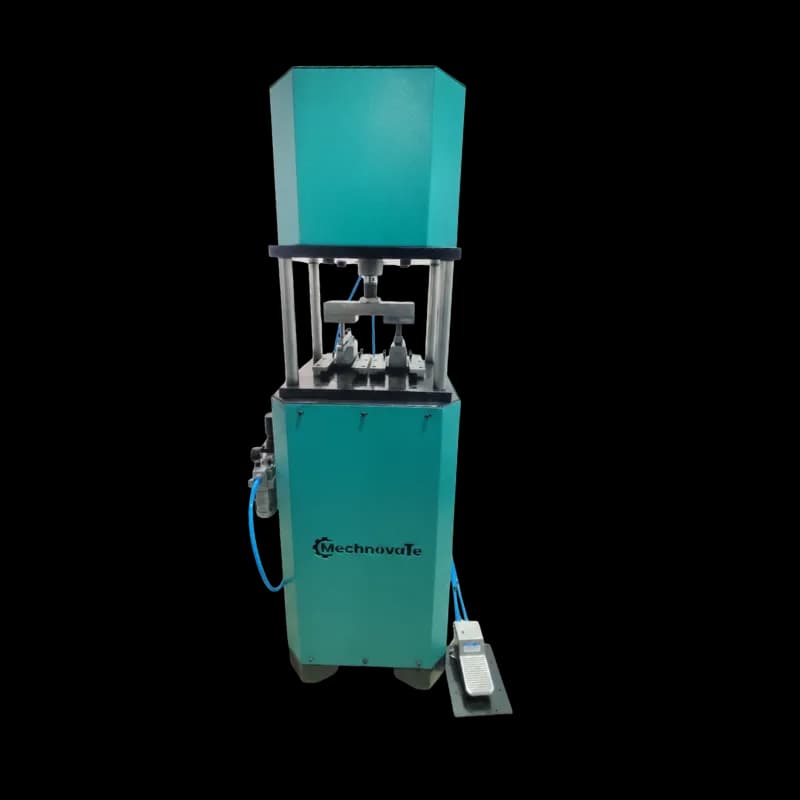
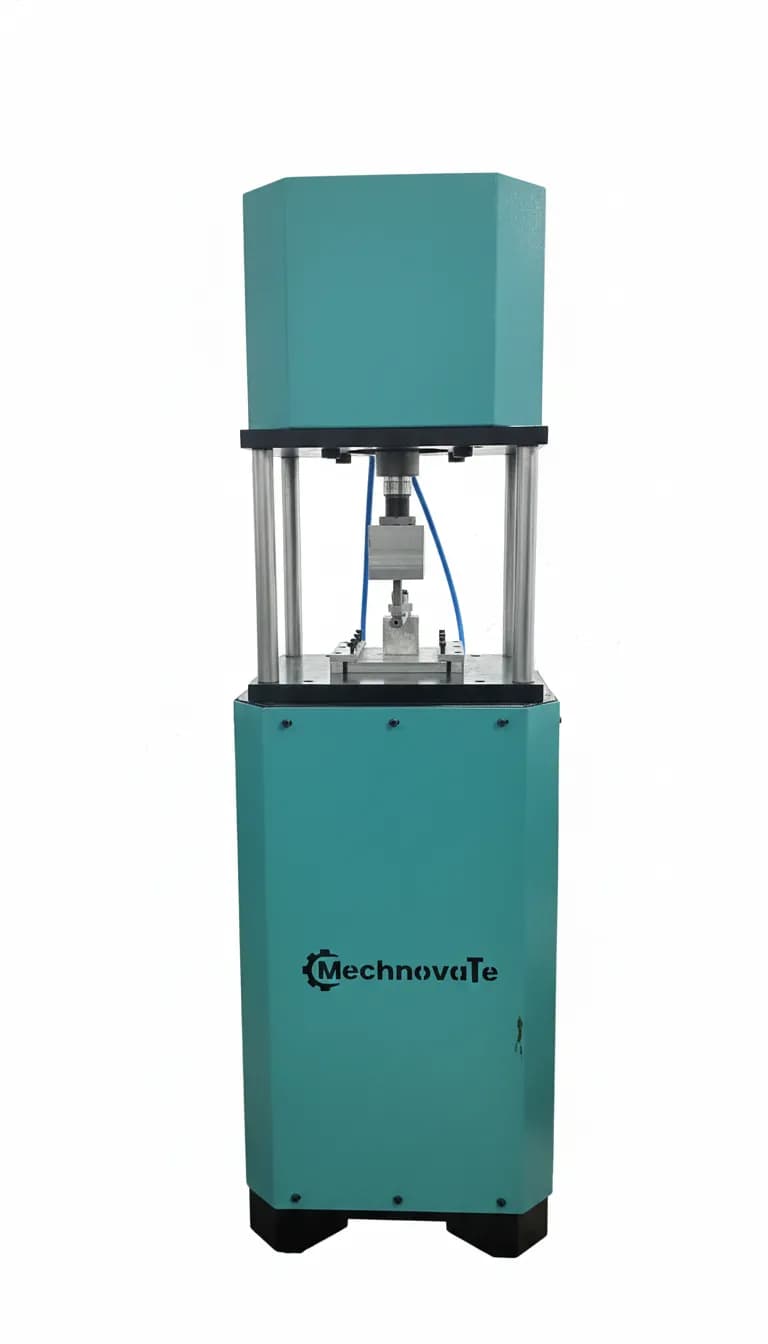
Manual crimping using a hand tool or bench lever introduces operator variability: the applied force depends on grip angle, handle position, and fatigue over a long shift. Across 25 frames in a day, even a skilled operator produces corners with measurable differences in gap closure. Pneumatic corner crimpers apply a fixed, repeatable force on every cycle — eliminating that variability entirely. For fabricators supplying high-rise coastal projects in Surat or Bharuch GIDC estates, this consistency is the difference between passing a water ingress test and failing one.
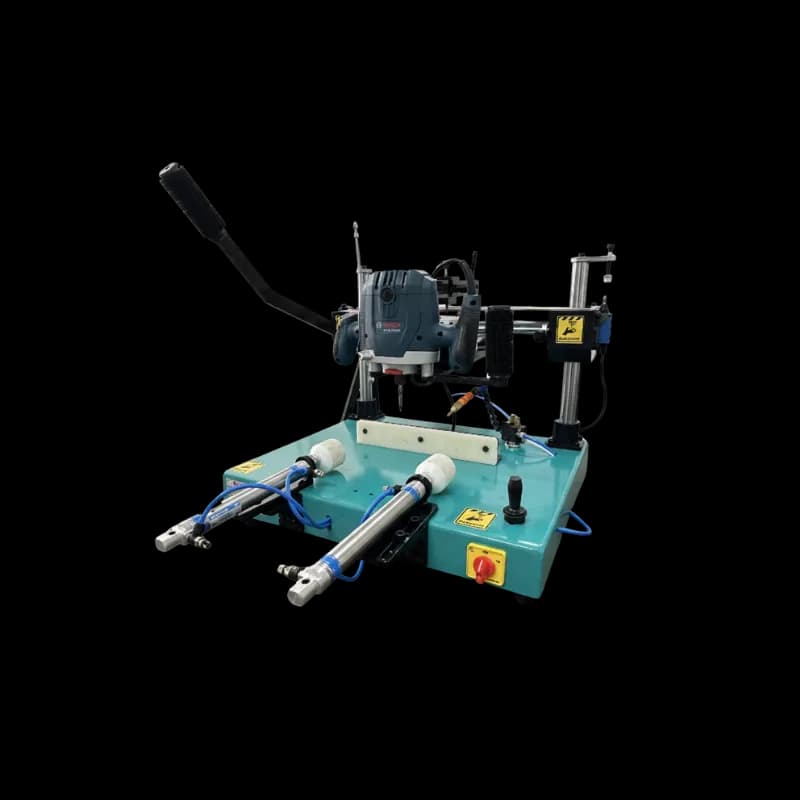
Fabricators who visit Mechnovate frequently pair a pneumatic crimper with a Pneumatic Copy Router Machine to maintain the same standard of repeatability across notching and milling operations, not just crimping.
Pneumatic vs Manual: The 50-Minute-Per-Day Calculation
A manual corner crimping operation takes roughly 3.5 to 4 minutes per frame when you account for positioning, crimping all four corners, checking joint quality, and moving the frame. A pneumatic machine with foot-pedal actuation and fixed die alignment reduces that to approximately 1.5 to 2 minutes per frame.
At 25 frames per day — a typical mid-volume Gujarat workshop — that saves roughly 50 minutes every working day. Over 25 working days per month, that is approximately 20 hours of recovered production capacity. Here is how to convert that into a payback estimate:
- Calculate your labour cost per frame. If a helper earning ₹500/day runs crimping full-time, your cost at 25 frames/day is ₹20 per frame.
- Quantify the time saving. 50 minutes/day × 25 days = 20.8 hours/month recovered.
- Convert hours to frames. At 25 frames per 8-hour day, each hour of capacity equals roughly 3 frames. Twenty recovered hours equals approximately 60 additional frames per month.
- Apply your margin. If your net margin on an aluminium sliding window is ₹800, those 60 additional frames add ₹48,000 in monthly gross contribution.
- Divide machine price by monthly contribution. A pneumatic crimper priced between ₹80,000 and ₹1,20,000 pays back in 2–3 months at this throughput — before accounting for reduced rework costs from inconsistent manual work.
Experienced fabricators report that manual crimping generates 3–5% frame rejection or rework per month from joint inconsistency. Eliminating that alone often shortens the payback period further.
Corner Key Compatibility: Specifications to Confirm Before You Buy
Gujarat's dominant profile systems — Domal, Jindalinium, Dumal, and Hindalco — use corner keys in two primary thicknesses: 1.5 mm and 2.0 mm. Getting the die specification wrong costs you a set of destroyed keys, wasted frames, or a machine that needs to be re-diesed. Confirm the following before committing to a purchase:
- Corner key thickness: Domal's standard 60 mm series uses 1.5 mm keys in most configurations. Jindalinium's 65 mm and 70 mm heavy-duty series predominantly uses 2.0 mm keys. Ask your profile supplier for the exact spec, not a general estimate.
- Die set interchangeability: Ask whether the machine accepts multiple die inserts in the same holder. If your workshop handles both Domal and Jindalinium, this saves purchasing two machines.
- Corner key length: Flat-back 45 mm keys and L-shaped 35 mm keys require different die geometries. Confirm which type your frames use.
- Profile throat clearance: Wider-chamber sections like the Domal 65 mm system require deeper throat depth on the crimper. Measure your deepest profile before specifying.
Alumil profiles, used on a minority of Gujarat projects, use metric key sizing and sometimes require dedicated die sets. If you handle Alumil alongside domestic profiles, confirm die availability with your machine supplier before purchase.
What Gujarat Fabricators Are Investing in First
When fabricators across Ahmedabad, Surat, and Rajkot GIDC discuss workshop upgrades with Mechnovate's team, a clear pattern emerges: crimping machines are typically the first pneumatic investment — before routing, punching, or welding. The logic is straightforward. A bad notch or a mis-punched hole is reworkable. A poorly crimped corner, once the key is crushed incorrectly, usually means dismantling the frame and replacing the corner key, which destroys it. Crimping is the one step where errors are hardest to reverse.
Fabricators in Rajkot's GIDC cluster have reported to Mechnovate that switching from manual to pneumatic crimping reduced frame rejection rates from 6–7% to under 2% — a bigger per-unit impact than any other single machine change they made.
Once crimping is automated, the next highest-impact upgrade in most Gujarat workshops is pneumatic punching. The 2-Station Pneumatic Punching Machine handles two punch operations per cycle, which significantly accelerates hardware fitting on busy production days. See the workshop setup guide for a recommended machine investment sequence by volume tier.
FAQ
What is the typical price range for an aluminium corner crimping machine in India?
Manual corner crimping machines start at approximately ₹15,000 to ₹25,000. Pneumatic corner crimping machines range from ₹80,000 to ₹1,50,000 depending on maximum crimping force, die set configuration, and frame. For Gujarat fabricators producing 20 or more frames per day, the payback period on a pneumatic machine is typically 2–4 months, based on labour savings and reduced rework alone. Fabricators running 35+ frames per day often see payback within 6 weeks.
Which corner key specifications are compatible with Domal and Jindalinium profiles used in Gujarat?
Domal profiles in the standard 60 mm series use 1.5 mm corner keys in most configurations. Jindalinium's 65 mm and 70 mm series primarily uses 2.0 mm corner keys. Dumal and Hindalco follow similar thickness specifications depending on the profile series. Always confirm the exact key thickness and key length with your profile supplier before selecting die sets for a crimping machine. Using a 1.5 mm die on a 2.0 mm key — or vice versa — produces an under-crimped or split joint that will fail under water pressure.
How quickly does Mechnovate deliver machinery to Gujarat cities?
Mechnovate dispatches from Ahmedabad with a 1–2 business day delivery timeline to Gujarat cities including Surat, Vadodara, Rajkot, Bhavnagar, Bharuch, Anand, and Gandhinagar. For confirmed orders placed before 12:00 PM, same-day dispatch is often available. Call +91-9265699061 to confirm the specific lead time for your city and check current stock before placing an order.
Should I buy a crimping machine before a punching machine?
Most Gujarat fabricators who have discussed sequencing with Mechnovate invest in crimping first, because crimping errors are irreversible while punching errors are reworkable. Once your crimp quality is consistent and your rejection rate falls, the next upgrade with the highest daily time impact is usually pneumatic punching — particularly the 2-Station Pneumatic Punching Machine, which processes two punch positions per foot-pedal cycle and substantially reduces time per frame on hardware fitting.
Ready to Upgrade?
Mechnovate has worked with 500+ aluminium and uPVC fabricators across 20+ Indian cities, and our team understands Gujarat's profile mix, corner key specifications, and the performance demands of coastal and high-rise projects in detail. Whether you are evaluating your first pneumatic crimping machine or planning a full workshop expansion, call us at +91-9265699061 or contact us — we will give you a direct answer on machine specifications, die set compatibility with your profile brand, and current pricing with Gujarat delivery timelines included.
Get more articles like this
Follow Mechnovate on Google to see our guides in Google Discover & News